CFA Level 1 Syllabus: Subjects, Weightage & Study Plan
Stepping into the field of investment management immediately raises problems of how to handle thousands of pages of intricate material. Knowing the precise extent of the CFA Level 1 syllabus helps you plan your studies and avoids exam-day jitters. This course is designed to get you through the material in the most effective way possible, using the official topic weightings, course breakdown and practical study timelines.
Subjects and Topics in the CFA Level 1 Syllabus
The program consists of 10 different discipline areas to create a basis for comprehending global investment management. Each subject covers particular analytical skills that are in demand in today’s financial markets.
-
Ethical and Professional Standards: Focuses on the CFA Institute Code of Ethics, Standards of Professional Conduct, and Global Investment Performance Standards.
-
Quantitative Methods: Introduces time value of money, statistical concepts, probability distributions, hypothesis testing, and regression analysis.
-
Economics: Covers microeconomic principles, macroeconomic cycles, monetary and fiscal policies, and international trade.
-
Financial Statement Analysis: Explores income statements, balance sheets, cash flow statements, and accounting standard differences between IFRS and US GAAP.
-
Corporate Issuers: Examines corporate governance, capital structure, working capital management, and capital budgeting decisions.
-
Equity Investments: Analyzes market organization, industry analysis, index construction, and basic security valuation models.
-
Fixed Income: Covers bond pricing, yield measures, credit risk, and interest rate risk metrics like duration and convexity.
-
Derivatives: Introduces the mechanics and valuation principles of forwards, futures, options, and swaps.
-
Alternative Investments: Examines private equity, real estate, commodities, infrastructure, and hedge funds.
-
Portfolio Management: Explores modern portfolio theory, risk and return measures, capital asset pricing models, and behavioral finance biases.
Subject Weightage in the CFA Level 1
Recognising the CFA Level 1 topic weightage helps candidates understand how questions are distributed across subjects and prioritise their preparation accordingly. The examination consists of 180 multiple-choice questions split equally across two computer-based sessions.
|
Subject Area |
Approximate Exam Weight |
Primary Focus |
|
Ethical and Professional Standards |
15 to 20 percent |
Professional integrity and conduct standards |
|
Financial Statement Analysis |
11 to 14 percent |
Financial reporting quality and statement interpretation |
|
Equity Investments |
11 to 14 percent |
Equity markets and valuation methodologies |
|
Fixed Income |
11 to 14 percent |
Debt securities and risk calculations |
|
Portfolio Management |
8 to 12 percent |
Asset allocation and portfolio theory |
|
Alternative Investments |
7 to 10 percent |
Non-traditional asset classes |
|
Quantitative Methods |
6 to 9 percent |
Mathematical and statistical tools |
|
Economics |
6 to 9 percent |
Market structures and economic policies |
|
Corporate Issuers |
6 to 9 percent |
Corporate governance and financial decisions |
|
Derivatives |
5 to 8 percent |
Contract pricing and risk hedging |
Exam Session Structure for the CFA Level 1 Syllabus
The exam schedule divides the curriculum logically to manage candidate fatigue and test different cognitive competencies throughout the day.
-
Session 1 Content: Features Ethical and Professional Standards, Quantitative Methods, Economics, and Financial Statement Analysis. This block establishes the quantitative and ethical foundation required for the rest of the curriculum.
-
Session 2 Content: Covers Corporate Issuers, Equity Investments, Fixed Income, Derivatives, Alternative Investments, and Portfolio Management. This section applies analytical tools directly to asset classes and portfolio construction frameworks.
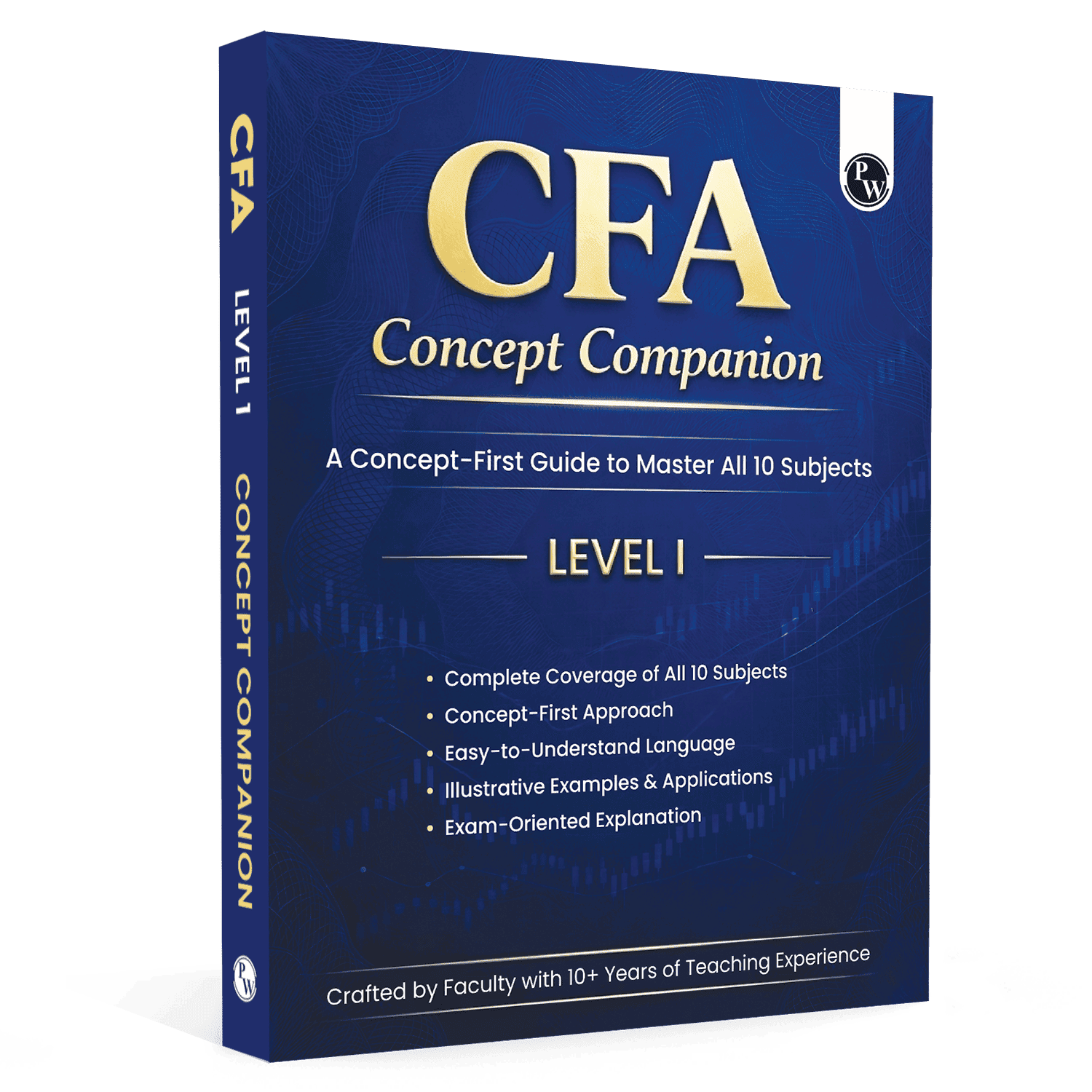
PW CFA Concept Companion Level 1 Book covers all 10 subjects with a concept-first approach, exam-oriented explanations, practical examples and guidance from experienced faculty for effective CFA preparation.
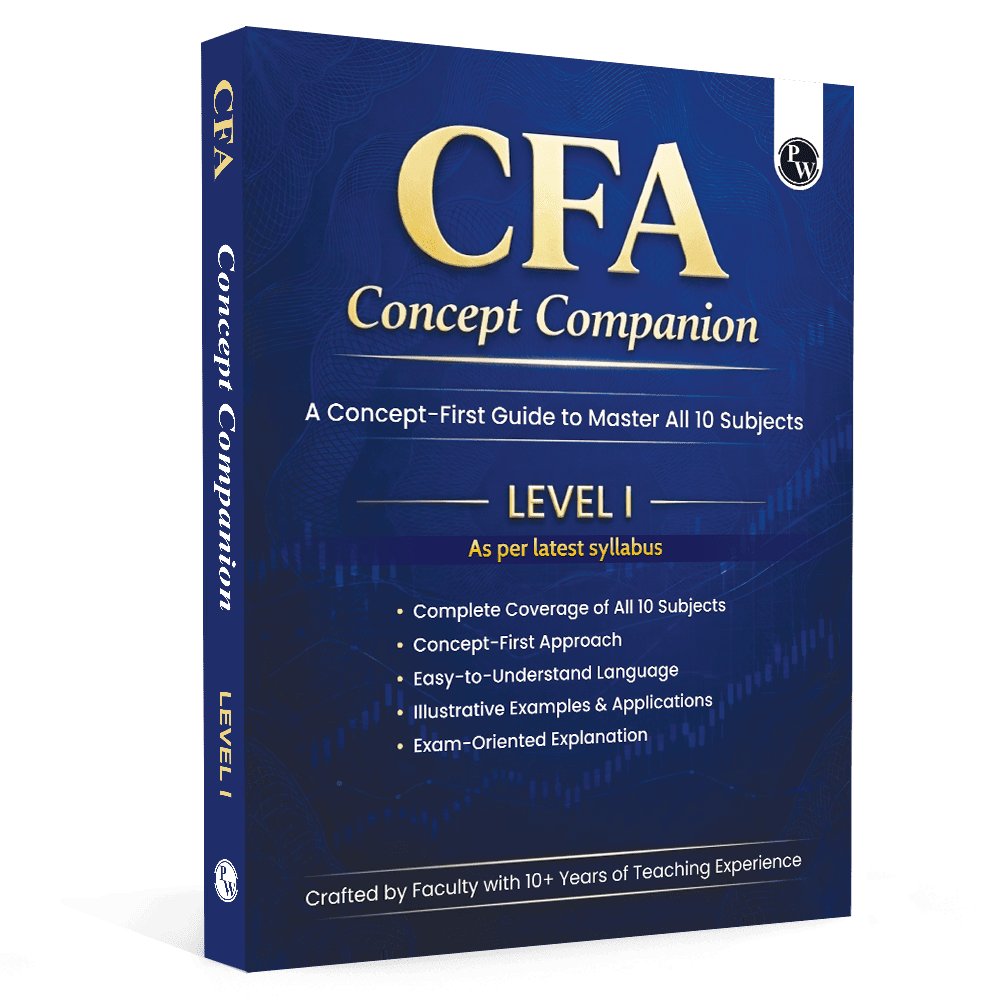
PW CFA Level 1 Book 2027 Edition covers all 10 subjects with a concept-first approach, easy exam-oriented explanations, examples and content aligned with the latest CFA Level 1 syllabus.
Study Plan to Complete the CFA Level 1 Syllabus
Passing the examination requires a disciplined time commitment, usually averaging 300 hours of focused preparation over a period of five to six months.
-
Phase 1: Read through all official learning modules once. Do not get bogged down memorising every minute detail; instead, focus on conceptual clarity, especially in heavy areas like financial reporting and quantitative methods.
-
Phase 2: Complete targeted practice questions and build concise summary notes for formulas. Pay close attention to CFA level 1 curriculum updates and practice problems provided by the institute.
-
Phase 3: Transition entirely to solving mock examinations under timed conditions. Review every incorrect answer to understand the underlying logic rather than relying purely on score tracking. Consistent revision of Ethics during the final weeks often makes the difference on borderline results.
Best Study Resources for the CFA Level 1 Syllabus
Utilising the right preparatory textbooks and practice tools ensures you absorb the official learning outcome statements efficiently.
-
Official Institute Books: The primary readings provide complete coverage of every single topic tested on exam day, making them indispensable for comprehensive learning.
-
Third-Party Prep Providers: Supplementary notes help distil lengthy readings into concise summaries, making revision faster during the final months before your test date. Access detailed learning tools directly through the CFA Books Store.
-
Question Banks: Solving thousands of practice problems builds the mental stamina required for the rigorous computer-based format.
Common Mistakes While Preparing for the CFA Level 1
Many candidates fail their initial attempt due to preventable study habits and poor time management strategies.
-
Leaving Ethics Until the End: Treating professional standards as an afterthought hurts overall scores because this topic carries the highest individual weight and acts as a tie-breaker on borderline results.
-
Passive Reading: Highlighting textbook pages without doing problems at the conclusion of chapters provides a false sense of security in complex mathematical topics.
-
Ignoring Mock Exams: Not practicing under stringent time limitations means poor pacing during the actual testing sessions and not enough questions addressed.
Tracking Your Progress Through the CFA Level 1 Syllabus
Monitoring your progress will allow you to see if you are covering the course at a steady pace. Just make a simple tracker with all ten subjects and break each one down into three parts, learning, question practice and revision. Mark a stage only once you have completed it, not after you have read the chapters of a subject. Check your tracker at the conclusion of each week. If you’ve finished the course but the practice accuracy is still low, spend more time on questions instead of quickly going to a new subject. You can also jot down formulas, tough concepts and queries that must be tried again and again. As the exam draws nearer, use the tracker to find out what topics and subjects are still pending and require a second cycle of review. This way your preparation is more organized and you can avoid neglecting vital topics in the last few weeks.
Revision Strategy for the CFA Level 1 Syllabus
As the exam date approaches, revision needs to become more focused. Instead of going through the whole syllabus again, go over small notes, formulas, relevant definitions, previously highlighted questions for quick revision. Note any areas where you made repeated practice errors. Break up the last revising period into smaller subject blocks. First review the principles and then see how well you are able to apply them with a short series of questions. Ethics, formulae, financial statement principles and valuation subjects can be reviewed periodically, rather than saving them for the last few days. Mock tests might also help you in your final revision. After each test, take note of where your accuracy was lacking and revisit those areas for focused practice. This generates a revision cycle based on real performance, not just re-reading done chapters.
FAQs
What is the most heavily weighted topic in the syllabus?
Ethical and Professional Standards carries the highest weight at 15 to 20 percent. Strong performance here also serves as a deciding factor for borderline pass or fail grades.
How many hours are required to complete a typical CFA level 1 study plan?
Candidates generally require between 280 and 310 hours of dedicated study time spread across several months to digest the material thoroughly.
Are there any recent changes to the CFA level 1 syllabus 2026?
The curriculum maintains stability with a fixed number of learning modules and consistent topic weight ranges compared to previous cycles.
Which subjects form the calculation-heavy sections of the CFA Level 1 subjects?
Quantitative Methods, Fixed Income, and Financial Statement Analysis require rigorous numerical problem-solving and formula application.
How are the exam questions distributed across the testing day?
The exam features 180 multiple-choice questions split evenly into two 135-minute sessions administered on the same day.