CSEET Previous Year Papers: How to Use PYQs for Preparation
Textbooks give you knowledge, but they do not always show you how concepts appear in the actual test format. This uncertainty creates unnecessary anxiety as exam day approaches.
Solving CSEET previous year papers directly resolves this problem by turning abstract theory into practical practice. By working through actual past questions, you immediately see where your preparation stands, where conceptual gaps remain, and how to allocate your remaining study time efficiently.
What Are CSEET Previous Year Papers
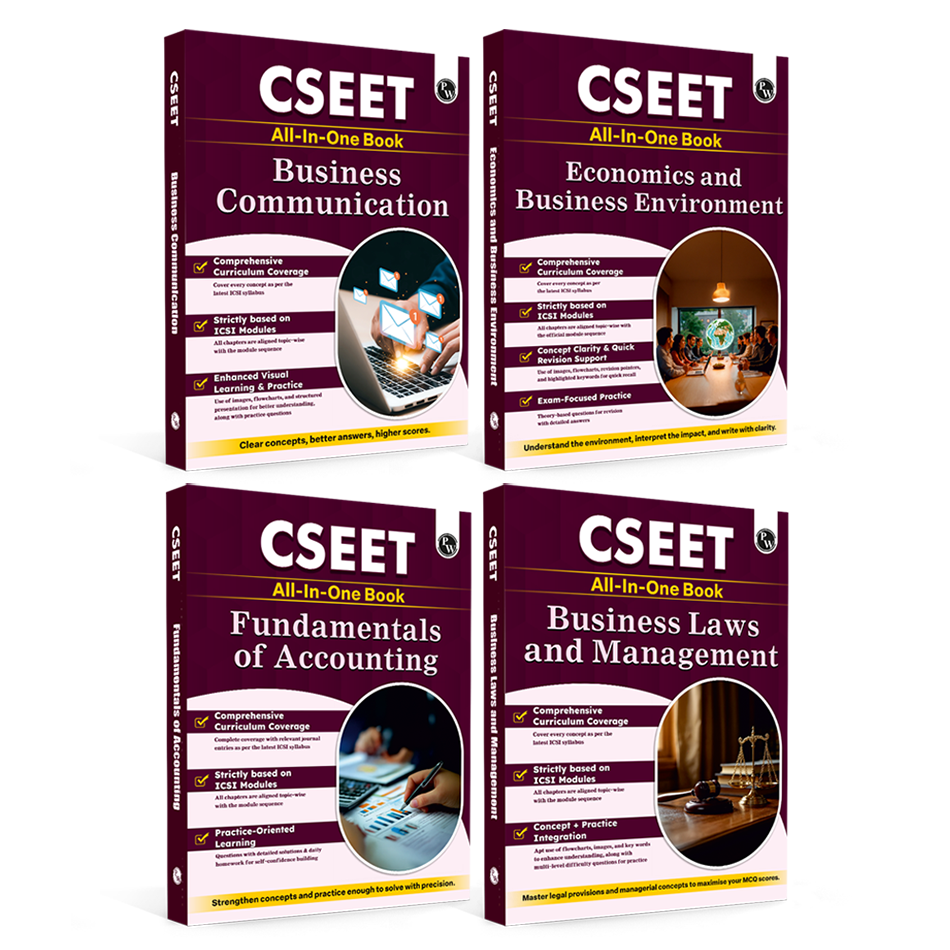
CSEET previous year papers are specialized practice sets and past exam questions structured to reflect the official ICSI testing pattern. They offer candidates a clear look into how test items are designed across all key subjects, including Business Laws & Management, Economics & Business Environment, Business Communication, and Fundamentals of Accounting.
When you open authentic CSEET question papers, you gain access to structured revision tools that mirror the real assessment:
-
Complete Curriculum Coverage: Questions cover every major topic strictly adhering to the latest ICSI syllabus.
-
Sequential ICSI Module Alignment: Practice chapters are arranged in the exact order of official study modules, making systematic study straightforward.
-
Theory-Based Practice Sets: Comprehensive collections of practice questions accompanied by detailed explanatory answers for deeper conceptual clarity.
-
Visual Recall Aids: Text structures incorporating revision pointers, highlighted keywords, and structured presentations to speed up final reviews.
What Can You Learn from CSEET Previous Year Papers
Working regularly with CSEET previous year question papers provides clarity that reading textbook chapters alone cannot deliver. It translates static study material into actionable exam techniques.
Here is what you learn by analyzing CSEET PYQs systematically:
1. Understanding Examiner Expectations
Each subject in the syllabus requires a unique approach. CSEET question papers teach you how static definitions from Business Communication or Business Laws & Management are framed into multiple-choice items. You learn to spot subtle distinctions between similar choices and identify key phrasing in the question text.
2. Pinpointing High-Priority Topics
Not all chapters demand equal time during revision. Solving CSEET previous year papers highlights recurring themes and concepts. For instance, you will quickly notice which accounting principles or legal provisions are tested most frequently, allowing you to prioritize high-yield areas during review sessions.
3. Building Speed and Timing Control
Answering theoretical questions under timed conditions is very different from reading quietly at your desk. Regular practice with CSEET previous year question papers trains your mind to read, analyze, and select correct answers swiftly, leaving adequate time at the end to double-check tricky items.
4. Diagnosing Conceptual Weaknesses
Practice sets act as an immediate diagnostic tool. If you consistently stumble on questions covering Fundamentals of Accounting or Economics & Business Environment, you get immediate feedback on which chapters require a thorough re-reading.
How to Use CSEET Previous Year Papers After Completing Each Topic
A common mistake is saving CSEET previous year papers for the very end of your preparation. Instead, using them topic-by-topic as you complete each chapter maximizes retention and prevents the accumulation of unaddressed doubts.
Follow this structured approach after finishing any chapter:
-
Complete the Module Chapter: Read through the entire chapter in your main study material to build foundational clarity.
-
Attempt Immediate Topic Questions: Open your CSEET PYQ book and solve the specific section belonging to that completed topic.
-
Analyze Detailed Answers: Do not just mark answers as right or wrong. Read the accompanying detailed explanations to understand the underlying logic.
-
Highlight Revision Pointers: Take note of essential keywords and revision pointers provided in the solutions to streamline future reviews.
-
Maintain an Error Journal: Write down every question you missed along with a short note explaining why you chose the wrong option.
This chapter-wise integration ensures that your CSEET preparation remains active, measurable, and directly tied to exam standards throughout your study timeline.
Which CSEET Previous Year Papers Should You Practise First
Organizing your practice material logically prevents burnout and ensures steady progress. Jumping straight into comprehensive mock tests before mastering individual subjects can cause unnecessary confusion.
The table below details the recommended practice order using your CSEET book material:
|
Practice Stage |
Material Type |
Core Focus & Objective |
|
Stage 1: Topic-Wise Sets |
Single-chapter practice sets |
Strengthen individual concepts right after completing a chapter in the ICSI module. |
|
Stage 2: Subject-Wise Modules |
Full subject practice tests |
Evaluate subject comprehension across subjects like Business Communication or Fundamentals of Accounting. |
|
Stage 3: Full-Length Mock Sets |
Combined paper assessments |
Experience real exam conditions across all four major subjects simultaneously. |
Study Strategy Plan for CSEET Previous Year Papers and Topic Revision
Balancing original reading, note-making, and continuous solving requires a structured routine. A well-planned schedule ensures that practice sessions do not eat into basic study time, but rather reinforce it.
Below is an effective weekly revision schedule designed to integrate CSEET previous year papers seamlessly into your daily routine:
|
Day of the Week |
Primary Study Focus |
Actionable Practice Task |
|
Monday to Wednesday |
Core Subject Theory |
Study 2–3 chapters thoroughly from official modules, taking key notes. |
|
Thursday & Friday |
Topic-Wise Question Practice |
Solve corresponding questions from CSEET previous year papers for studied topics. |
|
Saturday |
Performance Analysis |
Review incorrect responses, read detailed explanations, and update your error journal. |
|
Sunday |
Quick Keyword Review |
Re-read highlighted keywords, summary tables, and revision pointers for fast recall. |
Tips to Analyse Your Performance Using CSEET Previous Year Papers
Simply checking off questions without reviewing your performance misses the main benefit of practice material. Systematic analysis is where real score improvements happen.
-
Log Your Accuracy Metrics: Keep a dedicated record of how many questions you attempt, how many you get right, and how many you get wrong in each subject.
-
Classify Your Mistakes: Group your incorrect answers into three distinct categories:
-
Conceptual Gaps: You did not know or understand the core rule.
-
Reading Errors: You misread the question or overlooked negative words like "NOT" or "EXCEPT."
-
Recall Slips: You knew the concept but mixed up definitions, dates, or specific terms.
-
Re-Visit Explanation Notes: Spend extra time reading the detailed answers provided for theoretical questions to absorb proper presentation styles.
-
Focus on Highlighted Keywords: Pay close attention to highlighted keywords and flowcharts in answer keys, as these contain the core facts examiners look for.
-
Re-Attempt Weak Sections: Every two weeks, go back and re-attempt only the questions you previously got wrong to verify that you have fixed those knowledge gaps.
Mistakes to Avoid While Solving CSEET Previous Year Papers
To get the most value out of your revision time, avoid these common preparation mistakes:
-
Skipping Explanations for Correct Guesses: If you guessed an answer correctly without being certain, always read the solution text. Relying on lucky guesses builds false confidence that can fail on exam day.
-
Attempting Mixed Papers Too Early: Trying to complete full-length CSEET question papers before finishing basic module readings leads to low scores and unnecessary frustration. Build your base first.
-
Ignoring the Error Journal: Failing to log past mistakes means you are likely to repeat the same errors when similar questions appear in future tests.
Read More - CSEET Syllabus: Complete Subject-Wise Syllabus with PW Books
Frequently Asked Questions
How do CSEET previous year papers improve my overall score?
Solving CSEET previous year papers helps you identify high-priority topics, improves your answering speed, points out conceptual weaknesses, and familiarizes you with official exam formats.
Where can I find organized CSEET PYQs for systematic practice?
Candidates can use structured collections like a dedicated CSEET PYQ book where questions are organized topic-by-topic in the exact sequence of official ICSI modules.
When should I begin solving CSEET question papers during my study schedule?
Start solving topic-wise CSEET question papers immediately after completing each individual chapter, rather than waiting until the entire syllabus is finished.
Are CSEET previous year question papers fully updated for the latest syllabus?
Reliable CSEET previous year question papers are crafted strictly according to the latest ICSI syllabus across all four major subjects, including Business Laws & Management and Fundamentals of Accounting.
Is it enough to rely only on a CSEET PYQ book for exam readiness?
While a CSEET PYQ book is vital for testing recall and practice, it should be combined with thorough studying of complete theoretical concepts in official ICSI modules.