How to Use CUET PG Books for Effective Preparation?

Balancing university assignments alongside entrance test planning often feels overwhelming when you face vast syllabus requirements. Finding clarity becomes difficult without structured guidance. To stay on track, candidates require reliable study resources that simplify complex concepts and align directly with the latest examination pattern.
Having the right CUET PG books early in the semester allows you to structure your study routine systematically, tackle domain-specific subjects, and approach revision without stress.
Preparing for CUET PG starts with choosing dedicated materials designed for structured learning and self-evaluation.
Overview of CUET PG Books
Entering the first term of your final year means academic expectations increase rapidly. Students must prepare for the Common University Entrance Test for Postgraduate (CUET PG) to secure admission to postgraduate programs across Science, Commerce, Humanities, Management, and other disciplines. The entrance examination assesses candidates on domain-specific knowledge and, for selected programs, general aptitude.
Having comprehensive CUET PG study material helps candidates prepare systematically for the latest examination pattern. Quality academic books provide clear, structured guidance, ensuring that you build subject confidence step by step throughout your term.
Key advantages of using dedicated subject books include:
-
Strong Conceptual Understanding: Important concepts are explained in simple, structured language, helping students build a firm foundation in their chosen subject.
-
Exam-Oriented Preparation: Books feature chapter-wise questions, practice exercises, mock tests, and previous year questions (PYQs) structured according to the latest exam pattern.
-
Better Practice and Accuracy: Regular practice improves conceptual clarity, increases question-solving accuracy, and boosts overall confidence during the test.
-
Comprehensive Syllabus Coverage: High-quality books cover all prescribed topics detailed in the official syllabus, ensuring no key concept is left out.
-
Updated Content: Study materials remain aligned with the latest syllabus and current examination standards.
How Can CUET PG Books Help You Prepare for Different Subjects
Each academic discipline presents distinct requirements during first-term preparation. Science subjects require clear conceptual understanding and numerical accuracy, while Humanities subjects demand strong theoretical retention. Commerce subjects focus on financial and accounting principles, whereas Management programs test analytical reasoning and general aptitude.
Standardized study books cater directly to these varying discipline requirements by presenting topics in a clear, digestible format.
|
Academic Stream |
Focus Area |
Role of Study Materials |
|
Science |
Domain-specific theoretical principles and problem-solving |
Provides structured chapter-wise questions, simple conceptual explanations, and detailed solutions. |
|
Commerce |
Accounting rules, financial theories, and numerical exercises |
Delivers updated content, step-by-step guidance, and practice exercises tailored to the syllabus. |
|
Humanities |
Theoretical frameworks, historical contexts, and analytical concepts |
Summarises comprehensive syllabus topics into structured revision notes and practice papers. |
|
Management |
General aptitude, logical reasoning, and discipline knowledge |
Offers targeted mock tests, practice exercises, and previous year questions to build speed. |
By selecting books aligned with your specific discipline, you ensure that every hour of study directly contributes to completing your required syllabus efficiently.
How to Use CUET PG Books for Effective Preparation
Owning good reference books is only the first step. To achieve top scores, you must know how to utilize these resources systematically during your academic semester. Following a deliberate approach helps transform static textbook reading into active learning.
Follow this step-by-step strategy:
-
Understand the Syllabus:
-
Review the complete official syllabus for your chosen subject before opening your books.
-
Identify primary topics, essential chapters, and marks allocation patterns.
-
Build Strong Concepts First:
-
Read introductory chapters thoroughly to build clear foundational understanding.
-
Avoid jumping straight to advanced questions without mastering basic principles.
-
Practice Chapter-Wise Questions:
-
Solve practice exercises immediately after completing each individual chapter.
-
Use practice sets to identify immediate weak spots in your understanding.
-
Solve Previous Year Questions (PYQs):
-
Work through past exam papers to understand question patterns and difficulty levels.
-
Identify recurring exam topics to prioritize during review sessions.
-
Attempt Timed Mock Tests:
-
Complete full-length mock tests under real examination conditions.
-
Evaluate your test-taking speed and overall precision.
-
Revise Consistently:
-
Use quick revision notes and practice papers regularly before the final examination.
-
Revisit complex topics multiple times throughout the term to ensure long-term memory.
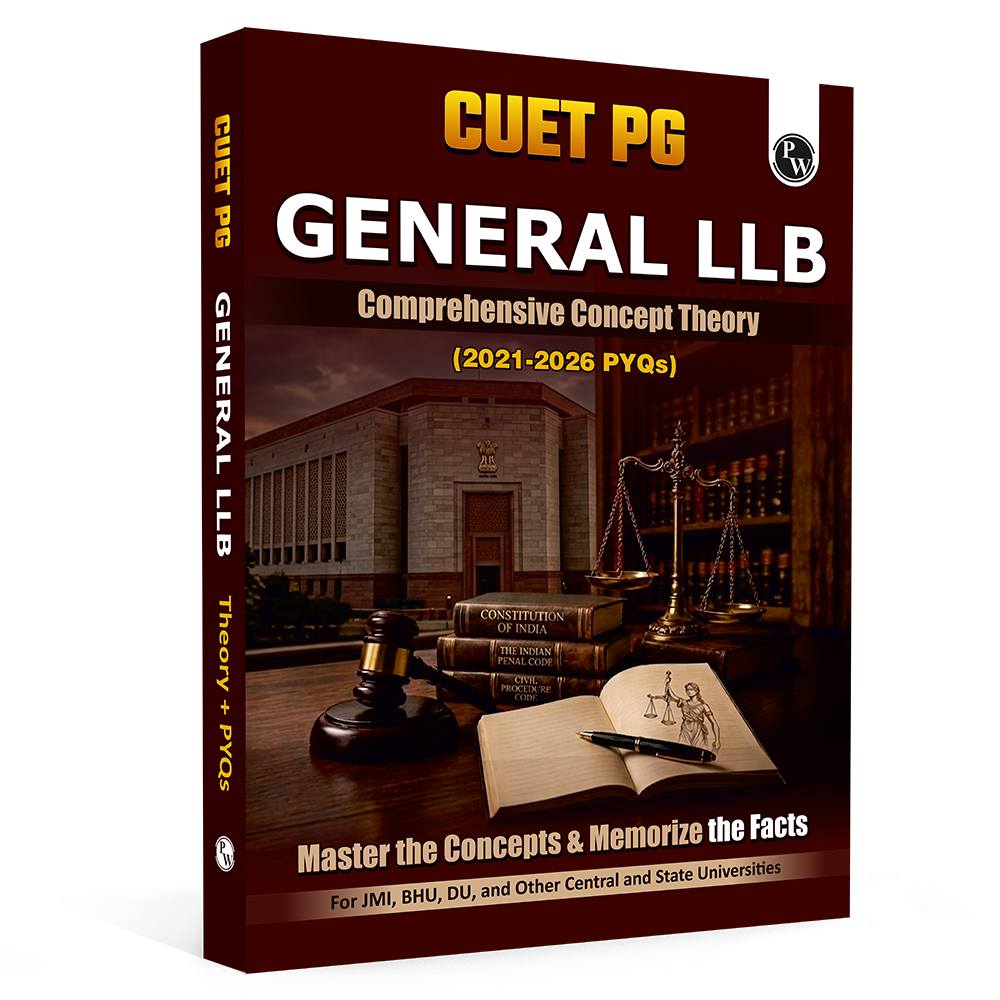
CUET PG General LLB book with concept-based theory and 6 years of PYQs (2026–2021), designed for JMI, BHU, DU, and other central universities.
Which CUET PG Books Should You Use at Each Stage of Preparation
Your study needs evolve as you progress through your first term session. Matching your books to your current phase of preparation prevents overwhelm and guarantees balanced learning.
Stage 1: Early Term - Conceptual Foundation
-
Resource Type: Textbooks focusing on simple explanations and structured content.
-
Objective: Establish solid subject knowledge across all prescribed topics.
-
Target Audience: Suitable for both absolute beginners starting early and repeat candidates refreshing their knowledge.
-
Action Plan: Read fundamental chapters carefully and note down essential key points.
Stage 2: Mid Term - Practice and Skill Building
-
Resource Type: Dedicated CUET PG preparation books containing chapter-wise practice exercises and previous year questions.
-
Objective: Strengthen problem-solving skills and enhance accuracy across specific domain topics.
-
Action Plan: Solve chapter-wise exercises regularly after finishing theoretical reading.
Stage 3: Late Term - Assessment and Final Revision
-
Resource Type: Practice papers, mock test compilations, and quick revision notes.
-
Objective: Evaluate overall exam readiness and build speed under timed conditions.
-
Action Plan: Take full-length mock tests, analyze mistakes, and perform fast-paced revision.
Selecting the best CUET PG books tailored to each stage ensures your preparation remains focused and effective from week one.
Read More - CUET PG Syllabus 2027: Subject-Wise Books for Preparation
How to Make a Study Strategy Plan with CUET PG Books
Balancing university classes with entrance examination prep demands a realistic weekly routine. Developing a structured strategy plan allows you to integrate textbook study smoothly without neglecting college performance.
Consider this weekly timeline framework:
-
Phase 1: Foundation Building (Weeks 1 to 4)
-
Focus primarily on theoretical concepts in your books.
-
Dedicate fixed daily time slots to reading one domain topic thoroughly.
-
Complete basic conceptual questions at the end of each chapter.
-
Phase 2: Targeted Practice (Weeks 5 to 8)
-
Transition to heavy question practice using chapter-wise exercises.
-
Solve previous year questions (PYQs) with detailed solutions to recognize standard formats.
-
Track recurring errors and re-read relevant textbook sections to clarify doubts.
-
Phase 3: Mock Testing and Final Review (Weeks 9 to 12)
-
Shift focus to complete practice papers and full-length mock tests.
-
Analyze performance metrics after every mock test to gauge progress.
-
Perform systematic revision using quick notes and key summary sheets.
This structured framework ensures comprehensive syllabus coverage while maintaining steady progress during your CUET PG preparation.
Common Mistakes to Avoid While Studying with CUET PG Books
Studying without a clear plan can lead to avoidable mistakes during your academic session. Recognizing potential pitfalls helps you maintain focus and maximize the benefits of your study materials.
Avoid these common errors:
-
Studying Without Syllabus Alignment: Reading chapters without checking the latest exam syllabus leads to wasted effort on non-prescribed topics.
-
Skipping Conceptual Fundamentals: Jumping directly into solving advanced exercises without reading base chapters weakens overall accuracy.
-
Neglecting Past Exam Papers: Ignoring previous year questions prevents you from understanding true exam difficulty and topic weightage.
-
Delaying Revision Sessions: Postponing revision until the last few weeks causes information overload and confusion before exam day.
-
Ignoring Mock Tests: Practicing without taking timed mock tests makes it difficult to manage time during the actual examination.
Maintaining a disciplined study routine and staying aligned with official exam patterns ensures complete readiness for the entrance test.
Frequently Asked Questions About CUET PG Books
What features make books suitable for postgraduate entrance preparation?
High-quality books cover the complete updated syllabus, offer simple conceptual explanations, incorporate chapter-wise practice questions, and include past year papers with full-length mock tests.
Do postgraduate preparation books include previous year questions?
Yes, standard books include previous year questions (PYQs) with detailed step-by-step solutions to help students understand question patterns and build test confidence.
Are these books suitable for absolute beginners?
Yes, these materials are designed with simple language and structured layouts, making them ideal for both beginners starting their first term and repeat candidates.
How do mock tests included in preparation books help candidates?
Mock tests allow students to evaluate their performance, assess speed and accuracy, identify remaining weak areas, and adapt to real examination conditions.
Why is conceptual clarity important when studying for entrance exams?
Building strong conceptual clarity helps students solve both basic and complex domain-specific questions confidently while avoiding errors during the examination.