Features of PW GATE Mechanical Engineering PYQ Book
Preparing for competitive engineering examinations often overwhelms students due to vast syllabi, complex numerical queries, and unpredictable difficulty levels. Without a structured practice framework, aspirants struggle to identify recurring problem patterns or allocate time efficiently across core subjects.
Solved past papers bridge the gap between theoretical knowledge and real exam execution. Utilizing a high-quality GATE mechanical engineering PYQ resource allows candidates to test their conceptual clarity, build numerical accuracy, and gain complete familiarity with actual test standards.
Importance of GATE Mechanical Engineering PYQ
Preparing for Graduate Aptitude Test in Engineering requires more than just memorising formulas or reading theory notes. Mechanical engineering spans diverse domains including thermodynamics, fluid mechanics, manufacturing technology, solid mechanics, and machine design.
Candidates must transform theoretical concepts into rapid numerical problem-solving. Practicing GATE mechanical previous year questions provides direct exposure to the standard, style, and trickiness of questions set by conducting Indian Institutes of Technology (IITs).
Standard textbook exercises frequently focus on derivation or simple single-step numericals. In contrast, GATE mechanical PYQs integrate multiple concepts into single questions, testing both fundamentals and analytical depth. Regular practice with previous papers helps students build crucial test-taking habits:
-
Understanding Question Patterns: Identifying how fundamental formulas are modified into complex multi-concept numericals.
-
Improving Speed and Accuracy: Reducing calculation errors in Virtual Calculator operations through repeated practice.
-
Time Management: Learning to allocate appropriate time slices based on 1-mark and 2-mark question categories.
-
Targeted Revision: Spotting recurring themes across Thermodynamics, Strength of Materials, and Production Engineering.
Comprehensive mechanical engineering solved papers act as a diagnostic mirror. They instantly highlight conceptual blind spots, unit conversion slip-ups, and weak chapters that require immediate revision prior to full-length test series.
What are the Features of GATE Mechanical Engineering PYQ?
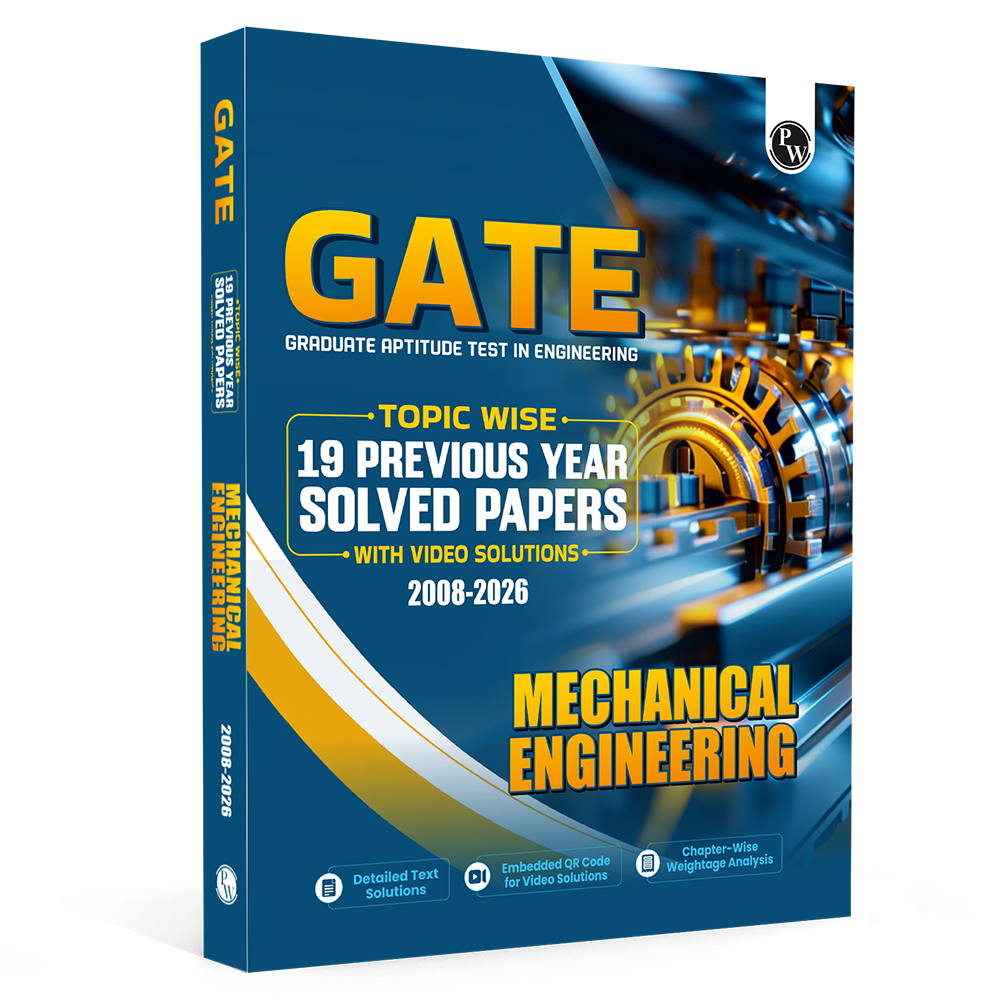
The GATE mechanical PYQ book is specifically designed to eliminate common study roadblocks faced by engineering aspirants. Rather than presenting unstructured question sets, this volume organizes 19 years of authentic questions (2008 to 2026) into a streamlined, student-friendly layout. Below are the primary features that distinguish this title in GATE me preparation.
19 Years Topic-Wise Question Coverage (2008 to 2026)
Randomly mixed question papers often confuse students who are completing the syllabus topic by topic. This compilation segreGATEs questions by core subjects, sub-topics, and individual chapters.
-
Systematic Progression: Aspirants can finish a topic in class and immediately practice all relevant PYQ problems from 2008 through 2026.
-
Complete Paper History: Covers 19 full years of paper history, capturing subtle shifts in question style and difficulty across different IIT exam conducting bodies.
-
SegreGATEd Difficulty Levels: Helps learners progress smoothly from fundamental 1-mark questions to challenging 2-mark numerical answer type (NAT) problems.
Step-by-Step Solutions and Video Explanations
A common flaw in standard solution GATE books is the presence of short, skipped steps that leave students confused. The GATE mechanical PYQ book solves this by offering two layers of explanatory support:
-
Comprehensive Text Solutions: Every question features a clear, step-by-step breakdown using standard formulas, neat diagrams, and explicit unit conversions.
-
QR Code Video Solutions: Integrated QR codes alongside questions allow students to scan and instantly watch detailed video explanations delivered by expert faculty members.
This combination guarantees that no doubt remains unresolved, whether a student prefers quick reading or visual walkthroughs.
Year-Wise Subject Weightage Analysis
Not all engineering subjects carry equal mark distribution in the final examination. Wise aspirants prioritize high-yield areas to maximize their score potential.
-
Visual Data Charts: Detailed weightage tables illustrate mark trends across Manufacturing Engineering, Industrial Engineering, Thermal Sciences, Engineering Mechanics, and Applied Mechanics.
-
Strategic Planning: Enables students to dedicate maximum practice hours to high-weightage topics while maintaining steady coverage over lower-yield units.
-
Trend Identification: Highlights emerging focus areas, such as modern machining processes or advanced heat transfer modes.
What is the Structure of GATE Mechanical Engineering PYQ?
To understand the scope of this preparation resource, examine the core framework and publication specifications detailed below:
|
Resource Parameter |
Details & Specifications |
Aspirant Benefit |
|
Year Coverage |
19 Years (2008 – 2026) |
Comprehensive historical perspective on exam trends |
|
Organization |
Topic-wise & Chapter-wise Segregation |
Seamless integration with daily classroom learning |
|
Solution Types |
Text Solutions + QR Code Video Explanations |
Dual-mode learning for deep conceptual clarity |
|
Page Count & Format |
~740 Pages / Quality Paperback |
Durable print resource built for repeated study sessions |
|
Analysis Tools |
Subject & Chapter-wise Weightage Charts |
Data-driven decision making for study scheduling |
This structured design makes the GATE mechanical PYQ book a complete package for structured study, targeted practice, and systematic revision.
Subject Focus Areas Covered in GATE Mechanical Engineering PYQ
The syllabus for mechanical engineering is divided into distinct streams. The GATE previous year questions collection ensures thorough coverage across all mandatory streams:
1. Applied Mechanics and Design
-
Engineering Mechanics: Free body diagrams, trusses, dynamics, and friction.
-
Strength of Materials: Stress-strain relationships, Mohr circle, bending and shear stresses, deflection of beams, and thin cylinders.
-
Theory of Machines: Mechanisms, flywheels, governors, vibrations, and gear trains.
-
Machine Design: Design against static and fatigue loads, shafts, gears, rolling contact bearings, and brakes.
2. Fluid Mechanics and Thermal Sciences
-
Fluid Mechanics: Fluid statics, Bernoulli equation, pipe flow, boundary layer theory, and dimensional analysis.
-
Heat Transfer: Conduction, convection, radiation, heat exchangers, and boiling/condensation.
-
Thermodynamics & Applications: Laws of thermodynamics, thermodynamic cycles, power plant engineering, IC engines, and refrigeration/air conditioning.
3. Materials, Manufacturing, and Industrial Engineering
-
Engineering Materials: Structure and properties of materials, phase diagrams, and heat treatment.
-
Metal Casting, Forming, and Joining: Mold design, forging, rolling, extrusion, welding processes, and defects.
-
Machining and Machine Tool Operations: Mechanics of machining, tool life, CNC machining, and non-traditional machining methods.
-
Industrial Engineering: Production planning and control, inventory control, operations research, forecasting, and linear programming.
Every section in the PYQ compilation offers dedicated sub-topic problems. This categorization helps aspirants isolate difficult topics and build mastery step by step.
Benefits of Solving GATE Mechanical Engineering PYQ
Integrating authentic past questions into daily study routines offers clear advantages over relying solely on unverified practice sets. Here is how systematic practice with a dedicated GATE mechanical PYQ book transforms your performance:
Realistic Exam Alignment
Practice material created without strict oversight often fails to replicate actual exam standards. By practicing real past questions from 2008–2026, students condition their minds to the precise logic, difficulty, and phrasing used by IIT paper setters.
Elimination of Calculation Errors
Mechanical engineering tests rely heavily on numerical answer type questions where options are absent. Practicing with structured mechanical engineering solved papers trains students to manage numerical accuracy, apply correct SI units, and avoid rounding-off mistakes.
Building Speed and Mental Endurance
Solving 65 questions in a 3-hour period requires sustained mental focus. Daily practice with time-bound question chunks builds the speed needed to navigate complex multi-step problems without fatigue.
Self-Assessment and Confidence
Tracking accuracy rates across 19 years of solved papers provides an objective measure of readiness. Watching performance improve from past papers to recent years builds genuine confidence before entering the examination center.
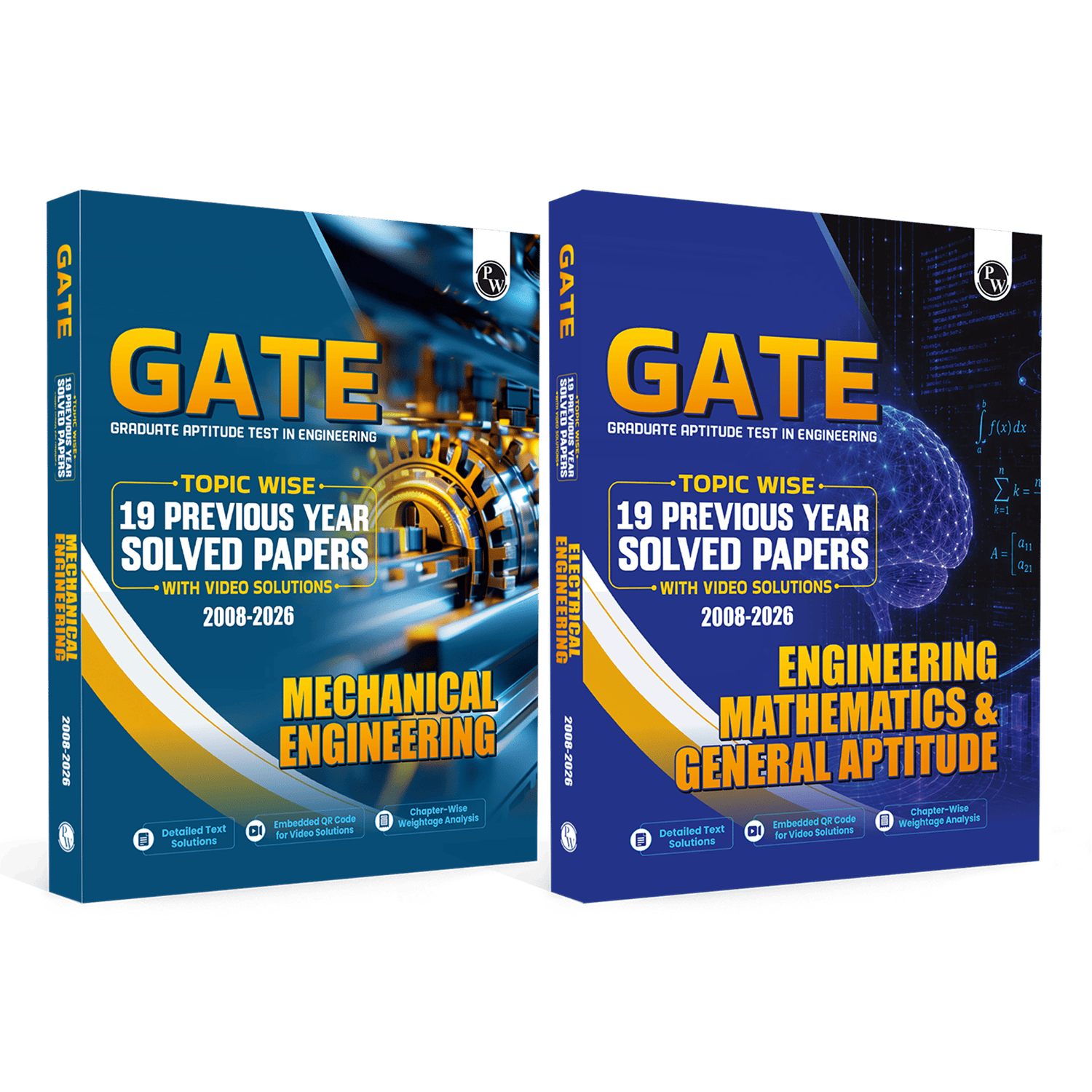
Also Check - GATE Mathematics & General Aptitude Book
How to Use GATE Mechanical Engineering PYQ?
Owning a complete preparation resource is only the first step; using it strategically determines your final rank. A structured approach ensures maximum retention and skill development.
Phase 1: Concept Mastery
│
▼
Phase 2: Topic-wise PYQ Solving (2008–2026)
│
▼
Phase 3: Error Analysis & Video Solution Review
│
▼
Phase 4: Time-Bound Revision & Formula Logging
Stage 1: Topic-wise Alignment during Syllabus Coverage
Do not wait to complete the entire syllabus before opening your past paper book. As soon as you finish a chapter—such as Fluid Statics, Kinematic Pairs, or Internal Combustion Engines—solve all corresponding questions in the PYQ section. This reinforces theoretical concepts with practical problem-solving.
Stage 2: Independent Problem Solving
Avoid checking the answer key immediately after reading a prompt. Attempt every numerical independently using a virtual calculator interface. Give yourself at least two to three attempts to resolve tough questions before consulting written solutions.
Stage 3: Leveraging Video Explanations for Complex Queries
When written steps feel brief or when an alternative shortcut is needed, scan the QR code next to the question.
Stage 4: Error Notebook Maintenance
Maintain a dedicated notebook to record every mistake made during PYQ practice. Categorize errors into conceptual misunderstandings, calculation slips, or formula misapplications. Reviewing this error log weekly prevents repeating the same mistakes during full-length mock tests.
Read More: GATE Exam Eligibility
GATE PYQ FAQs
How many years of GATE mechanical engineering PYQ should an aspirant solve?
Aspirants should ideally solve at least 15 to 20 years of past papers. Practicing 19 years of questions (2008 to 2026) ensures complete coverage of evolving exam patterns, varied difficulty levels, and recurring numerical concepts.
Is topic-wise solving better than year-wise practice for GATE me preparation?
Yes, topic-wise solving is far more effective during early syllabus coverage. It allows you to practice questions immediately after learning a chapter. Year-wise full paper practice should be reserved for the final two months before the exam.
How do QR code video solutions in the GATE mechanical PYQ book help?
QR code video solutions allow students to instantly watch expert faculty explain difficult concepts and step-by-step problem-solving methods on their smartphone, clearing doubts without delays.
Are numerical answer type questions included in this book?
Yes, the compilation includes all question formats used in GATE—including Multiple Choice Questions (MCQs), Multiple Select Questions (MSQs), and Numerical Answer Type (NAT) problems from 2008 through 2026.
Why is weightage analysis important in mechanical engineering solved papers?
Weightage analysis reveals which subjects and chapters consistently carry the highest mark allocations. This data helps aspirants prioritize high-yield topics during revision, ensuring maximum return on preparation time.