Why Every UPSC ESE Aspirant Should Start with General Studies PYQs

Starting your preparation for Paper 1 requires a clear understanding of exam patterns. Solving UPSC ESE general studies PYQ sets a solid foundation by highlighting high-weightage topics, recurring question trends, and exact difficulty levels before you dive into deep theoretical study.
Importance of UPSC ESE General Studies PYQ
PYQ is important for understanding the Paper 1 exam pattern, question types, and important topics. Solving previous year questions helps aspirants identify high-weightage areas such as Engineering Aptitude, Project Management, Engineering Ethics, Quality & Standards, and Environment & Safety.
It also improves speed, accuracy, and time management by providing practice with real exam-level questions. Regular PYQ practice helps candidates find weak areas, understand recurring concepts, and focus their revision on topics that are more relevant to the UPSC ESE Paper 1 examination.
Features of UPSC ESE General Studies PYQ
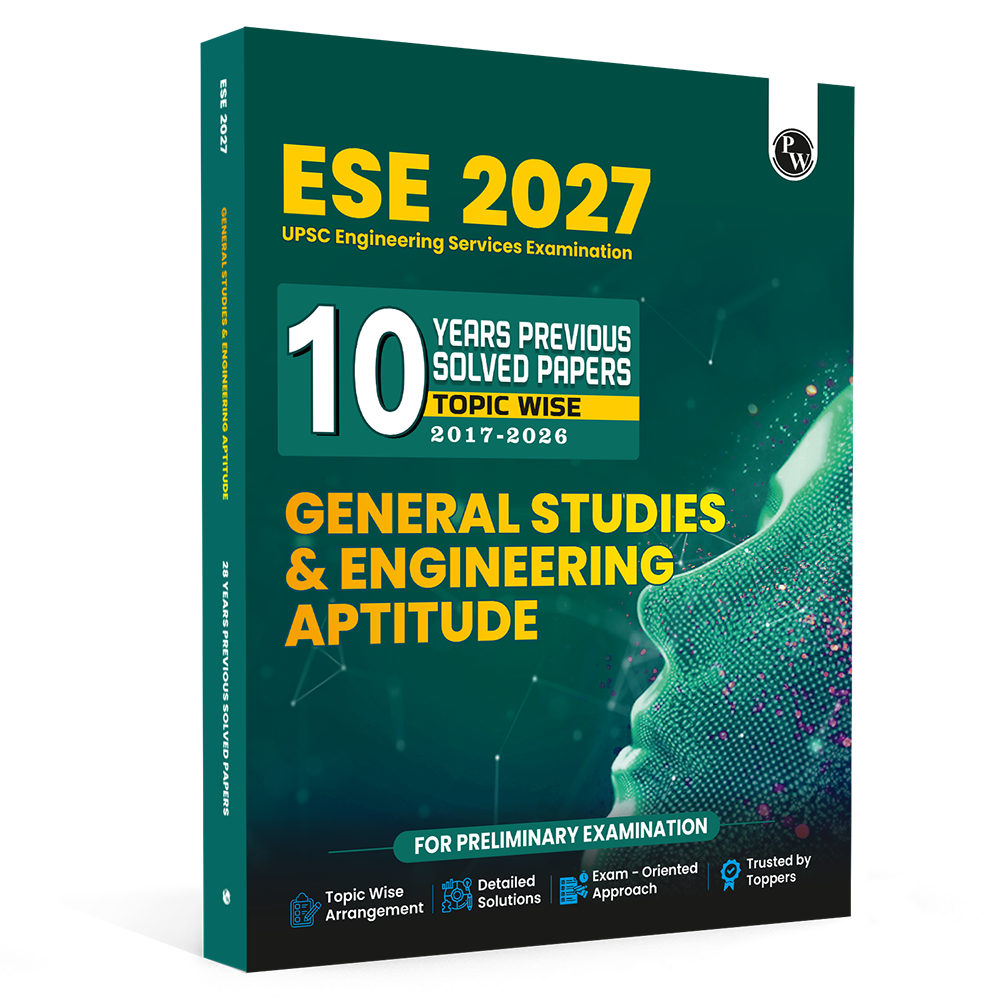
Prepare for the UPSC ESE Civil Engineering exam with a well-organized collection of previous year questions. The UPSC ESE Books covers 28 years of PYQs with detailed solutions and an exam-focused approach to help you understand important topics and improve your preparation.
28 Years of Topic-Wise PYQs (1999–2026): Practice UPSC ESE Civil Engineering Previous Year Questions from 1999 to 2026. The questions are arranged according to the latest syllabus to help you cover important topics and prepare in a focused way.
Topic-Wise & Chapter-Wise Coverage: Get questions organized by topic and chapter for easy practice and revision. This structure helps you find important areas, understand question trends, and focus on topics that need more practice.
Detailed Text Solutions: Understand each question with clear and detailed text solutions. The explanations help improve conceptual understanding, learn the right solving approach, and build better problem-solving skills.
Exam-Oriented Approach: Practice questions and solutions designed around UPSC ESE requirements. The book helps you become familiar with the exam pattern and improve your overall exam readiness.
Trusted by Toppers: A useful preparation resource for UPSC ESE aspirants, with focused practice and detailed solutions to support effective preparation and help you work towards better exam performance.
How UPSC ESE General Studies PYQ Helps in Exam Success?
Previous year questions serve as the master blue print for Preliminary Paper 1. Instead of reading theoretical textbooks blindly, analyzing real exam questions shows you the precise depth required for each module.
Syllabus Mapping and Weightage Distribution
Exam syllabi describe topics in broad terms, but past papers show how marks are actually distributed. By reviewing previous tests, you can categorize topics into high-yield and low-yield sections.
-
Project Management: Focuses consistently on network diagrams, CPM/PERT techniques, and project life cycles.
-
Engineering Ethics: Prioritizes moral dilemmas, professional codes of conduct, and corporate responsibility cases.
-
Standards and Quality: Emphasizes ISO standards, quality control tools, and total quality management principles.
-
Engineering Aptitude: Tests logical reasoning, data interpretation, and mathematical problem-solving skills under time pressure.
Identifying Recurring Concepts and Question Patterns
Questions in Paper 1 rarely repeat verbatim, but underlying concepts appear year after year. Working through ese paper 1 previous year questions reveals recurring themes across subjects:
-
Direct Formula Applications: Standard mathematical and aptitude problems requiring quick execution.
-
Statement-Based Reasoning: Questions evaluating ethical codes and quality management definitions.
-
Diagrammatic Problems: Critical path calculations and structural geometry questions.
Why Solve UPSC ESE General Studies PYQ First?
Many candidates delay ESE previous year paper practice until they finish reading entire text books. However, tackling past papers from day one completely changes how you retain new information.
Over-Studying and Material Overload
General Studies covers ten distinct subjects, ranging from environmental science to information technology. Trying to read exhaustive reference books for every topic takes hundreds of hours. Past papers act as a selective filter, ensuring you invest time only in exam-relevant concepts.
|
Subject Area |
Typical Focus in Exam |
Recommended PYQ Approach |
|
Engineering Aptitude |
Numerical problem solving and analytical logic |
Solved practice for speed and accuracy |
|
Engineering Ethics |
Theoretical definitions and ethical frameworks |
Concept mapping and statement analysis |
|
Quality & Standards |
ISO codes, TQM tools, and reliability formulas |
Direct formula practice and trend analysis |
|
Environment & Safety |
Conservation rules, pollution standards, climate protocols |
Fact-based recall and trend identification |
Exam-Level Problem-Solving Speed
Preliminary Paper 1 contains 100 questions to be answered in 2 hours. This leaves just 72 seconds per question. Early exposure to engineering aptitude PYQs trains your brain to process calculations faster and eliminate incorrect options efficiently.
What Are the Benefits of UPSC ESE General Studies PYQ?
Consistent practice with past exam papers transforms passive reading into active learning. It builds operational speed and mental stamina necessary for exam day.
Learning Paper 1 Time Management
Time pressure is the biggest obstacle in the Preliminary stage. Practising timed sets of past questions helps you develop an optimal attempt strategy.
-
Round 1: Answer direct, memory-based questions in Ethics, Material Science, and Environment within 30 seconds each.
-
Round 2: Solve moderate mathematical and logical reasoning questions requiring 1 to 1.5 minutes.
-
Round 3: Address complex CPM/PERT or multi-statement questions if time permits.
Improving Option Elimination Techniques
UPSC questions often feature four closely matched statements. Regular practice with upsc engineering services preparation material trains you to identify subtle keywords like "always", "never", or "only" that indicate false options.
-
Eliminate Extreme Claims: Broad statements with absolute terms are frequently incorrect.
-
Verify Dimensional Units: Numerical aptitude options often contain intentional unit conversion traps.
-
Identify Contrasting Pairings: When two choices directly contradict each other, one of them is usually correct.
How to Choose the Best UPSC ESE General Studies PYQ Book?
Selecting the right study resource determines how efficiently you absorb past paper insights. A high-quality book should combine vast historical coverage with crystal-clear explanations.
What to Look for in a PYQ Resource
-
Extensive Historical Coverage: Accessing 28 years of questions (1999–2026) allows you to observe long-term examiner patterns and recurring question structures.
-
Topic-Wise & Chapter-Wise Arrangement: Organised chapters allow you to align past paper practice directly with your daily study timetable.
-
Detailed Text Explanations: Comprehensive solutions help clarify step-by-step logic, eliminating the need to consult separate reference manuals.
-
Recent Exam Alignment: Focused coverage of recent papers (2016–2026) ensures you remain updated on current UPSC testing trends.
Read More: UPSC ESE Syllabus and Exam Pattern
UPSC ESE FAQs
Why is UPSC ESE general studies PYQ essential for Paper 1 preparation?
It clarifies the exact exam pattern, highlights high-weightage topics like Project Management and Ethics, and trains you to solve questions within the strict 72-second per question limit.
How many years of ese paper 1 previous year questions should I solve?
Solving at least 10 to 28 years of past questions provides comprehensive coverage of recurring themes, structural question patterns, and changing syllabus trends.
Should I practice engineering aptitude PYQs before completing the syllabus?
Yes, attempting past aptitude questions early helps you understand formula applications, spot calculation traps, and focus your theory revision on high-frequency topic areas.
How does the UPSC ESE PYQ book assist in self-study?
The book categorizes past questions topic-wise and provides clear, detailed text solutions, allowing you to identify weak areas and track your accuracy systematically.
What is the best strategy to analyze ESE GS solved papers?
Solve questions under timed conditions, review the explanations for all four options, note down conceptual mistakes in a revision journal, and re-attempt incorrect questions after two days.