How Chapterwise PYQs Make IIT JAM Physics Revision Easier
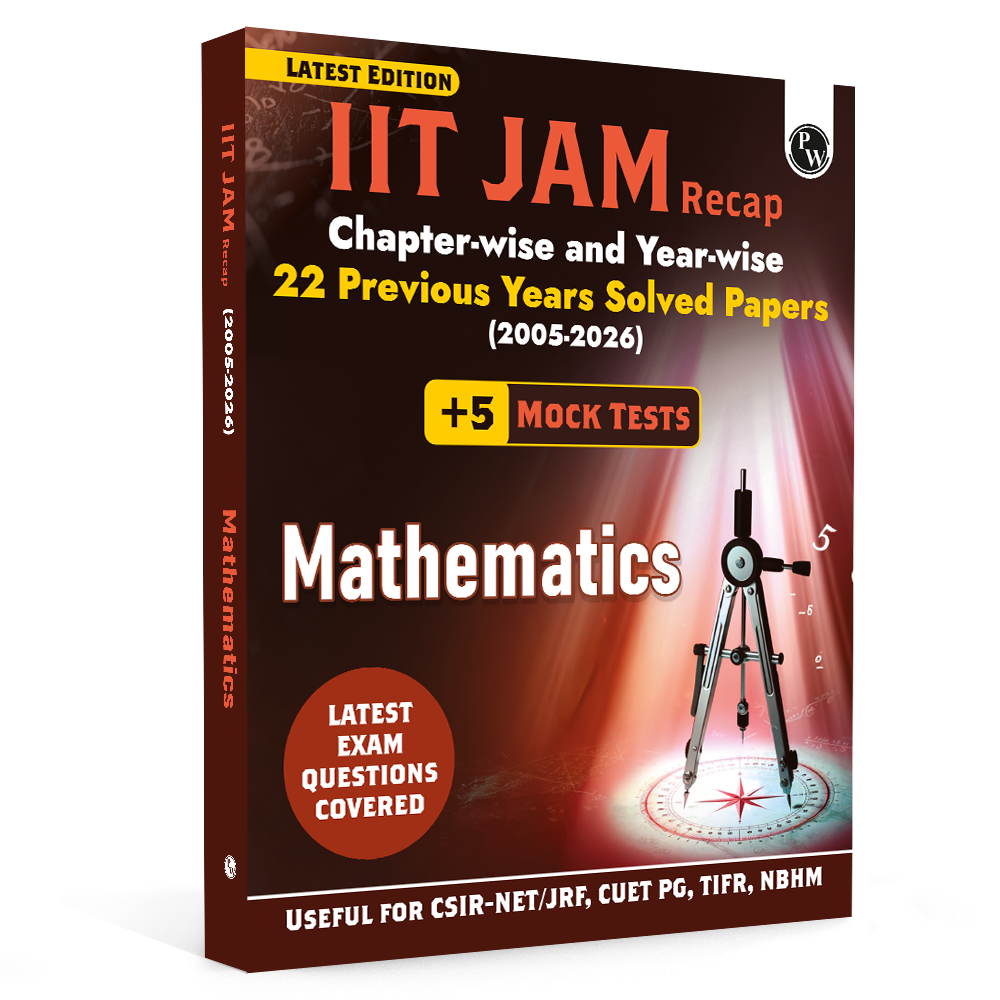
For the IIT JAM Physics exam, it is important to have a well-structured study plan, especially when you are revising. An official IIT JAM Physics PYQ book helps you to get familiar with the real exam pattern and question trends. This keeps your revision focused, efficient and relevant to the syllabus as it is today.
Check Out: IIT-JAM Books
Importance of IIT JAM Physics PYQ
Standard revision often consists of reading through entire textbooks, and this can take a huge amount of time. The IIT JAM Physics chapterwise PYQs format allows you to focus on specific topics and test your knowledge straight away. This structured approach helps you see your major strengths and identify the specific formulas or concepts that need more study.
A dedicated IIT JAM Physics question bank will help you get out of reading passively. Instead of memorising the notes, you actually have to solve problems that have been released in previous cycles. This active recall improves your memory retention and develops the exact analytical skills you’ll need on the actual exam day.
Important Topics Covered in IIT JAM Physics PYQ
The syllabus spans several distinct areas of Physics. Knowing how to categorise these topics based on the standard book index makes it easier to track your daily or weekly progress.
|
Physics Subject Area |
Core Sub-topics to Practice |
Estimated Weightage |
|
Electronics |
Intrinsic and Extrinsic Semiconductors, Op-Amps, Digital Logic |
Around 10% |
|
Mechanics |
Kepler's Laws, Centrally Directed Forces, Fluid Dynamics, Kinematics |
Approximately 15% |
|
Solid State Physics |
Crystal Structure, X-ray Diffraction, Bragg's Law |
Around 5% |
|
Optics |
Fermat's Principle, Interference, Diffraction, Polarisation |
Approximately 8% |
|
Mathematical Physics |
Vector Calculus, Differential Equations, Matrices, Complex Analysis |
Around 12% |
|
Electromagnetic Theory |
Coulomb's Law, Maxwell's Equations, Lorentz Force, Dielectrics |
Approximately 18% |
|
Modern Physics |
Inertial Frames, Special Relativity, Quantum Mechanics Basics |
Approximately 20% |
|
Thermodynamics |
Laws of Thermodynamics, Ideal Gas Behaviour, Kinetic Theory |
Around 12% |
|
Oscillation and Waves |
Simple Harmonic Motion, Damped Oscillations, Wave Equation |
Approximately 5% |
How to Prepare for Exams with IIT JAM Physics PYQ
Students usually get anxious when they are confronted with complex numerical problems that are multi-step during the exam. You can easily understand how you can break down these lengthy questions into simple steps using reliable IIT JAM Physics PYQ. Following the steps in the solution you see how the abstract ideas of the theory are applied to actual numbers in practice.
Regular practice with these papers also minimises simple calculation errors. It familiarises you with the specific units and dimensional analysis required to solve NAT questions accurately, where even a tiny decimal error can cost valuable marks.
How to Improve Score with IIT JAM Physics PYQ
A structured past year question book acts as a comprehensive self-assessment guide rather than just a collection of old papers. It directly addresses the practical needs of aspirants aiming for top ranks.
-
Latest Exam Material: Stay fully updated with official IIT JAM Physics exam trends, featuring the latest questions compiled from 2005 to 2025. This ensures you master current topics highly likely to appear in upcoming exams.
-
Trend Analysis: Gain deep insights into recurrent question patterns over the years. This structural analysis guides you to focus strictly on high-yield topics and important chapters for the exam.
-
Detailed Explanations: Every single question is accompanied by clear, step-by-step solutions. This detailed approach works to enhance your problem-solving skills and clarify underlying abstract concepts.
-
Chapter-wise Segregation: The entire curriculum is systematically organised by chapters for easy, stress-free revision, helping you master targeted key topics and significantly boost your exam prep.
Benefits of Solving IIT JAM Physics PYQ
Breaking your prep into topic chunks helps to organise what can be a daunting syllabus. It helps you not to miss out on little sections that carry a lot of weight.
Better Time Management
When you practice with IIT JAM Physics Previous Year Questions sorted by chapter, it is easy to keep track of how long you take to solve a particular type of problem. For instance, mathematical Physics problems may take longer than solid-state physics questions. Spotting these early on will allow you to use your test hours more wisely.
Clear Insights into Chapter Weightage
The mark distribution for each chapter varies by year. By going through a structured Chapter Wise PYQ for IIT JAM Physics, you can easily identify the units that have been consistently producing high-scoring questions. So you can plan your study schedule around high-yield topics and don't have to guess where to focus.
Also Check, IIT JAM 22 Years Mathematics PYQ
How to Revise with IIT JAM Physics PYQ
An organised IIT JAM Physics Revision Strategy relies on consistency and structured self-assessment. Randomly picking questions rarely yields the best results.
-
Step 1: Revise Core Theories First: Spend around 30 minutes reviewing your short notes, basic definitions, and primary derivations for a specific chapter before attempting any problems.
-
Step 2: Solve Topic-Specific Questions: Graduate to the relevant section in your question book and attempt the problems without looking at the solutions immediately.
-
Step 3: Analyse Your Mistakes: Check the solutions to understand where your logic or calculation went wrong. Note down any recurring formula errors.
-
Step 4: Track Your Speed: Use a stopwatch to monitor how long it takes to solve Multiple Choice Questions (MCQs), Multiple Select Questions (MSQs), and Numerical Answer Type (NAT) questions.
Who Should Use IIT JAM Physics PYQ?
This book is specially designed for B.Sc. students to get admission in prestigious institutes like IITs and NITs through the forthcoming entrance exam. It is a very useful source for candidates who have completed their basic syllabus and want to check their real-time accuracy and problem-solving speed. In addition, this compilation method will be very effective for repeaters or self-study students who want to get a handle on complicated numerical patterns without wading through massive reference textbooks.
Read More: IIT JAM Exam Preparation with Previous Year's Question Paper
IIT JAM Physics PYQ FAQs
-
How do chapterwise past papers improve my overall revision speed?
They allow you to skip topics you already know and focus straight on your weak areas. This selectivity helps you avoid wasting hours reviewing familiar chapters and speeds up your overall preparation.
-
Are numerical answer-type questions covered in these question banks?
Yes, high-quality question banks include all exam formats, including Multiple Choice Questions, Multiple Select Questions, and Numerical Answer Type questions, categorised by their respective chapters.
-
How many years of previous questions should I solve for the exam?
It is generally recommended to solve papers spanning from 2005 to 2025. This extensive coverage provides a thorough understanding of shifting question patterns and difficulty levels over two decades.
-
Can I rely solely on previous year questions to clear the exam?
While past papers are essential for understanding the exam format and improving your speed, you must pair them with strong conceptual understanding from standard textbooks for the best results.
-
When is the ideal time to start solving past papers?
You should ideally begin solving chapter-wise papers alongside your regular classes. Once the full syllabus is complete, you can transition to full-length papers to build exam-day stamina.