JEE Main 2027: How to Make Short Notes From Your Preparation Books

With 25 questions per subject to attempt within a strict 3-hour limit, re-reading massive reference manuals weeks before the National Testing Agency (NTA) exam is practically impossible. Many aspirants struggle to filter hundreds of textbook pages into quick, digestible reference summaries.
Crafting structured JEE Main notes from books right at the beginning of your term ensures you retain critical analytical concepts without feeling overwhelmed. This guide provides a clear roadmap to extract maximum value from your textbook reading and build high-yield revision assets.
What Are JEE Main Notes From Books
Making JEE Main notes from JEE books is the structured process of transforming dense theoretical explanations, solved examples, and practice exercises into brief, highly targeted study tools. Standard JEE Main preparation books offer complete syllabus coverage, clear explanations, and extensive sets of basic to advanced questions. However, studying full chapters repeatedly during your preparation journey consumes valuable time.
Custom JEE Main study notes act as a condensed bridge between thick reference texts and quick revision. Instead of copying paragraph after paragraph from your textbook, you distill core definitions, underlying principles, and standard solved patterns into short summaries.
These curated documents serve as personal JEE Main short notes that highlight your specific learning gaps, frequently tested topics, and quick-reference data.
What Should You Include in JEE Main Notes From Books
Your JEE Main notes from books must remain selective and functional. Including every single line from a reference manual defeats the purpose of note-making. Focus strictly on elements that directly aid problem-solving accuracy and rapid memory retrieval.
-
Core Principles and Theories: Summarise complex theoretical concepts from Mathematics, Physics, and Chemistry using brief, direct bullet points.
-
Crucial Formulas and Derivation Steps: Document final mathematical equations alongside short notes on necessary conditions or edge cases.
-
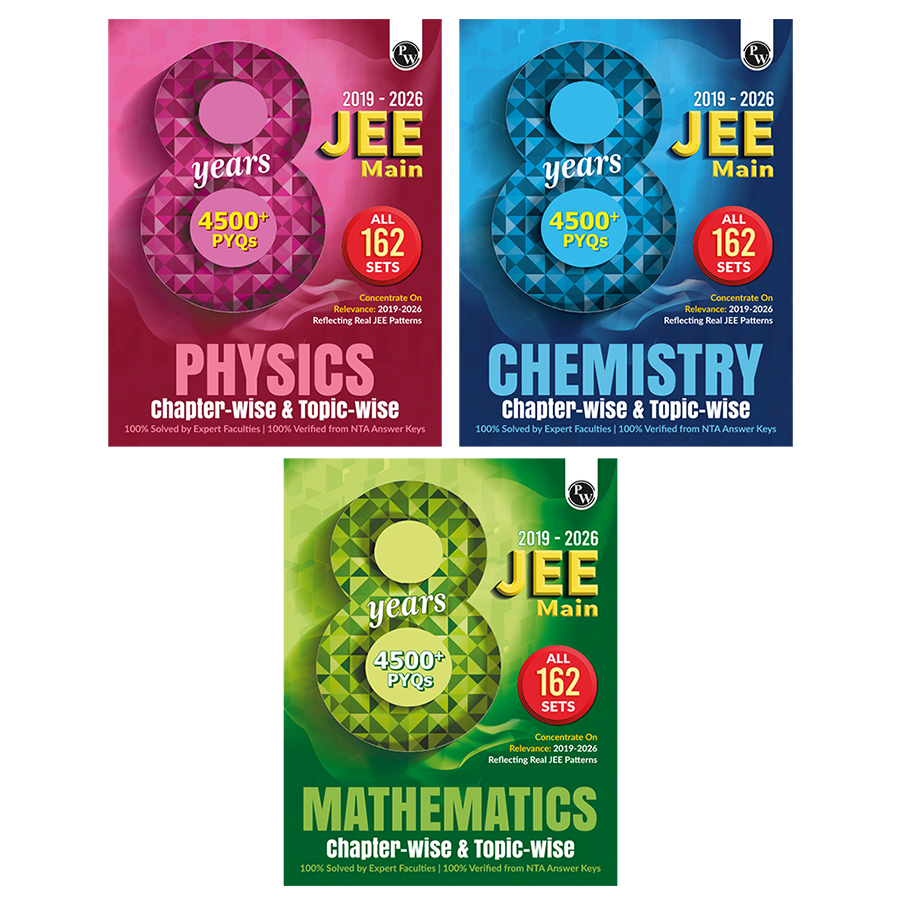
Chapter-Wise PYQ Trends: Note down recurring question types and structural patterns identified from 8 years of JEE Main PYQ sets.
-
Step-by-Step Solved Examples: Include representative sample problems that demonstrate how to apply basic theories to multi-concept questions.
-
Personal Error Logs: Reserve dedicated sections to record recurring calculation slips, conceptual misunderstandings, and tricky analytical steps observed during practice.
How to Make JEE Main Notes From Books Chapter by Chapter
Creating structured JEE Main notes from books requires a disciplined, step-by-step approach rather than hasty writing during your very first reading.
Step 1: Read the Chapter Completely First
Never write notes during your initial read-through of a new chapter. Read the section thoroughly to grasp the entire theoretical overview and logical flow. Identify the Main concepts, key definitions, and important solved examples provided by subject experts.
Step 2: Highlight Key Points and Trends
During your second reading, mark crucial definitions, standard formulas, and exceptional cases. Examine the chapter-wise JEE Main PYQs included in your books to spot trends and frequently evaluated concepts.
Step 3: Condense Information into Plain Text
Translate long explanations into short sentences, simple bullet lists, or compact tables. Express ideas in your own words rather than duplicating textbook sentences verbatim.
Step 4: Add Structured Practice Insights
Integrate insights gained from solving basic and advanced practice problems. Document specific tricks or multi-concept connections that made solving particular textbook exercises easier.
Formulas, Concepts, and Mistakes to Add to JEE Main Notes From Books
A solid JEE Main revision strategy relies heavily on how well your notes capture critical problem-solving data. Organizing mathematical equations and physical principles systematically improves speed and accuracy.
|
Subject Area |
Key Content to Include |
Strategic Benefit |
|
Physics |
Final derived formulas, standard physical constants, limits of application, and vector rules. |
Prevents application errors and speeds up numerical calculations during timed tests. |
|
Chemistry |
Reaction mechanisms, named organic reactions, exceptional periodic trends, and structural conditions. |
Ensures rapid recall during direct factual and theoretical questions. |
|
Mathematics |
Trigonometric identities, standard calculus limits, shortcut rules, and geometric properties. |
Reduces step count and saves crucial time during complex multi-concept problems. |
|
Error Tracking |
Specific calculation traps, sign convention mistakes, and overlooked boundary conditions. |
Targets individual weak areas to build consistency across practice sessions. |
How to Use JEE Main Notes From Books During Revision
Building comprehensive JEE Main notes from books provides immense utility only if you incorporate them actively into your daily and weekly routine.
-
Daily Quick Reviews: Spend 15 to 20 minutes at the start or end of your day reviewing recently created summaries to reinforce long-term memory.
-
Pre-Mock Test Brush Ups: Use your JEE Main revision notes to review critical formulas, physical reactions, and key theoretical points right before taking full-length mock tests.
-
Targeted Weak-Area Practice: Revisit corresponding chapter notes whenever mock test results reveal dropped marks or recurring logical errors.
-
Final Stage Overhauls: As exam dates approach, rely primarily on your short notes instead of re-opening bulky reference manuals, keeping your preparation focused and calm.
Tips to Keep JEE Main Notes From Books Short and Useful
To maintain highly functional JEE Main notes from books and JEE Previous Year Papers, keep your formatting crisp and simple.
-
Use Bullet Points Exclusively: Avoid long paragraphs. Group related ideas into short, readable bullet points.
-
Emphasize Critical Terms: Use bold text to highlight vital terms, standard units, and primary conditions for quick scanning.
-
Maintain Standard Notations: Stick to uniform mathematical and physical symbols throughout your notebook to prevent confusion during quick reads.
-
Leave Margin Space: Keep blank margins on every page to insert newly discovered PYQ tricks or unique test insights later in the term.
-
Keep Structure Chapter-Wise: Organize content neatly by subject, chapter name, and specific sub-topic for effortless navigation.
Common Mistakes to Avoid While Making JEE Main Notes From Books
Creating effective JEE Main notes from books requires avoiding common traps that lead to cluttered, unhelpful study material.
-
Copying Textbooks Word for Word: Writing down entire textbook paragraphs wastes time and produces bulky notebooks that are difficult to revise.
-
Writing Notes on the First Reading: Attempting to take notes before understanding the full chapter context results in highlighting non-essential details.
-
Neglecting Personal Mistakes: Failing to document past calculation errors or conceptual missteps limits your ability to improve weak areas.
-
Ignoring Chapter-Wise PYQs: Skipping exam trends and question patterns leaves your notes purely theoretical rather than exam-oriented.
-
Creating Unorganized Layouts: Writing haphazardly without clear section breaks or logical structures makes quick revision during test series frustrating.
Read More - Exploring the Benefits of the IIT JEE Exam for Students
JEE Main Short Notes FAQs
When should I start making JEE Main notes from books?
Begin making notes during your second reading of a chapter at the start of your academic term. This ensures you understand the broader topic context before distilling key formulas, theories, and solved examples.
Should I cover all three subjects in my JEE Main short notes?
Yes, you should maintain short summaries for Physics, Chemistry, and Mathematics. Each subject requires quick retrieval of distinct elements such as formulas, organic reactions, or mathematical identities.
How do JEE Main notes from books help during final exam preparation?
They replace heavy reference manuals with concise, high-yield summaries. This allows you to revise the complete syllabus multiple times quickly, boosting speed and accuracy before tests.
What is the ideal length for a chapter summary?
A chapter summary should ideally be limited to 2–4 concise pages depending on topic weightage. Focus strictly on core formulas, key concepts, exceptional cases, and recurring PYQ trends.
How often should I update my JEE Main revision notes?
Update your notes regularly whenever you analyze mock test results or solve new PYQ sets. Adding newfound shortcut methods and personal error logs keeps your notes dynamic and useful.