JEE Main Application of Derivatives PYQ Preparation with PW Book
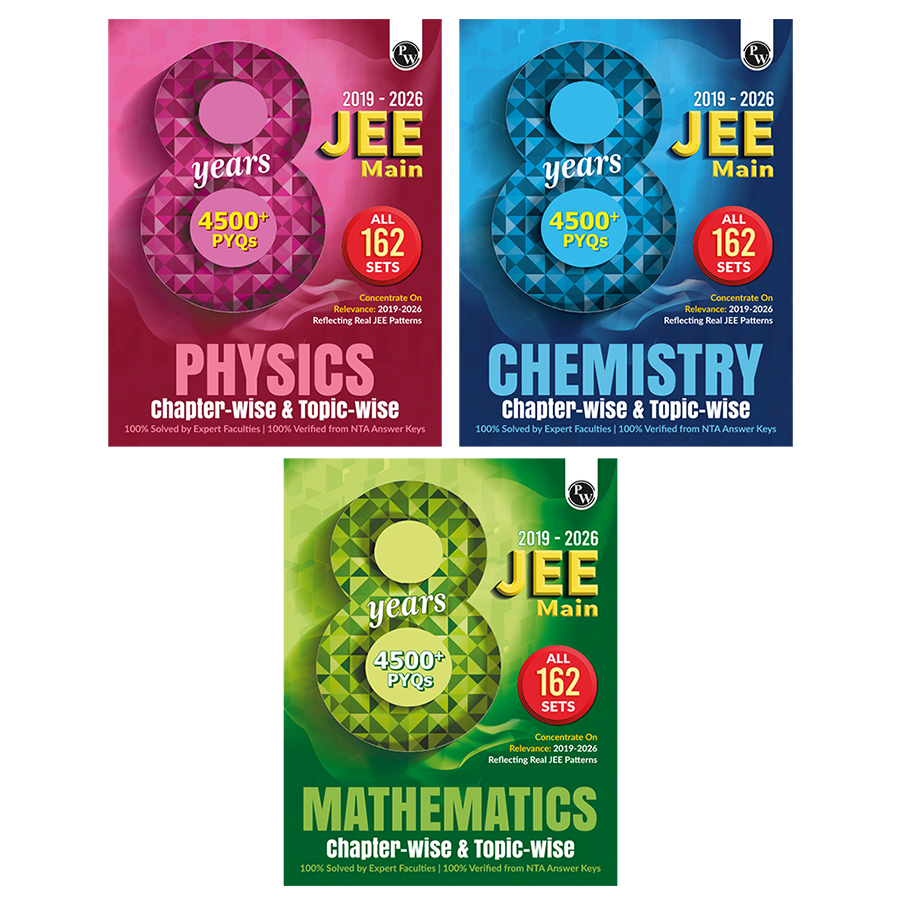
A strong comprehension of ideas and regular practice of questions can help you prepare for JEE Main calculus. Solving JEE Main application of derivatives PYQ helps the learners comprehend the many types of questions asked on derivatives in various exams. Solving JEE Previous Year Papers helps in identifying common patterns, enhancing problem-solving skills, and enabling candidates to manage time effectively when preparing for the mathematics exam.
JEE Main Application of Derivatives PYQ Trends
Analysing previous-year questions can help students understand how Application of Derivatives is tested in JEE Main. The questions commonly involve concepts such as tangents, normals, increasing and decreasing functions, maxima and minima, and rate of change. Working through application of derivatives JEE Mains questions sets allows candidates to recognise recurring concepts and understand how the same idea can be presented in different ways.
Students should pay attention to the information given in each question before selecting a formula or solving method. Some problems may require students to combine derivatives with functions, graphs, intervals, or given conditions. Reviewing these variations helps improve conceptual application rather than relying only on memorised formulas.
Regular PYQ practice can also help students identify their weaker areas. After each practice session, they can review incorrect and skipped questions, note the reason for each mistake, and revise the related concept. Over time, this approach can make preparation more organised and improve accuracy and time management.
-
Shift Analysis: Recent testing sessions can include multi-step problems combining monotonicity with functions and other calculus concepts.
-
Question Formats: Preparation should cover both Multiple Choice Questions and Numerical Value Questions.
-
Conceptual Application: Questions may require students to interpret curves, slopes, intervals, and conditions instead of relying only on direct formula application.
-
Mistake Analysis: Reviewing incorrect answers helps identify gaps in concepts, calculations, or question interpretation.
Important Topics in JEE Main Application of Derivatives PYQ
A focused approach to JEE Main PYQs helps students cover important concepts without spending equal time on every type of question. Application of Derivatives includes several sub-topics that require both formula knowledge and careful interpretation. Students should first revise the related concepts and then solve previous-year questions to understand how they are applied in different situations.
Practising these topics chapter-wise also makes it easier to identify weak areas. After solving a set, students can mark questions that took longer to solve or involved repeated mistakes. Revisiting these questions during revision can strengthen concepts and improve solving speed.
-
Tangents and Normals: Focus on equations of tangents and normals, slopes, angle of intersection between curves, and related length-based problems.
-
Monotonicity: Practise determining intervals where functions are increasing or decreasing using first-order derivatives and given conditions.
-
Maxima and Minima: Pay attention to local and global extrema, critical points, and problems involving closed intervals.
-
Rate of Change: Practise questions involving related quantities and understand how derivatives represent the rate at which one variable changes with another.
-
Graph-Based Questions: Review how the sign and value of derivatives can help interpret the behaviour, slope, and turning points of a function.
JEE Main Application of Derivatives PYQ Practice Strategy
A structured study plan transforms raw practice into measurable score improvement. Relying on disorganized resources often leads to wasted effort on outdated problem types. Integrating structured chapter-wise resources ensures comprehensive coverage of every sub-topic without missing recent updates.
-
Topic-Wise Breakdown: Solve problems immediately after finishing a chapter to solidify theoretical concepts.
-
Error Tracking: Maintain a separate log for calculation errors and conceptual misunderstandings.
-
Timed Drills: Simulate real examination pressure by setting a timer for individual problem sets.
JEE Main Application of Derivatives PYQ Topic Weightage
The following table highlights the major calculus sub-topics, their expected frequency, difficulty level, and suitable practice resources. This can help students organise their JEE Main Maths PYQ practice based on topic importance and difficulty.
Students can use this breakdown to decide how much time to spend on each area during revision. Topics with more complex question patterns may require additional practice, while easier areas can be revised through shorter question sets. Comparing performance across these topics can also help students identify where they need more conceptual revision or timed practice.
|
Sub-Topic in Calculus |
Average Frequency Per Shift |
Difficulty Level |
Recommended Practice Source |
|
Tangents and Normals |
High |
Moderate |
Chapter-wise PYQ Compilations |
|
Monotonicity of Functions |
Moderate to High |
Advanced |
Shift-wise Solved Papers |
|
Maxima and Minima |
High |
Moderate-Advanced |
Previous Year Question Banks |
|
Rate of Change |
Low to Moderate |
Easy-Moderate |
Standard Textbooks |
How to Solve JEE Main Application of Derivatives PYQ
Attempting past questions requires a disciplined approach and active problem-solving. Simply reading solutions may help with understanding, but solving questions independently gives students a better idea of their actual preparation level. While working with PYQ, students should first identify the concept being tested, decide on a suitable method, and then solve the question without immediately checking the answer.
After completing a practice set from JEE Books, students should review both incorrect and skipped questions. This helps them understand whether the difficulty was caused by a conceptual gap, calculation mistake, or difficulty interpreting the question. Maintaining short notes for frequently repeated errors can also make revision more focused.
-
Initial Attempt: Spend adequate time attempting a complex problem independently before checking the solution.
-
Concept Identification: Identify whether the question involves tangents, normals, monotonicity, maxima-minima, or rate of change.
-
Solution Review: Compare your method with the detailed solutions to understand where your approach can be improved.
-
Alternative Approaches: Look for shorter algebraic methods or graphical approaches that may reduce solving time.
-
Timed Practice: Gradually introduce time limits to improve speed while maintaining accuracy.
-
Reattempt Difficult Questions: Solve marked questions again after revision to check whether the concept has been understood properly.
Chapter Wise JEE Main Application of Derivatives PYQ Practice
Systematic practice using compiled archives makes it easier to organise daily study schedules and cover each Application of Derivatives topic in a planned manner. Chapter-wise and shift-wise resources allow students to move from basic questions to more challenging problems while keeping track of the concepts they have already practised. Using PYQ regularly can also help students understand how familiar concepts are presented in different question formats.
Students can divide their practice into smaller sets and review their performance after completing each topic. Questions that take longer to solve or lead to repeated mistakes can be marked for later revision. This approach prevents students from repeatedly solving only familiar questions and encourages them to work on weaker areas.
-
Pattern Recognition: Consistent exposure to past papers helps students recognise common question structures involving curves, slopes, extrema, and monotonicity.
-
Speed Enhancement: Regular numerical practice can reduce hesitation and improve calculation speed during timed sessions.
-
Topic-Wise Revision: Chapter-wise sections make it easier to revise specific concepts without going through unrelated questions.
-
Weak Area Tracking: Marking incorrect or difficult questions helps students identify topics that need additional practice.
-
Confidence Building: Structured revision and repeated practice can improve familiarity with different question patterns before the exam.
Read More: Features of PW JEE Main PYQ Book
JEE Main Application of Derivatives PYQ FAQs
How many years of JEE Main application of derivatives PYQs should I practice?
Practising the last 8 years of papers provides an optimal balance of volume and relevance. This window covers recent shifts, offering hundreds of variations across different difficulty tiers.
Are JEE AOD questions helpful for numerical value sections?
Yes, practicing previous questions helps understand integer-type problems where precision and calculation speed dictate success rates.
Why should I use chapterwise books for JEE Maths PYQs?
Chapter-wise segregation allows focused targeting of weak spots, ensuring that concepts like monotonicity or maxima-minima are thoroughly reinforced before moving to full mock tests.
How does AOD JEE preparation benefit from error analysis?
Categorizing mistakes into conceptual gaps or silly calculation errors prevents repeating the same mistakes during actual examinations.
Where can I find reliable solutions for application of derivatives PYQ sets?
Comprehensive and verified solutions are available in dedicated Physics Wallah publications designed specifically for engineering entrance aspirants.