JEE Main Coordination Compounds PYQ Preparation with PW Book
You might feel confident after reading notes, yet struggle when confronting actual exam questions under timed conditions. Bridging this gap requires transitioning from passive theory review to targeted question practice.
Working systematically through real exam papers brings clarity to complex concepts like isomerism, bonding theories, and magnetic properties with JEE Main Coordination Compounds PYQ.
By evaluating past trends and practicing structured problems, you can refine your analytical skills, eliminate recurring mistakes, and build the speed necessary to secure top marks in the upcoming engineering entrance examination.
What is JEE Main Coordination Compounds PYQ
Practicing JEE Main previous year papers is one of the most reliable ways to gauge your actual readiness for the entrance test. Coordination Compounds carries significant weight in inorganic chemistry, making consistent practice essential for a strong performance.
-
Understanding Actual Difficulty Levels: Solving real paper sets exposes you to authentic question standards, ensuring your preparation matches actual exam requirements.
-
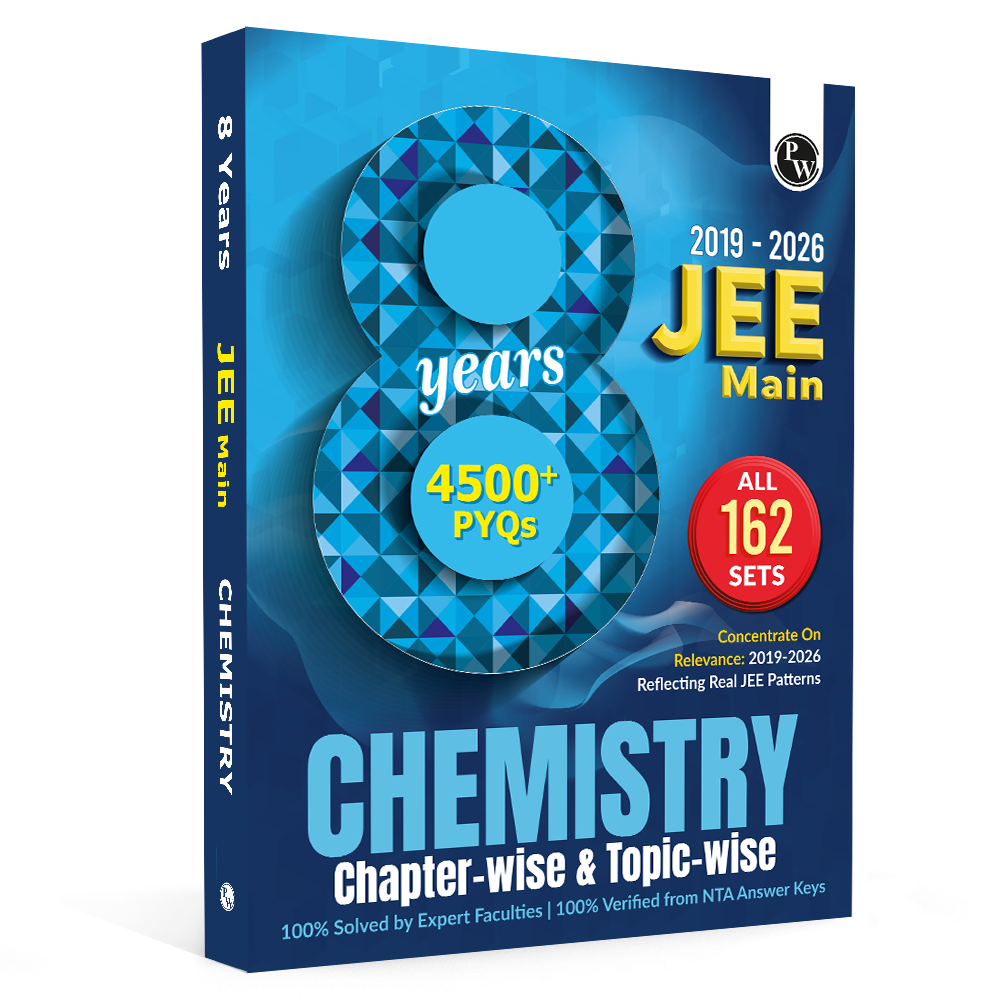
Identifying Repeated Trends: Reviewing questions from 2019 to 2026 across 162 shift sets reveals predictable patterns, high-priority topics, and frequently asked question types.
-
Refining Exam Speed: Time management is crucial during the test. Regular practice improves your question recognition speed, allowing you to solve inorganic problems quickly.
-
Pinpointing Learning Gaps: Tackling coordination compounds PYQ highlights specific weak spots, such as confusing IUPAC naming rules or miscalculating crystal field stabilization energy.
-
Building Exam Confidence: Working through 4500+ detailed, error-free solutions across JEE chemistry PYQs reduces exam-day anxiety and strengthens logical problem-solving.
Concepts to Revise Before JEE Main Coordination Compounds PYQ Practice
Before diving straight into solving JEE previous year papers, review fundamental theoretical concepts. Having a firm grasp of these core areas will streamline your coordination compounds JEE preparation and boost your solving speed.
-
Werner's Theory of Coordination Compounds: Understand primary and secondary valencies, ionisation in aqueous solutions, and structural formulations.
-
IUPAC Nomenclature & Formulas: Memorise rules for naming coordination entities, central metal atoms, positively/negatively charged ligands, and neutral species.
-
Isomerism in Coordination Entities: Distinguish between structural isomerism (linkage, ionization, hydrate, coordination) and stereoisomerism (geometrical $cis/trans$ or $fac/mer$, and optical isomerism).
-
Valence Bond Theory (VBT): Practice determining hybridization ($sp^3$, $dsp^2$, $sp^3d^2$, $d^2sp^3$), magnetic behavior (paramagnetic vs. diamagnetic), and spin state (high-spin vs. low-spin).
-
Crystal Field Theory (CFT): Master crystal field splitting in octahedral and tetrahedral fields, spectrochemical series order, magnetic moments, and color predictions based on $d-d$ transitions.
-
Organometallic Compounds & Bonding: Review metal carbonyls, synergistic bonding mechanisms, and stability factors of complexes.
How to Use a Book for JEE Main Coordination Compounds PYQ Preparation
Using a structured chapterwise and topicwise practice book transforms raw study hours into effective results. To get the maximum benefit out of your preparation material, follow a systematic method.
|
Feature |
How It Helps Your Practice |
Recommended Action |
|
8-Year Shift Coverage (2019–2026) |
Exposes you to all 162 shift sets and modern question styles. |
Solve questions chronologically to observe recent shift trends. |
|
Topic-Wise Organization |
Groups similar coordination compounds JEE main questions together. |
Solve a specific sub-topic immediately after reviewing its theory. |
|
Smart Weightage Analysis |
Identifies high-yield areas within the chapter. |
Prioritise sub-topics with the highest question frequencies. |
|
Detailed Error-Free Solutions |
Clarifies underlying concepts and step-by-step logic. |
Compare your method with step-by-step solutions to identify faster techniques. |
Study Strategy for JEE Main Coordination Compounds PYQ
A structured study plan using JEE Books ensures balanced coverage of theory, problem-solving, and periodic revision throughout your mid-session preparation.
Phase 1: Topic-Wise Segregation
Begin by breaking down the chapter into smaller segments: Nomenclature, Isomerism, VBT, and CFT. Work through the relevant JEE coordination compounds questions sub-topic by sub-topic. Avoid jumping into mixed-question practice until individual sub-topics are solid.
Phase 2: Timed Practice Sessions
Set a timer while working through JEE main coordination compounds PYQ sets. Aim to solve each inorganic question within 60 to 90 seconds. This builds test-like pacing and reduces time pressure during the actual exam.
Phase 3: Error Analysis and Bookmarking
Keep an error journal alongside your practice book. Whenever you encounter a difficult question or make a calculation mistake, highlight the question and note the correct logical step. Revisit these bookmarked questions during your weekly revisions.
Tips to Solve JEE Main Coordination Compounds PYQ
Achieving high accuracy in inorganic chemistry relies on avoiding silly errors and carefully reading question stems. Apply these practical tips while practising JEE Main Chemistry PYQs during your daily study sessions:
-
Pay Attention to Ligand Field Strength: Always check whether a ligand is strong field or weak field using the spectrochemical series before predicting pairing or hybridization.
-
Double-Check Oxidation States: Calculate the central metal ion's oxidation state carefully to ensure accurate $d$-electron count predictions.
-
Watch Out for Optical Inactivity: Remember that complexes with a plane or centre of symmetry are optically inactive, regardless of the number of chiral centers.
-
Distinguish Inner vs. Outer Orbital Complexes: Verify whether $d$-orbitals used in hybridization come from the inner $(n-1)d$ shell or outer $n d$ shell.
-
Analyze All Shift Sets: Work through all 162 shift papers from 2019–2026 to get comfortable with variations in wording and conceptual combinations.
Practice Sheet for JEE Main Coordination Compounds PYQ Preparation
Use this sample practice sheet to test your conceptual clarity. Try solving these standard question models before checking the detailed solution steps in your practice book.
-
Question 1 (Nomenclature & Formula): Write the correct formula for Potassium trioxalatochromate(III) and determine the coordination number of the central metal atom.
-
Question 2 (Isomerism): Identify the total number of geometrical and optical isomers possible for the complex $[Co(en)_2Cl_2]^+$.
-
Question 3 (Valence Bond Theory): Predict the hybridization, geometry, and spin state of $[Ni(CN)_4]^{2-}$ versus $[NiCl_4]^{2-}$.
-
Question 4 (Crystal Field Theory): Calculate the spin-only magnetic moment ($\mu_{s.o.}$) in Bohr Magnetons (B.M.) for $[Fe(H_2O)_6]^{3+}$.
-
Question 5 (Metal Carbonyls): Explain the change in C-O bond length when $Cr(CO)_6$ undergoes oxidation or reduction based on synergistic bonding principles.
JEE Main Coordination Compounds PYQ FAQs
What is the weightage of coordination compounds in the entrance exam?
Coordination Compounds typically accounts for 1 to 2 questions in almost every shift paper, making it one of the highest-weightage topics in Inorganic Chemistry.
How many years of past papers should I solve for this chapter?
Solving 8 years of previous questions (2019 to 2026) covering 162 shift sets provides comprehensive practice aligned with current exam trends.
Is Crystal Field Theory (CFT) more important than Valence Bond Theory (VBT)?
Both theories are frequently tested. CFT is heavily tested for magnetic moments, color, and splitting energy, while VBT is commonly tested for hybridization and geometry.
Why are detailed solutions important when practicing past papers?
Detailed, error-free solutions help you understand the exact step-by-step logic, eliminate conceptual errors, and learn faster solving techniques.
How can I improve my speed when solving inorganic chemistry questions?
Practice topic-wise past questions under timed conditions and maintain a mistake notebook to quickly review frequently confused concepts.