JEE Main Current Electricity PYQ Preparation with PW Book
Current electricity remains one of the most consistent, high-yield topics in the examination syllabus. Students frequently struggle with complex circuit analysis, sign conventions, and calculation errors under timed test conditions.
Focusing directly on a JEE Main current electricity PYQ module helps bridge the gap between theoretical knowledge and practical examination standards. Solving authentic JEE previous year paper problems allows you to identify recurring question patterns, test your accuracy, and build exam confidence.
This comprehensive article provides step-by-step strategies, critical concept summaries, and practical insights to optimize your practice routine using dedicated previous year question resources.
Importance of JEE Main Current Electricity PYQ
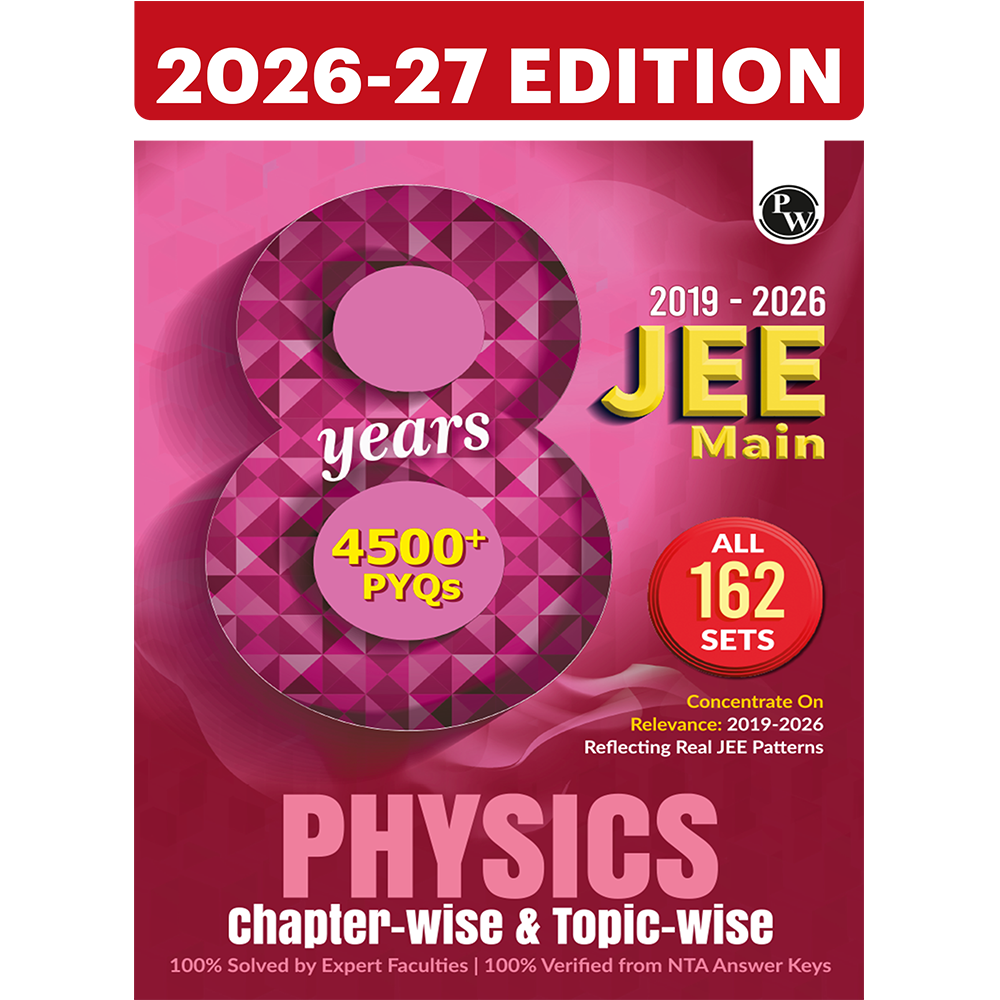
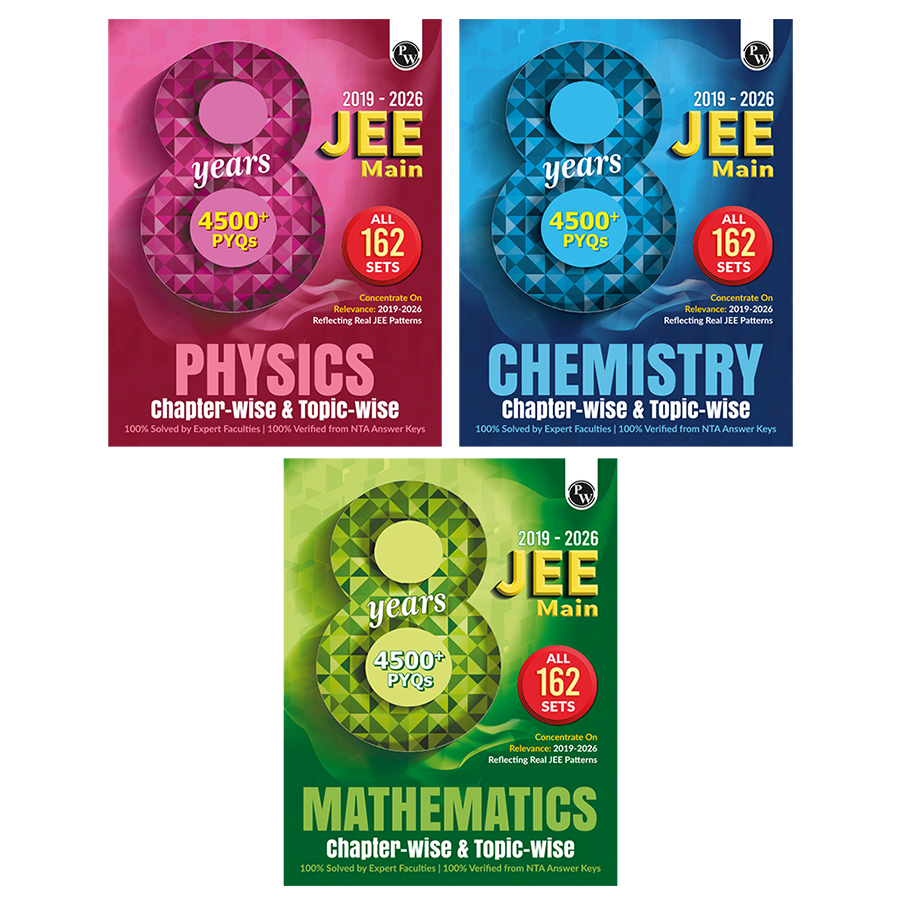
Previous Year Questions (PYQs) for current electricity consist of authentic questions asked in official exam papers across past testing sessions. For the period spanning 2019 to 2026, these comprise all 162 shift papers, providing complete coverage of modern question formats.
-
Comprehensive Question Bank: Access to over 4500+ JEE physics PYQs across all chapter modules.
-
Shift-Wise Realism: Experiencing all 162 shift paper formats offers a realistic preparation environment reflecting exact exam standards.
-
Topic-Wise Categorization: Questions organized by sub-topics allow targeted practice on specific circuit types and laws.
-
Error-Free Solutions: Detailed, step-by-step solutions assist in understanding complex multi-step physics problems.
Concepts to Revise with JEE Main Current Electricity PYQ
Before attempting current electricity JEE Main questions, reviewing fundamental theoretical principles is essential for speed and accuracy.
-
Ohm’s Law and Resistance: Understand resistivity, temperature dependence of resistance, and color coding.
-
Kirchhoff’s Laws: Master Kirchhoff's Current Law (KCL) and Kirchhoff's Voltage Law (KVL) with proper potential drop sign conventions.
-
Combination of Resistors: Practice series and parallel combinations, delta-star transformations, and symmetry-based circuit simplifications.
-
Electrical Instruments: Review the working principles of Wheatstone bridges, metre bridges, and potentiometers.
-
Electric Cell Circuits: Grasp internal resistance, terminal potential difference, and grouping of cells in series and parallel combinations.
-
Power and Energy: Focus on Joule's heating effect, power dissipation across components, and maximum power transfer theorem.
How to Use JEE Main Current Electricity PYQ
Utilizing an organized 8-year (2019–2026) solved paper collection such as the 8 Years JEE Main PYQs requires a structured methodology to maximize learning gains, identify recurring question patterns, and improve exam-oriented problem-solving skills.
|
Preparation Feature |
Strategic Utility |
Learning Outcome |
|
Topic-Wise Arrangement |
Targets weak theoretical sub-topics directly. |
Eliminates individual concept gaps quickly. |
|
Weightage Analysis |
Identifies high-frequency question types. |
Optimizes study time allocation. |
|
All 162 Shift Sets |
Provides realistic test paper environment. |
Enhances exam stamina and timing. |
|
Detailed Solutions |
Verifies step-by-step mathematical logic. |
Prevents repeat calculation errors. |
Study Strategy Plan for JEE Main Current Electricity PYQ
Structuring your weekly schedule around targeted current electricity PYQ sessions ensures consistent skill progression during mid-session preparation.
-
Phase 1: Concept Refresh: Spend 2 hours reviewing core formulae, circuit laws, and instrument derivations.
-
Phase 2: Topic-Wise PYQ Practice: Solve current electricity PYQs grouped by individual sub-topics (e.g., KVL, instruments).
-
Phase 3: Timed Problem Solving: Attempt 20–25 JEE current electricity questions within a 45-minute timed block to simulate real examination pressure.
-
Phase 4: Error Analysis: Compare your steps with the detailed solutions to identify logical slips or formula misapplications.
-
Phase 5: Revision and Retesting: Re-attempt incorrectly answered questions after 3 days to confirm long-term concept retention.
Tips to Solve JEE Main Current Electricity PYQ
Numerical questions in physics require both precision and procedural clarity. Using JEE Books for regular practice and applying systematic habits can significantly reduce simple mistakes during the exam.
-
Draw Clear Circuit Diagrams: Re-draw complex networks cleanly and mark node potentials before applying equations.
-
Assign Sign Conventions Early: Consistently apply positive and negative directional indicators for loop currents when using KVL.
-
Convert Units to Standard Form: Ensure current, voltage, resistance, and time values are strictly in SI units before performing calculations.
-
Simplify Complex Networks: Look for bridge balances or lines of symmetry to reduce circuit complexity before writing algebraic equations.
-
Verify Answer Magnitude: Check if calculated current or resistance values fall within physically realistic numerical bounds.
Mistakes to Avoid in JEE Main Current Electricity PYQ
Many candidates lose marks due to avoidable procedural errors rather than a lack of subject knowledge during current electricity JEE preparation.
-
Skipping Internal Resistance: Forgetting to account for the internal resistance of cells in multi-branch circuits.
-
Misinterpreting Potentiometer Polarity: Incorrectly connecting cell polarities while analyzing zero-deflection lengths in potentiometer problems.
-
Confusing Current Density and Drift Velocity: Applying macroscopic Ohm's law formulas where microscopic charge carrier parameters are specified.
-
Neglecting Detailed Solutions: Marking a question as correct without reviewing whether a simpler solution method was available.
-
Practicing Without Time Limits: Solving numerical problems at a leisure pace, leading to poor time management during shift exams.
Practice Sheet for JEE Main Current Electricity PYQ
Test your concept clarity with this representative set of JEE Main Physics PYQ practice problem outlines derived from past examination formats.
-
Problem 1 (Circuit Analysis): A network of six equal resistors, each of resistance RR, forms a closed hexagonal frame with a central connection. Calculate the equivalent resistance across two opposite corners.
-
Problem 2 (Potentiometer): A potentiometer wire of length 400 cm has a resistance of 8 Ω. A cell of emf 2 V and internal resistance 2 Ω is connected across it. Find the balancing length for an external cell of emf 1.2 V.
-
Problem 3 (Temperature Coefficient): The resistance of a heating element is 100 Ω at 20 °C. If its temperature coefficient of resistance is 0.0015 °C⁻¹, calculate the resistance at 500 °C.
-
Problem 4 (Kirchhoff's Laws): In a two-loop circuit with two ideal batteries of 12 V and 6 V and three resistors of 2 Ω, 4 Ω, and 6 Ω, determine the current passing through the central 4 Ω branch.
-
Problem 5 (Electrical Power): Two electric bulbs rated 220 V, 60 W and 220 V, 100 W are connected in series across a 220 V supply. Determine the total power consumed by the combination.
JEE Main Current Electricity PYQ FAQs
How many shift papers are included in the 2019-2026 PYQ collection?
The collection includes all 162 shift papers spanning 2019 to 2026, offering complete coverage across modern exam sessions.
Why is topic-wise arrangement beneficial for current electricity preparation?
Topic-wise organization allows students to isolate weak areas, such as circuit instruments or cell combinations, and practice targeted questions systematically.
How does weightage analysis help during revision?
Weightage analysis highlights high-scoring and frequently asked topics, helping students prioritize their time on crucial physics concepts.
What is the total number of questions available in the 8-year book?
The book contains over 4500+ JEE Main Physics questions accompanied by detailed, error-free solutions.
How does practicing previous years' questions build exam readiness?
Solving past questions familiarizes students with the actual difficulty level, enhances problem-solving speed, and improves critical thinking under time constraints.