JEE Main Modern Physics PYQ Preparation with PW Book
Modern physics carries high weightage in the exam, yet many aspirants struggle to convert theoretical understanding into swift problem-solving speed. Identifying exact question trends and solving authentic shift papers systematically is crucial to building speed and scoring well. Solving targeted JEE main modern physics PYQ modules helps bridge the gap between basic concepts and actual exam performance.
Overview of JEE Main Modern Physics PYQ
JEE Previous year questions from modern physics represent authentic past exam problems asked during various shifts of the national entrance test. These problems test fundamental concepts, mathematical applications, and conceptual principles across atomic and nuclear physics topics.
By practising JEE main modern physics PYQs, students get an accurate understanding of the exact difficulty level set by exam authorities.
Features of the JEE Main Modern Physics PYQ Book
Lets’ understand the features of the modern physics PYQ book.
-
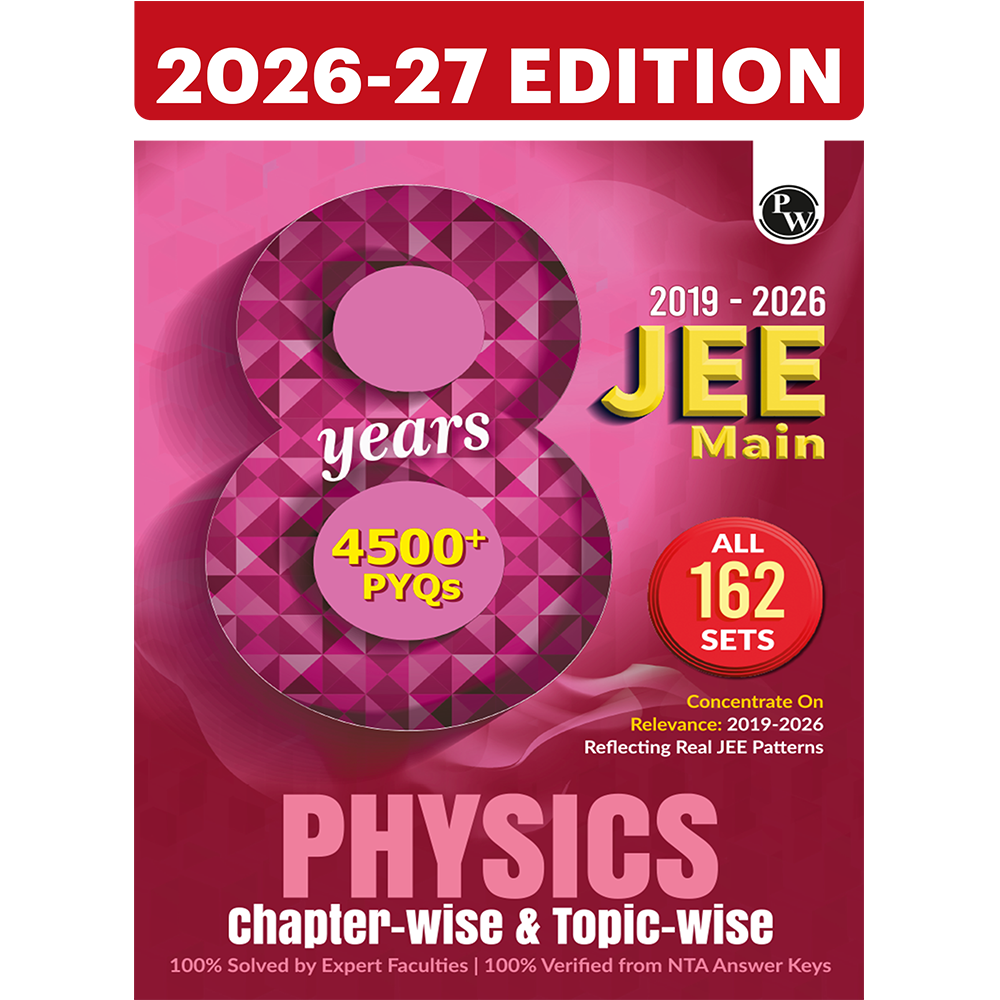
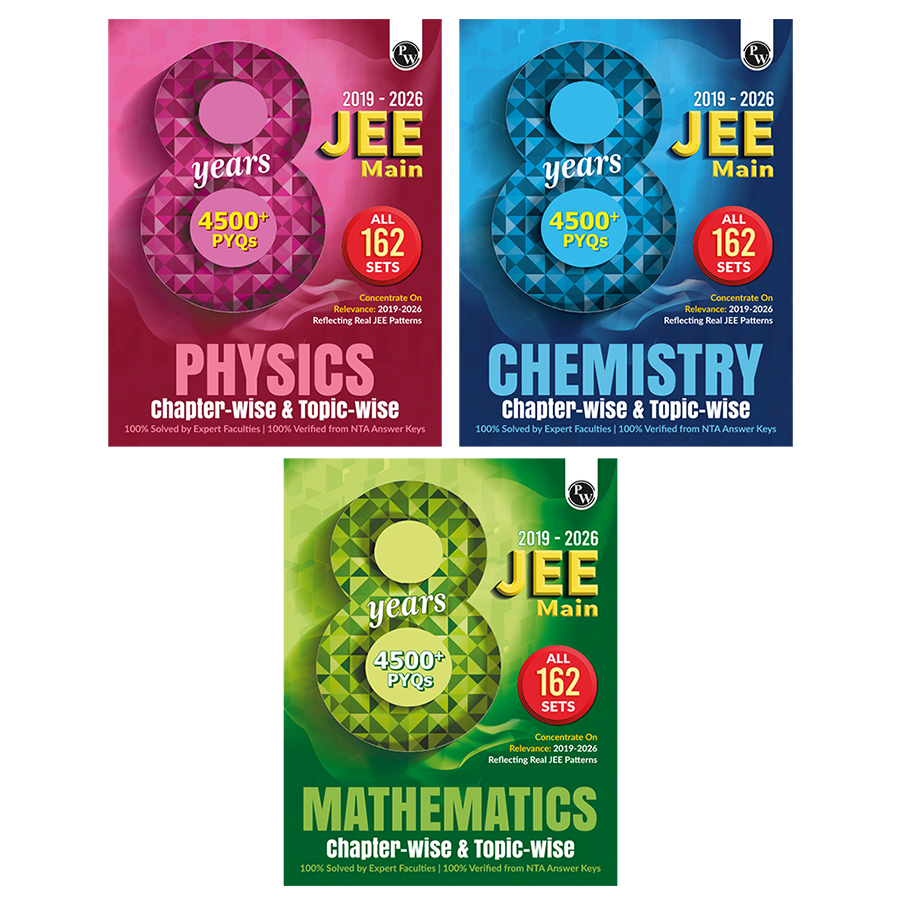
8 Years Focused Coverage (2019–2026): The content is curated strictly from recent years (2019–2026) to match the current exam pattern and eliminate outdated material.
-
All 162 Shift Sets Included: Gain access to every single shift paper across recent sessions for a comprehensive and realistic practice experience.
-
4500+ Questions with Detailed Error-Free Solutions: Practice extensively with over 4500+ JEE main physics PYQs accompanied by step-by-step, accurate solutions that clear up conceptual doubts.
-
Topic-Wise Arrangement: Questions are organized systematically by sub-topic, making it easier to target weak areas and systematically strengthen your physics foundation.
-
JEE-Level Difficulty: Problems are designed to reflect the genuine difficulty level of the actual exam, building true exam readiness.
-
Weightage Analysis: Understand topic importance clearly to focus your revision on high-scoring, frequently asked areas as part of your overall modern physics JEE preparation.
Topics to Revise Before JEE Main Modern Physics PYQ Practice
Before jumping directly into solving past papers, revising core concepts ensures higher accuracy and saves valuable study time. Focusing on frequently tested sub-topics gives you a solid foundation.
-
Dual Nature of Matter and Radiation: Photoelectric effect equations, stopping potential calculations, work function, and de Broglie wavelength relationships.
-
Atomic Structure: Bohr’s atomic model, energy level transitions, spectral series (Lyman, Balmer, Paschen), and radius/velocity proportions for orbits.
-
Nuclei and Radioactivity: Binding energy per nucleon, mass defect calculations, radioactive decay laws, half-life, and mean-life equations.
-
Semiconductor Electronics: Energy bands, p-n junction diode characteristics, rectifiers, and logic gate truth tables.
Building absolute clarity on these concepts with the help of JEE Books makes solving Modern Physics JEE Main questions significantly smoother and faster during timed tests.
How to Use Books for JEE Main Modern Physics PYQ Preparation
Using a dedicated previous year question book requires a structured approach rather than random problem-solving. A structured resource containing over 4500+ physics questions across 162 shift papers gives you all the material needed for thorough preparation.
|
Book Feature |
Preparation Benefit |
How to Use It |
|
Topic-wise Arrangement |
Allows targeted practice on specific weak areas |
Pick one sub-topic at a time and solve all questions sequentially |
|
Weightage Analysis |
Identifies high-scoring and frequently asked topics |
Allocate more revision hours to topics carrying maximum weightage |
|
Error-Free Detailed Solutions |
Provides clear step-by-step logic |
Cross-check incorrect attempts immediately to fix conceptual flaws |
|
162 Shift Papers Coverage |
Offers realistic exam-level practice |
Solve questions under simulated timed conditions |
Working with a well-organized book simplifies JEE modern physics questions practice by eliminating outdated content and keeping your revision focused.
Study Strategy for JEE Main Modern Physics PYQ
To maximize your retention and accuracy, structure your daily study routines into clear, actionable steps.
-
Review Theory First: Briefly re-read formulas and key principles from your notes before opening the practice book.
-
Attempt Unassisted Practice: Solve a batch of 15 to 20 questions without checking the answer keys initially.
-
Analyze Solutions Thoroughly: Refer to the detailed, step-by-step explanations for every question you got wrong or spent too much time on.
-
Maintain a Formula and Error Log: Note down specific calculation traps, formulas you forgot, or shortcut tricks revealed in the solutions.
-
Re-visit Weak Topics: Use the topicwise organization to solve extra problems from chapters where your accuracy drops below 80%.
Adopting this disciplined cycle improves your performance significantly during JEE Main PYQs practice sessions, helping you identify recurring question patterns, strengthen concepts, and improve accuracy.
Tips to Solve Formula Based Questions in JEE Main Modern Physics PYQ
A vast majority of questions in this segment rely directly on correct formula application and precise numerical calculations.
-
Memorize Standard Constants: Keep exact values for Planck's constant, electron mass, speed of light, and charge of an electron at your fingertips to avoid hesitation.
-
Pay Attention to Units: Convert all given values into standard SI units (or electron-volts where appropriate) before executing calculations to prevent preventable errors.
-
Simplify Calculations First: Express numbers in power-of-ten notation before dividing or multiplying large figures.
-
Identify Direct Substitutions: Recognize standard question patterns where values can be plugged straight into core formulas without multi-step derivations.
-
Practice Numerical Entry Type Problems: Pay close attention to rounding off instructions when answering integer or numerical response questions.
Mastering these minor tactical adjustments ensures you tackle overall JEE physics PYQs with speed and high accuracy.
Read More: JEE Main Chapter Wise PYQ
JEE Main Modern Physics PYQ FAQs
Q1. Why are modern physics questions considered high-scoring in JEE Main?
Modern physics questions are mostly formula-based and direct compared to complex mechanics problems. Practicing a reliable JEE main modern physics PYQ set helps students score quick and predictable marks in the exam.
Q2. How many years of past papers should I solve for modern physics?
Solving past 8 years of papers (2019 to 2026) covering all 162 shift sets provides complete exposure to every possible question variation and difficulty level.
Q3. Can I score well in modern physics just by memorizing formulas?
While formulas are critical, understanding underlying concepts like unit conversions, energy state transitions, and photoelectric trends is necessary to avoid tricky calculation traps.
Q4. How does topicwise arrangement in a practice book help during mid-session revision?
Topicwise organization allows you to target specific weak areas without wasting time searching through unstructured papers, making your practice highly efficient.
Q5. How much time should I spend on each numerical question during practice?
Aim to solve standard formula-based questions within 1.5 to 2 minutes per problem to build the ideal speed required for the actual test.