Smart Study Plan for JEE Main Physics Using 8 Years PYQs
If you are preparing for the Joint Entrance Examination, you likely know that the syllabus is vast and time is limited. Many students struggle to identify which topics carry the most weight and how to approach complex numericals. This is where a strategic approach using jee main physics pyq becomes essential. By analysing the last 8 years of papers, you can decode the exam pattern, understand the difficulty level, and focus your energy on high-yield chapters.
This article provides a structured roadmap to mastering Physics using previous year questions to ensure you score maximum marks in the upcoming session.
Check Out - JEE Books
Importance of JEE Main Physics PYQ
Success in JEE Main is not just about hard work; it is about smart work. Using a jee main physics pyq bank allows you to see the actual application of theoretical concepts. Unlike standard textbook problems, these questions are designed to test your analytical skills and speed.
Studying with 8 years of papers helps in several ways:
-
Understanding Question Trends: You can see how the frequency of questions from specific chapters like Modern Physics or Electrostatics has shifted over time.
-
Time Management: Practising these papers in a timed environment simulates the actual exam pressure.
-
Identifying Trap Questions: JEE often includes questions that look simple but involve tricky conceptual nuances. Recognising these patterns early saves marks.
Features of JEE Main Physics PYQ
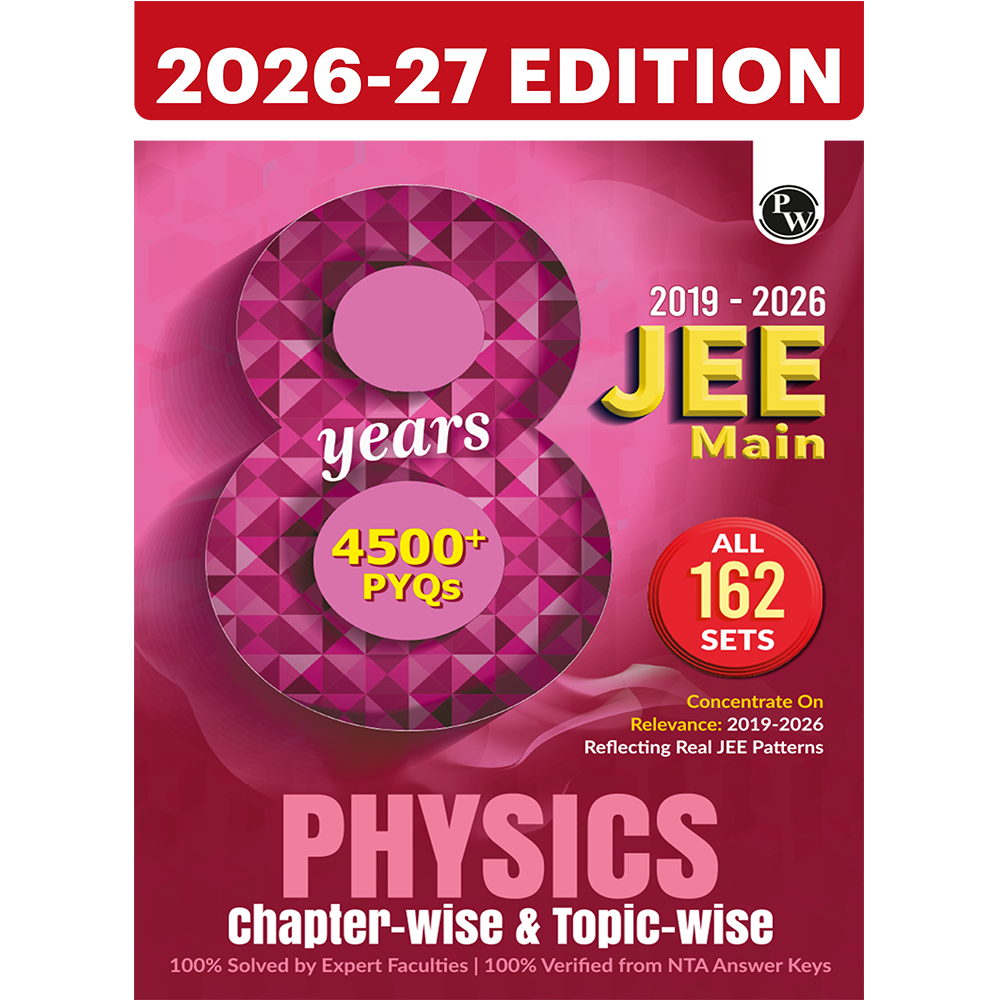
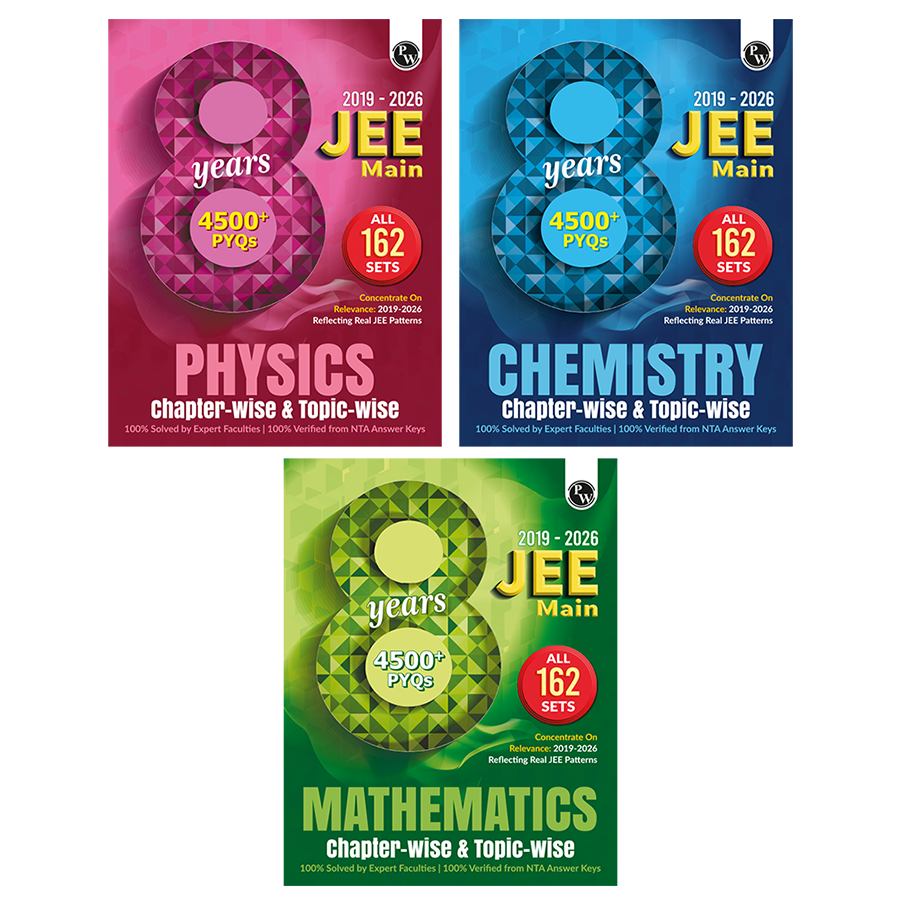
Updated PYQ Collection: Practice with the latest JEE Main previous year questions to stay familiar with current exam patterns and question styles.
Recent Year Coverage (2019–2026): Carefully selected questions from recent exams ensure preparation remains aligned with the latest syllabus and trends.
Exam-Oriented Difficulty Level: Questions are crafted to match the actual JEE Main standard, helping students strengthen problem-solving accuracy and speed.
Complete 162 Shift Papers: Get access to all shift-wise papers for comprehensive practice and a real exam-like experience.
Topic Weightage Insights: Analyze chapter-wise importance to focus more effectively on high-weightage and frequently tested topics.
Topic-wise Practice Structure: Questions are systematically arranged chapter by chapter for targeted preparation and better conceptual understanding.
4500+ Solved Questions: Includes detailed and well-explained solutions for over 4500 questions to support step-by-step learning and error reduction.
Improves Analytical Ability: Consistent PYQ practice sharpens logical thinking, pattern recognition, and exam temperament.
Covers Multiple Question Types: Includes both MCQs and numerical-based questions to prepare students for every format asked in JEE Main.
How to Use JEE Main Physics PYQ
Instead of jumping randomly between topics, the most effective strategy is to use jee mains pyq chapterwise physics. This method ensures that once you finish a chapter from your notes, you immediately validate your learning.
Phase 1: High-Weightage Chapters
Start with chapters that consistently appear in the exam. Based on the last 8 years of data, these usually include:
-
Modern Physics: Atomic structure, Dual Nature of Matter, and Nuclear Physics are high-scoring and relatively straightforward.
-
Current Electricity: Expect at least 2 to 3 questions from Ohm’s Law, Kirchhoff’s Laws, and Potentiometers.
-
Thermodynamics and KTG: A predictable section where formulas are key.
Phase 2: Moderate Complexity
Once you have secured the easy marks, move to:
-
Optics: Ray optics often has more weightage than wave optics.
-
Electrostatics: Focus on Gauss’s Law and Capacitance.
-
Magnetism: Focus on the moving charges section and electromagnetic induction.
Benefits of Practising JEE Main Physics PYQ
Many students prefer a jee mains pyq physics pdf because it allows for offline practice and easy tagging of difficult questions. Having a digital or physical collection of these papers ensures you can revisit mistakes without searching through multiple books.
Key advantages include:
-
Marking Critical Questions: While solving, you can highlight questions that took more than three minutes to solve. These are the ones you must review during the final week.
-
Formula Mapping: You can create a "Formula Sheet" based specifically on the types of numericals that appear in the jee pyq physics sets.
-
Detailed Solutions: Quality resources, offer step-by-step solutions that explain the "why" behind every step, not just the "how."
Step-by-Step Strategy to JEE Main Physics PYQ
To get the most out of your JEE Main physics pyq practice, follow this three-step cycle:
Step 1: Concept Consolidation
Read your NCERT and class notes thoroughly. Ensure you understand the derivation of formulas, as JEE sometimes tweaks the standard conditions of a formula to test your depth of knowledge.
Step 2: Timed Practice
Take a block of 30 questions from a specific year. Set a timer for 60 minutes. Do not look at the solutions until the time is up. This builds the stamina required for the three-hour marathon of the actual exam.
Step 3: Error Analysis
This is the most skipped yet most important step. If you get a question wrong, determine if it was a:
-
Calculation Error: You need more rough-work discipline.
-
Conceptual Gap: You need to re-read the topic.
-
Reading Error: You missed a word like "not," "incorrect," or "minimum."
Check Out: JEE Test series
Chapter Wise JEE Main Physics PYQ for Mock Tests
Once you have completed individual chapters, start using jee chapter wise pyq to create your own mini-mocks. Combine three or four related chapters (e.g., the whole of Mechanics or Electromagnetism) and solve them together. This helps your brain learn to switch between different concepts rapidly, which is exactly what happens during the JEE Main exam.
The 8-year pyq is particularly helpful here as it categorises questions by difficulty. You can start with "Level 1" questions to build confidence and gradually move to the more complex "Level 2" problems that involve multi-concept applications.
Read More: JEE Main Physics Syllabus 2026
JEE Main Physics PYQ FAQs
How many years of jee main physics pyq are enough?
Practising at least the last 8 years is highly recommended. This period covers the change in exam conducting bodies and the shift to multiple shifts per session, providing a massive variety of questions.
Is solving jee mains pyq chapterwise physics better than full papers?
Initially, chapterwise practice is better for building a foundation. However, in the last two months before the exam, you should switch to solving full-year papers to improve your overall time management.
Where can I find a reliable jee mains pyq physics pdf?
Some educational sites offer comprehensive books and digital resources that provide 8 years of solved papers with detailed explanations, which are more reliable than random internet downloads.
Can I clear JEE Main by only doing jee pyq physics?
While PYQs are vital, they should supplement your primary learning. Use them to understand the application of concepts you have already studied in your main curriculum.
Why should I focus on jee chapter wise pyq for Mechanics?
Mechanics often involves several sub-topics like Kinematics, Laws of Motion, and Rotational Dynamics. Solving them chapterwise helps you identify exactly which part of the motion laws you find difficult.