JEE Main PYQs: How to Identify Important Concepts?

Preparing for JEE Main is more than simply finishing the syllabus and reading textbooks. Students also need to understand the subjects and the question patterns that are tested across the shifts. JEE Main PYQs can enable you to find repeating themes, important topics and common question patterns. Regularly analyzing these questions will allow you to revise more specifically and practice the ideas in an exam-orientated fashion.
How to Use JEE Main PYQs to Find Important Topics
Preparing for India’s premier engineering entrance test requires more than just reading textbooks cover to cover. Aspirants often find themselves overwhelmed by the vast syllabus and endless study material available. This is where smart preparation methods change the game. By diving deep into JEE Main PYQs, you can easily shift from hard work to smart work. Recognising recurring themes, understanding question weightage, and decoding what examiners love to ask will drastically improve your mock scores and overall confidence for the big day.
Students can use JEE previous year papers to understand what ideas they need to practice more instead of blindly solving every question. Start tackling the problems chapter wise and note down the topics which come repeatedly. You may then compare questions from different years and different shifts to determine if the same concept is assessed in different ways. This technique helps you realize that a significant topic may not always be presented using the same phrasing or numerical figures.
It is also useful to separate frequently asked concepts from questions that appear only once. A topic that appears across several shifts deserves regular revision, while less frequent topics can be covered according to your available study time. Maintain a simple list of high-frequency concepts for Physics, Chemistry, and Mathematics and update it as you solve more papers.
|
Feature |
Details |
|
Primary Resource |
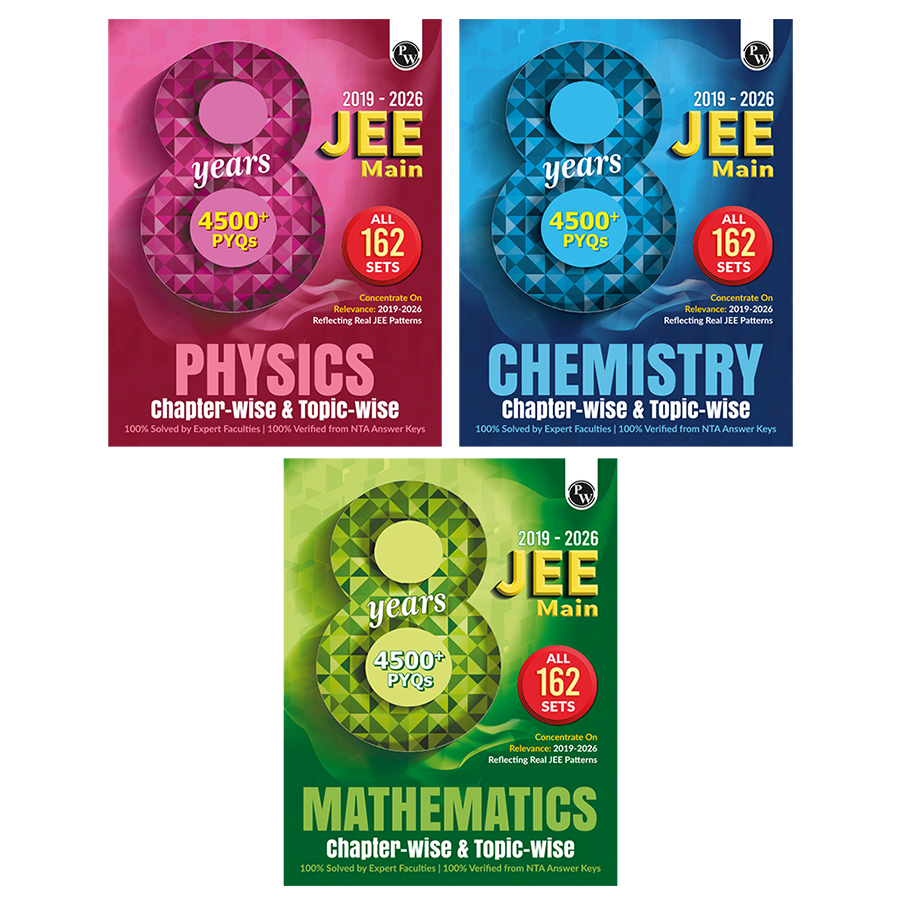
8 Years JEE Main PYQ Combo (2019–2026) |
|
Total Shift Papers |
162 Sets covering Physics, Chemistry, and Mathematics |
|
Question Volume |
13,500+ Questions with Error-Free Detailed Solutions |
|
Core Advantage |
Topic-wise segregation for pinpointing JEE Main important concepts |
JEE Main PYQs for Understanding Important Topics
Many students treat past papers as a tool meant only for the final month of revision. This approach limits their true value. Analysing JEE Main previous year questions right from the beginning of your preparation helps you map out the core blueprint of the examination. NTA repeats certain core concepts with subtle twists in numerical values or language formatting.
When you study JEE Main chapter wise PYQs, you stop guessing what is important. Instead, you rely on concrete data gathered from thousands of questions across multiple shifts. This clarity saves valuable hours and prevents you from getting bogged down in low-yield topics that rarely appear in the actual test.
PYQs can also show you the level of application expected from a chapter. A student may understand a formula while studying theory but struggle when the same formula is used in an unfamiliar situation. Previous year questions help identify this gap early. By reviewing your incorrect attempts, you can determine whether the problem comes from weak concepts, calculation mistakes, poor question interpretation, or time pressure.
Another advantage is that PYQs give you a feel of the language of the entrance exam questions. Some questions may appear hard due to the way they are phrased, even if the idea is well known. Regular exposure minimizes this uncertainty and helps you to quickly realize the genuine necessity of a query. This makes JEE books good for learning and revision rather than just last stage practice.
JEE Main PYQ Analysis for High Weightage Topics
Every section of the engineering entrance exam behaves differently. To build a solid strategy, you must look at each subject through a separate lens using a reliable JEE Main PYQ analysis.
Physics Strategy and Core Focus
Physics typically honors conceptual clarity in conjunction with mathematical application. As per the latest trends, Modern Physics, Current Electricity and Heat and Thermodynamics have very high weightage.
-
Focus heavily on 8-year archives to spot recurring formulas.
-
Practise both numerical value questions and standard MCQs.
-
Pay attention to graph-based questions, which appear frequently in modern shifts.
Chemistry As a Score Booster
Chemistry is widely considered the ultimate rank booster because it takes less time to solve compared to Mathematics.
-
Physical Chemistry: Concentrate on numerical sections involving Mole Concept, Chemical Kinetics, and Thermodynamics.
-
Organic Chemistry: Learn General Organic Chemistry (GOC) and name reactions thoroughly, as they form the foundation of multi-step problem solving.
-
Inorganic Chemistry: Treat NCERT as your ultimate textbook, using past archives to find lines from which examiners frame direct questions.
Mathematics Problem-Solving Patterns
You must have stamina and be able to calculate quickly and accurately to study mathematics. In chapters like Vectors and 3D Geometry, Matrices and Determinants, and Sequences and Series, we have a set of questions asked numerous times every shift. JEE Main important questions from these topics help you learn shortcut tactics and manage time under pressure.
How to Find Important Topics Using JEE Main PYQs
Isolating core topics requires a structured routine. Avoid randomly flipping through pages. Follow a systematic protocol to extract maximum utility from your study sessions:
-
Complete the Theory First: Finish your class notes and standard textbook readings before touching any archive book.
-
Solve Chapter-by-Chapter: Pick up a dedicated resource like the 8 Years JEE Main PYQ Combo to tackle questions immediately after wrapping up a chapter.
-
Maintain an Error Log: Note down every concept where you stumble. These logged mistakes highlight your exact weak spots.
-
Track Question Frequency: If a specific sub-topic appears in more than three shifts over an eight-year span, mark it down as a high-priority concept.
Check Out: JEE Revision Books
Common Mistakes to Avoid While Solving JEE Main PYQs
Even with the right books, students often make errors that sabotage their progress. Do not look at the solution manual immediately when a question looks tough. Spend at least ten minutes wrestling with the logic yourself.
Another common pitfall is ignoring shift papers from recent years. The exam pattern evolved significantly after the shift to online computer-based tests. Prioritising papers from 2019 to 2026 ensures your practice matches current difficulty standards and question framing styles. Timed practice sessions also keep exam-day panic at bay by building natural speed and stamina.
One more mistake is treating every incorrect answer in the same way. A calculation error needs a different correction from a concept-based mistake. After each practice session, classify your errors into categories such as conceptual gaps, calculation mistakes, incorrect assumptions, and time-management issues. This makes your revision more targeted.
Students should also avoid solving PYQs only when they feel confident. Difficult questions can provide useful information about which concepts require more attention. Instead of checking the solution immediately, try to identify the exact point where your approach stopped working. Then study that concept again and attempt a similar question without looking at the solution.
Finally, avoid measuring preparation only by the number of questions solved. Solving 100 questions without reviewing mistakes may be less useful than solving fewer questions carefully and understanding every error. The goal should be to improve accuracy, speed, and conceptual understanding with each practice session.
JEE Main PYQs FAQs
How many years of JEE Main PYQs should I solve?
Solving the last 8 to 10 years of JEE Main PYQs is ideal because it accounts for the latest changes in testing patterns, question styles, and NTA guidelines.
Are chapter-wise PYQ books better than full-length papers?
Chapter-wise books are more effective during the initial learning phase because they let you test specific JEE Main important concepts right after studying a chapter theory.
How do I find high-weightage topics using PYQs?
By reviewing JEE Main chapter wise PYQs, you can track how often a specific concept appears across different shifts, allowing you to build a data-driven priority list.
Can PYQs alone guarantee a good rank?
While they are critical for understanding JEE Main previous year questions, they must be paired with thorough textbook theory, conceptual clarity, and regular full-length mock tests.
How should I use detailed solutions given in PYQ books?
Do not just check the final answer. Read through the step-by-step logic in the solution to discover alternative short cuts and avoid repeating conceptual errors.