Why the Latest JEE Main PYQs Matter for 2027 Aspirants?
Engineering aspirants targetting the Joint Entrance Examination face a common dilemma during their preparation journey. Many students spend hundreds of hours studying theoretical concepts across Physics, Chemistry, and Mathematics, yet they struggle to score high marks during mock tests.
The primary issue is a lack of alignment with actual test standards and time constraints. To solve this problem effectively, serious candidates rely on authentic JEE Main PYQs. Practising past question sets bridges the gap between learning theory and mastering exam execution.
Overview of JEE Main PYQs
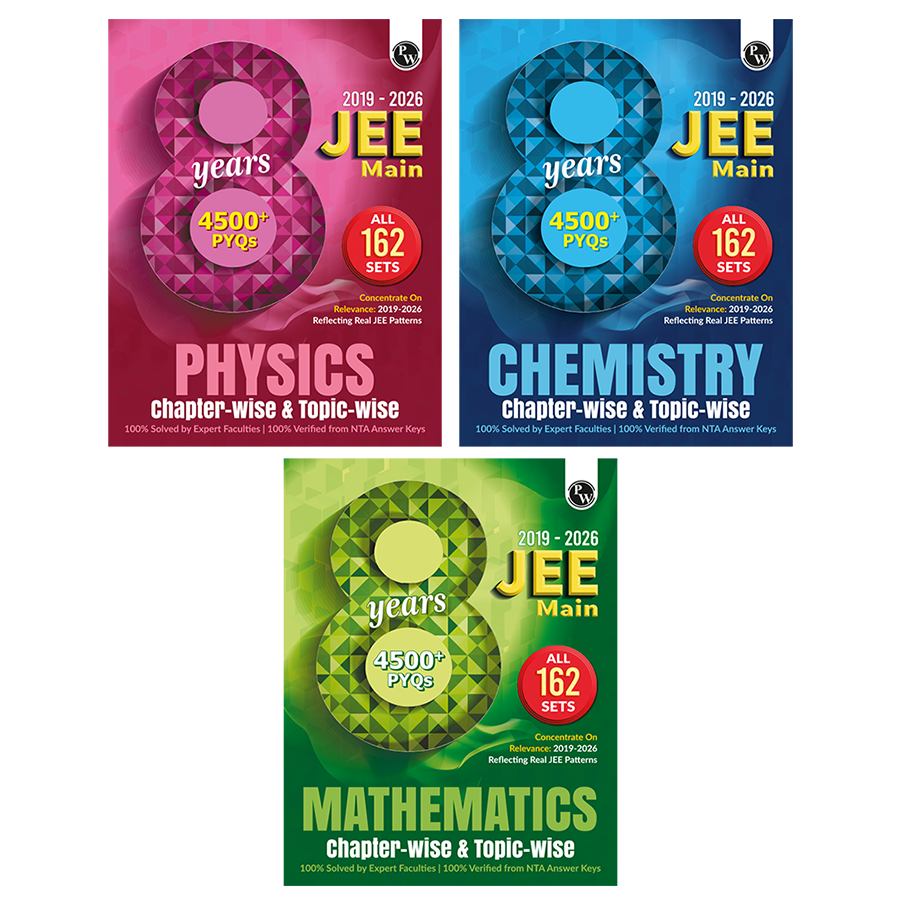
JEE Main Previous Year Questions (PYQs) are one of the most reliable resources for engineering entrance exam preparation. They help students understand the actual exam pattern, difficulty level, and the type of questions asked by the National Testing Agency (NTA). Instead of relying only on theory, practising authentic JEE Main PYQs enables aspirants to apply concepts under real exam conditions while improving speed and accuracy.
Features of JEE Main PYQs Book
Practising previous year questions is one of the most effective ways to prepare for JEE Main. This book provides comprehensive coverage of recent exam questions, detailed solutions, and topicwise practice to help you strengthen concepts, understand exam trends, and improve your performance.
-
Latest JEE Main PYQ Practice: Solve recent JEE Main Previous Year Questions (PYQs) to stay updated with the latest exam pattern and question trends.
-
Focus on Relevant Questions (2019–2026): Practice only the most recent and exam-relevant JEE Main questions while avoiding outdated question patterns.
-
JEE Main-Level Question Standard: Experience questions that closely match the actual difficulty level, style, and format of the JEE Main examination.
-
All 162 Shift-Wise Papers Included: Get access to all 162 JEE Main shift-wise question paper sets for complete and realistic exam preparation.
-
Smart Weightage Analysis: Identify high-weightage chapters and frequently tested topics through multi-year trend analysis to plan your preparation effectively.
-
Topicwise Practice: Master every chapter with well-organised topicwise and chapterwise JEE Previous Year Questions for focused learning and revision.
-
13,500+ Questions with Detailed Solutions: Practice over 13,500 questions supported by accurate, step-by-step solutions that improve conceptual understanding and problem-solving skills.
-
Improve Critical Thinking: Analyse question trends across multiple years to strengthen logical thinking, concept application, and exam-solving strategies.
-
Comprehensive Question Coverage: Prepare for every major JEE Main question format, including Multiple Choice Questions (MCQs) and Numerical Value Questions (NVQs), for complete exam readiness.
Why Are the Latest JEE Main PYQs Important for 2027 Aspirants?
The National Testing Agency (NTA) has modified the structure and difficulty level of the entrance exam over recent years. Questions asked five or ten years ago do not always reflect the current balance between conceptual depth, numerical speed, and multi-concept problem solving. Aspirants targetting the 2027 examination must focus on recent question trends to keep their study efforts relevant and efficient.
Tracking NTA Question Pattern Shifts
Exam trends evolve continuously. In Physics, recent test sessions have emphasised practical application and formula-based numerical questions. Chemistry has seen a higher proportion of statement-based and assertion-reasoning items alongside direct NCERT line items in Organic and Inorganic sections.
Mathematics has consistently tested deep problem-solving endurance with lengthy algebra and calculus problems. Practising the most recent question sets gives students clarity on these specific nuances:
-
Real Question Standards: Working with papers from 2019 through 2026 helps candidates experience the exact difficulty level set by the NTA.
-
Shift Variation Exposure: Multiple exam shifts per year mean hundreds of unique question variations exist for every topic.
-
New Question Types: Practising recent papers prepares students for multiple-choice questions (MCQs) and numerical value entry formats.
Building Real Exam Temperament
Theoretical understanding alone cannot prevent exam anxiety or poor time management. Solving authentic papers under timed conditions builds mental stamina and emotional control. Students learn how to remain calm when encountering unfamiliar problem formats, enabling them to make rational decisions during the actual test.
How Do JEE Main PYQs Help Improve Your Score?
Scoring well in engineering entrance tests requires a mix of accuracy, speed, and strategic question selection. Working regularly with a JEE Main and Advanced PYQ resource directly addresses these core performance indicators.
|
Performance Factor |
Without Past Paper Practice |
With Systematic PYQ Practice |
|
Question Selection |
Attempts questions randomly, risking time traps. |
Quickly identifies easy and moderate questions to attempt first. |
|
Solving Speed |
Spends excessive time calculating basic steps. |
Uses streamlined calculation techniques developed through practice. |
|
Error Rate |
Frequently makes silly mistakes in numerical inputs. |
Minimises calculation slips through repeated error analysis. |
|
Conceptual Retention |
Forgets formulas and reaction mechanisms quickly. |
Reinforces theoretical knowledge through active problem-solving. |
High-Weightage Physics, Chemistry, and Maths Chapters
Not all chapters in the syllabus carry equal weight in the final examination. By analysing question frequency over recent years, students can map out high-yield topics and allocate their study hours strategically.
-
Physics: Topics like Modern Physics, Current Electricity, Electrostatics, and Mechanics appear consistently across almost every shift paper.
-
Chemistry: Coordination Compounds, Chemical Bonding, General Organic Chemistry, and Thermodynamics regularly account for significant mark allocations.
-
Mathematics: Vectors and 3D Geometry, Definite Integrals, Matrices and Determinants, and Sequence and Series remain consistent high-scoring areas.
Speed and Question Selection
The entrance exam evaluates how efficiently candidates can select and solve correct questions within a 180-minute window. Working on latest JEE main questions allows students to categorize problems quickly into three distinct operational groups:
-
Category A (Immediate Attempt): Direct formula-based questions or simple memory recall items that take under 60 seconds.
-
Category B (Calculated Attempt): Conceptually clear problems requiring moderate multi-step calculations taking 2 to 3 minutes.
-
Category C (Skip or Leave for End): Lengthy, highly complex, or unfamiliar problem types that carry a high risk of negative marking.
How to Choose the Right JEE Main PYQs Book?
Selecting the right JEE books plays a critical role in structuring daily practice. A comprehensive compilation should provide complete paper coverage, accurate step-by-step solutions, and structured categorization rather than random collections.
-
Coverage Period: Focuses on recent years (2019 onwards) where the multi-shift computer-based test format was fully established.
-
Organisation: Offers both chapterwise and topicwise arrangements for systematic revision.
-
Solution Quality: Provides error-free, detailed explanations that teach alternate solving methods.
-
Weightage Insights: Features clear trend analysis charts showing topic importance over time.
Study Plan for the JEE Main PYQs
To get the highest return on time invested, candidates need a systematic practice strategy rather than solving questions passively.
1.Solve Topicwise Questions After Class Lectures: Focus on immediate concept reinforcement. After completing a sub-topic in class, solve 15 to 20 past questions related specifically to that topic. This highlights common application traps and verifies whether you understood the theoretical concept correctly.
2.Maintain an Error Tracker: Document every mistake systematically. Keep a dedicated notebook to record every question you solved incorrectly or skipped. Note whether the error was due to a calculation mistake, formula slip, or conceptual gap. Reviewing this log regularly prevents repeating mistakes on test day.
3.Conduct Timed Revision Sessions: Build speed and time discipline. During JEE main revision phases, do not solve questions leisurely. Set a timer for 60 minutes and aim to complete 25 to 30 mixed past questions without checking solutions mid-way. This trains your brain to handle time pressure.
4.Attempt Full Shift Papers in Simulated Environment: Final phase examination testing.
In the final months before the target session, attempt complete 3-hour shift papers from recent years. Sit in a quiet room, avoid external aids, and strictly adhere to the official timing to build physical and mental endurance.
Common Mistakes to Avoid While Solving JEE Main PYQs
Practising past papers is valuable only when executed correctly. Many aspirants waste hundreds of high-quality questions due to poor study habits. Avoiding these common traps ensures maximum score improvement:
-
Looking at Solutions Too Quickly: Attempting a question for only 30 seconds before reading the solution hinders critical thinking development. Always give every problem at least 3 to 5 minutes of honest effort before referring to the step-by-step answer.
-
Ignoring Numerical Value Questions: Many students focus solely on multiple-choice options and skip integer or numerical entry problems. Because numerical items carry no options to guide guessing, practicing them regularly is essential for accuracy.
-
Re-solving Only Easy Questions: Aspirants naturally feel good when solving questions from their strong topics while avoiding weaker chapters. True mark growth happens when you deliberately target difficult or skipped questions from previous practice rounds.
-
Neglecting Detailed Analysis: Merely scoring a practice paper without analyzing wrong attempts defeats the purpose of practice. Spend at least one hour reviewing every completed test paper to understand where and why mistakes occurred.
Read More: JEE Main Chapterwise PYQs
JEE Main PYQs Book FAQs
1. How many years of JEE Main PYQs are sufficient for 2027 preparation?
Practising papers from the last 8 years (2019 to 2026) is ideal because this period covers the entire computer-based test era conducted by the NTA, encompassing over 160 shift papers and 13,000+ distinct questions.
2. Should I start solving a JEE main PYQ during Class 11 or wait until Class 12?
You should start solving chapterwise past questions right from Class 11 as soon as you complete each chapter. Early exposure builds strong problem-solving skills and familiarises you with actual exam standards from the beginning.
3. Are the latest JEE main questions repeated in upcoming exams?
Exact questions are rarely repeated word-for-word. However, core concepts, mathematical structures, and question patterns are repeated frequently across different test shifts.
4. Is a chapterwise JEE PYQ book better than downloading online PDFs?
A structured book set provides organized topicwise practice, expert-verified step-by-step solutions, and trend analysis without the digital distractions, printing hassle, or unstructured file management of random PDFs.
5. How should I use JEE main previous year papers during revision?
During revision phases, solve past papers in timed 3-hour blocks to simulate test conditions. Follow every paper with thorough error tracking to fix conceptual gaps before the actual test.