JEE Main Ray Optics PYQ Preparation with PW Book
Ray Optics is one of the most high-scoring chapters in the syllabus, yet students frequently lose marks due to silly sign errors or incorrect lens-formula applications. Solving authentic JEE main ray optics PYQ sets helps bridge the gap between theoretical knowledge and real exam performance.
By practicing JEE previous year papers, you get a clear view of official difficulty levels, shift trends, and high-frequency formula applications. This guide breaks down the best strategies, key concepts, step-by-step methodologies, and structured practice plans to help you clear Ray Optics questions with high precision.
What Are JEE Main Ray Optics PYQ?
JEE main ray optics PYQ refers to actual questions asked in past Joint Entrance Examination Main shifts covering reflection, refraction, lenses, prisms, and optical instruments. These past papers serve as direct indicators of how the National Testing Agency (NTA) frames numerical and conceptual physics problems.
-
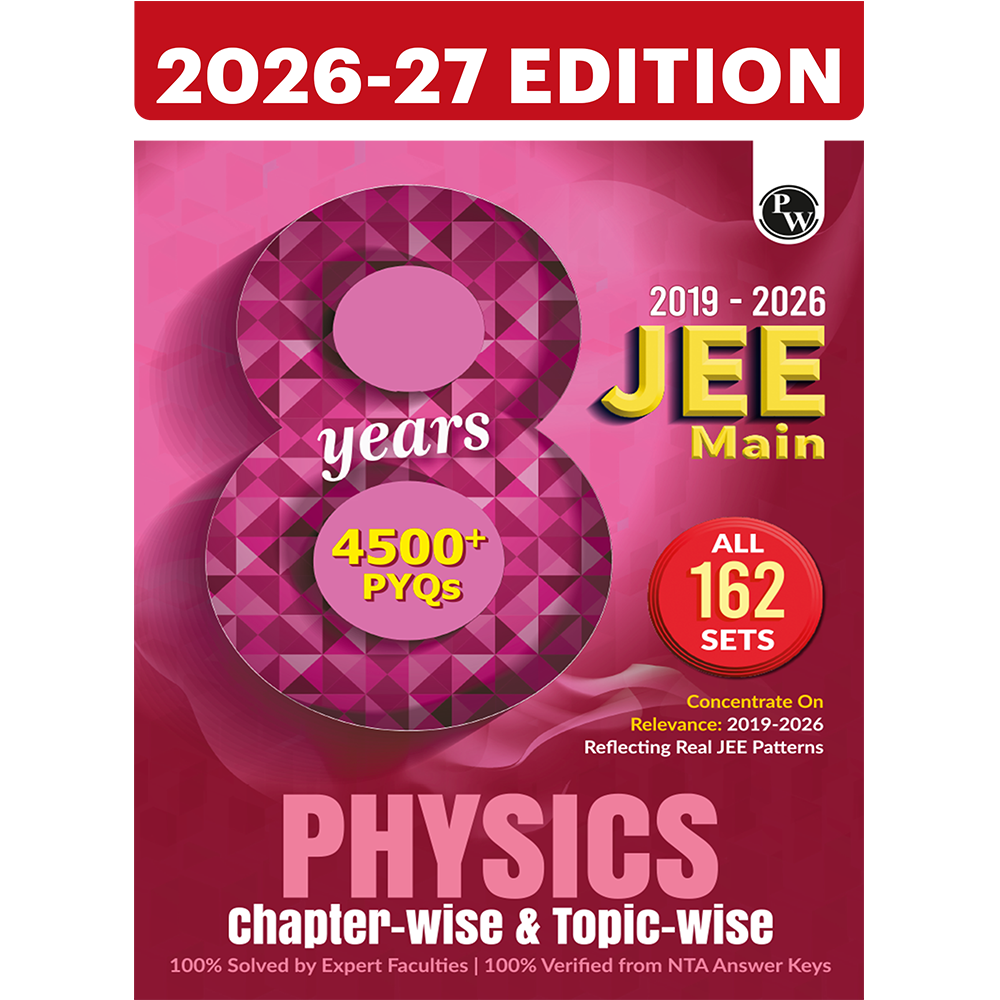
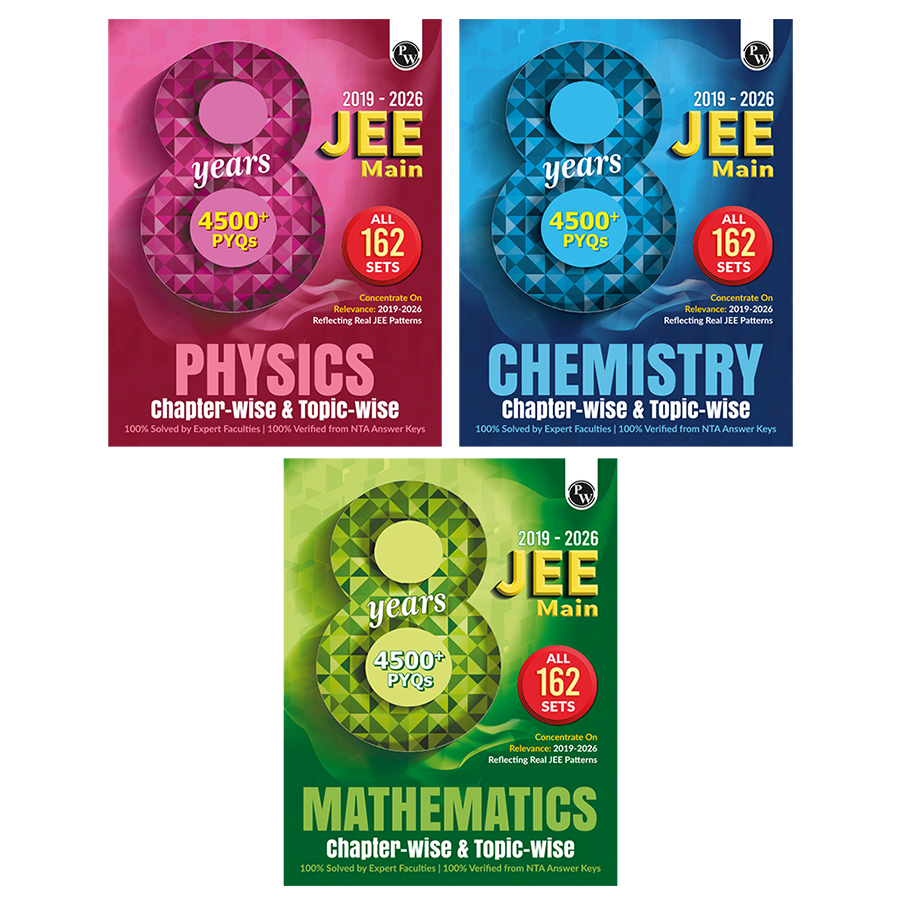
Exact Exam Patterns: They cover real shift papers spanning 2019 to 2026 across 162 shift sets.
-
Vast Question Bank: Working through past shifts gives access to over 4500+ physics questions across topics.
-
Trend Analysis: Practicing these reveals how weightage shifts between simple mirror questions and complex optical systems.
-
Topic-Wise Categorisation: Questions arranged by topic allow you to isolate Ray Optics from broader Optics units for targeted revision.
Concepts to Revise with JEE Main Ray Optics PYQ
Before attempting JEE Main Ray Optics PYQ practice, ensure your basic theoretical concepts and numerical formulas are thoroughly revised. Using JEE Books for concept revision and practice can help strengthen fundamentals before solving PYQs, reducing guesswork and avoidable mistakes.
-
Reflection at Plane and Spherical Surfaces: Real vs virtual image formation, focal length relations ($f = R / 2$), and mirror formula applications.
-
Refraction and Snell's Law: Relative refractive index, critical angle, and total internal reflection (TIR) conditions in prisms and optical fibres.
-
Refraction at Curved Surfaces and Lenses: Lens Maker’s formula, combination of thin lenses in contact, and displacement method.
-
Prism Theory: Angle of deviation, minimum deviation condition, refractive index of prism material, and dispersion without deviation.
-
Optical Instruments: Astronomical telescope, simple microscope, compound microscope, magnifying power, and tube length calculations.
How to Use Books for JEE Main Ray Optics PYQ Preparation
Using a comprehensive JEE Main previous year question book requires a planned approach rather than randomly solving questions. A structured book containing 162 sets of papers from 2019 to 2026 provides a deep question pool for systematic study.
-
Focus on Topic-Wise Sets: Start with the dedicated Ray Optics section to build continuity before moving to mixed test series.
-
Utilise Error-Free Solutions: Compare your approach with detailed solutions provided for all 4500+ questions to check for shorter methods.
-
Analyze Weightage Trends: Use weightage analysis tables to prioritize frequently tested sub-topics like lens combinations and TIR.
-
Avoid Solution Peeking: Always give every numerical a minimum of 3 to 5 minutes of honest effort before referring to solution keys.
Study Strategy for JEE Main Ray Optics PYQ
To build speed and accuracy, organize your revision using a systematic multi-day timeline.
|
Phase |
Focus Area |
Action Items |
Primary Goal |
|
Days 1–2 |
Basic Reflection & Refraction |
Solve basic mirror and Snell's law ray optics PYQ items. |
Master Cartesian sign conventions. |
|
Days 3–4 |
Lenses, Prisms & TIR |
Attempt ray optics JEE main questions on lens combinations and prism deviation. |
Understand composite optical systems. |
|
Days 5–6 |
Optical Instruments |
Practice magnification formulas for microscopes and telescopes. |
Eliminate formula confusion in instruments. |
|
Day 7 |
Review & Speed Test |
Solve 20 mixed ray optics JEE preparation questions under strict timing. |
Target 100% accuracy within 45 minutes. |
Tips to Solve Numerical Questions with a JEE Main Ray Optics PYQ
Solving JEE Main Physics PYQs in Ray Optics requires disciplined execution. A single misinterpretation of a sign can ruin an entire numerical.
-
Strict Cartesian Sign Convention: Always set the origin at the pole or optical centre. Light travels left to right by convention; distances measured along the incident light are positive, while those against are negative.
-
Draw Neat Schematics: Always draw a quick, rough ray diagram. Visualising light paths prevents wrong object/image distance assignments
-
Watch Out for Medium Changes: When dealing with apparent depth or lens immersion in liquids, re-calculate effective focal lengths using relative refractive indices
-
Maintain Unit Consistency: Check whether values are given in millimetres, centimetres, or metres before substituting them into equations.
Common Mistakes to Avoid When Solving JEE Main Ray Optics PYQ
Even well-prepared aspirants make routine errors during pressure situations. Recognizing these traps early saves valuable marks in the actual exam.
-
Mixing Up Lens and Mirror Formulas: Confusing 1/f=1/v−1/u1/f = 1/v - 1/u (lens) with 1/f=1/v+1/u1/f = 1/v + 1/u (mirror).
-
Ignoring Refractive Index Context: Forgetting that lens power changes when immersed in a liquid medium.
-
Misinterpreting Magnification Signs: Forgetting that real images have negative magnification, while virtual images have positive magnification.
-
Overlooking Tube Length Conditions: Confusing normal adjustment (ve=∞v_e = \infty) with the least distance of distinct vision (ve=Dv_e = D) in telescope and microscope calculations.
Read More: JEE Syllabus 2026 And Exam Pattern
JEE Main Ray Optics PYQ FAQs
Q1. How many questions appear from Ray Optics in JEE Main?
Ray Optics typically carries 1 to 2 questions per shift paper, making it one of the weightiest chapters in Class 12 Physics.
Q2. Are past year questions sufficient for scoring well in Ray Optics?
Yes, solving all past shift questions from 2019 to 2026 provides complete exposure to NTA's question trends, formula applications, and difficulty patterns.
Q3. Why are sign conventions so crucial in Ray Optics numericals?
Incorrect sign assignments reverse image positions and magnification values, leading to incorrect option selection despite proper formula choice.
Q4. What is the most important sub-topic under Ray Optics?
Refraction at spherical surfaces, thin lens combinations, total internal reflection, and optical instruments are the most frequently asked sub-topics.
Q5. How should I revise Ray Optics during the last month before exams?
Focus on formula sheets, sign convention rules, and re-attempting previously tagged difficult JEE Main ray optics PYQs.