Probability PYQs for JEE Main Revision with PW Book
Mastering probability JEE Main PYQ is essential for students targeting top ranks in the Joint Entrance Examination. Many aspirants struggle with complex conditional probability, Bayes' theorem, and permutation-combination applications under exam pressure. Using a structured collection of previous year questions helps identify key patterns and recurring concepts.
This article outlines how to solve probability JEE Main PYQ effectively using the dedicated PYQ books, ensuring maximum retention and problem-solving speed during your revision phase.
Importance of Probability JEE Main PYQ
Solving probability JEE Main PYQ gives aspirants direct insight into the exact difficulty level, question formats, and topic weightage expected in the exam. Probability is a high-scoring section in mathematics, but it requires clear conceptual understanding and speed.
-
Understand Question Patterns: Standard pattern recognition makes it easier to spot tricky constraints in JEE main probability questions.
-
Master Time Management: Solving timed maths PYQs JEE builds the pace required to handle lengthier paper sections.
-
Identify High-Yield Topics: Questions frequently reoccur around conditional probability, independent events, and binomial distribution.
-
Reduce Exam Anxiety: Familiarity with actual exam questions boosts overall confidence on test day.
Key Features of Probability JEE Main PYQ Book
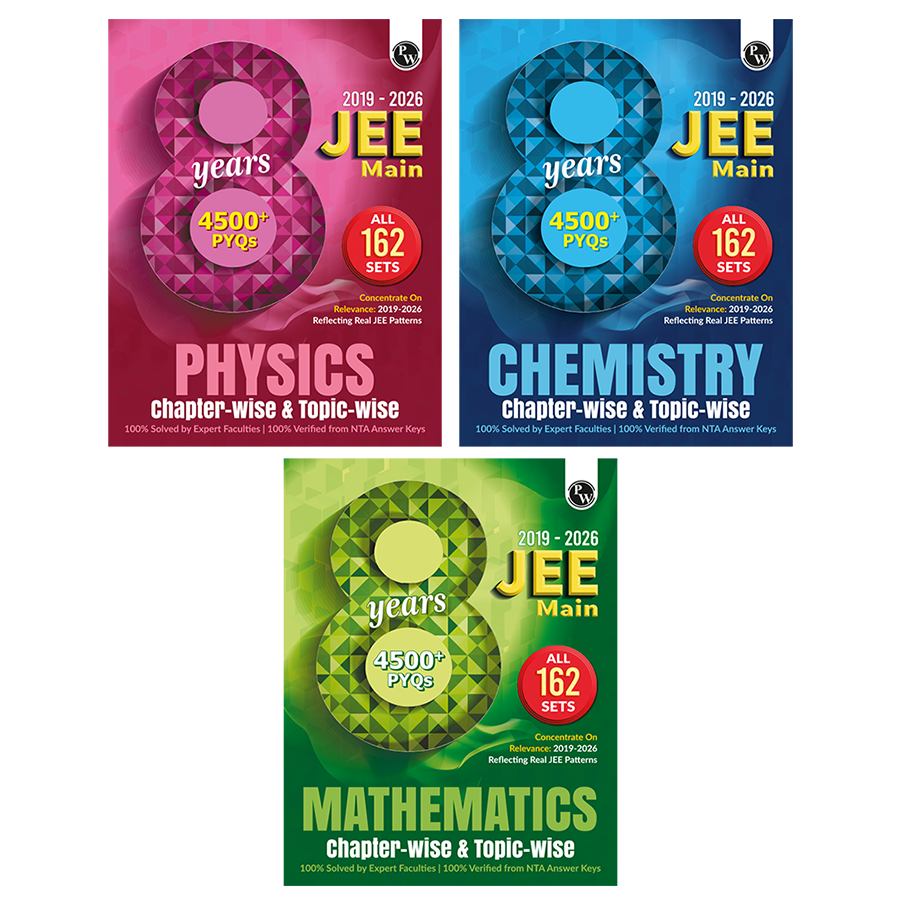
A strong preparation strategy begins with practising the right questions. This book brings together recent JEE Main Previous Year Questions, organised practice, and detailed explanations to help you master concepts, understand exam trends, and maximise your score.
-
Latest JEE Main Questions (2019–2026): Practice the most recent Previous Year Questions to stay updated with the latest JEE Main exam pattern and syllabus.
-
13,500+ Fully Solved Questions: Learn through an extensive collection of authentic JEE Main questions, each accompanied by accurate and easy-to-follow solutions.
-
Complete Collection of 162 Shift Papers: Prepare with every official shift-wise JEE Main paper, giving you a realistic understanding of the examination.
-
Chapterwise & Topicwise Coverage: Find questions arranged by chapters and topics, making focused practice, revision, and concept-building more efficient.
-
Real Exam Experience: Solve questions that closely reflect the actual difficulty level, structure, and style of the JEE Main examination.
-
Question Trend & Weightage Insights: Analyse frequently tested concepts and chapter-wise weightage to identify the topics that deserve maximum attention.
-
Concept-Focused Solutions: Understand the logic behind every answer with detailed explanations that improve accuracy and strengthen fundamentals.
-
Covers Every Major Question Type: Practice Multiple Choice Questions (MCQs) and Numerical Value Questions (NVQs) to become familiar with all JEE Main formats.
-
Strengthens Problem-Solving Skills: Improve analytical thinking, speed, and confidence by solving questions from multiple years and recognising recurring patterns.
Which Topics Are Covered in Probability JEE Main PYQ?
A targeted probability revision requires a clear breakdown of high-weightage topics. The table below highlights core concepts alongside typical question patterns found in JEE main probability questions.
|
Topic |
Key Concepts |
Examples |
|
Conditional Probability |
P(A | B) calculations, sample space reduction |
Card drawing, dice rolls with dependent outcomes |
|
Bayes' Theorem |
Reverse probability, partition of sample space |
Bag selection, factory defect rates, medical testing |
|
Independent Events |
P(A ∩ B) = P(A) × P(B), independent events |
Coin tosses, target-hitting probabilities |
|
Binomial Distribution |
Bernoulli trials, n, p, q = 1 − p |
At least/at most k successes in n trials |
|
Random Variables |
Probability distributions, E(X), Var(X) |
Rolling multiple dice, sum of drawn numbers |
Working through probability JEE PYQs systematically ensures all these critical sub-topics are thoroughly revised.
What Types of Probability JEE Main PYQ Questions Should You Practice?
To excel in JEE maths preparation, you must familiarize yourself with the standard types of questions that appear year after year.
Type 1: Conditional Probability Problems
-
These questions usually involve selecting items from multiple containers or sequential draws without replacement.
-
Focus on defining events correctly before applying P(A | B) = P(A ∩ B) / P(B).
-
Watch out for subtle wording changes like "given that" or "if it is known that."
Type 2: Bayes' Theorem Applications
-
Bayes' theorem problems test your ability to work backward from a known outcome to identify its origin.
-
Always list the total exhaustive events (E₁, E₂, …, Eₙ) first.
-
Calculate the individual prior probabilities P(Eᵢ) and conditional probabilities P(A | Eᵢ) clearly.
Type 3: Binomial Distribution and Bernoulli Trials
-
These questions involve repeating independent trials with two possible outcomes: success or failure.
-
Use the formula P(X = k) = C(n, k) · pᵏ · qⁿ⁻ᵏ.
-
Remember that q = 1 − p, and the total sum of probabilities equals 1.
How to Revise Probability JEE Main PYQ Effectively?
Organised practice JEE books is far more effective than randomly solving questions. Following a structured roadmap ensures complete coverage of probability JEE Main PYQ without missing vital concepts.
Step 1: Review Core Formulas
Before jumping into probability PYQs, quickly review key definitions, set properties, and standard theorems.
Step 2: Topic-Wise Topic Categorisation
Divide your practice sessions by sub-topics—such as Bayes' theorem or random variables—rather than attempting mixed sets immediately.
Step 3: Timed Practice Sessions
Set a target of 1.5 to 2 minutes per question when practicing JEE maths preparation questions to simulate real exam conditions.
Step 4: Analyze Mistakes
Carefully review wrong answers to determine if the error was conceptual, calculation-based, or due to misunderstanding the question text.
Mistakes to Avoid While Solving Probability JEE Main PYQ
Even well-prepared candidates lose marks due to avoidable errors while solving probability JEE Main PYQ.
-
Confusing Mutually Exclusive and Independent Events: Mutually exclusive means A ∩ B = ∅, whereas independent means P(A ∩ B) = P(A) × P(B).
-
Misinterpreting Sample Space: Failing to count ordered vs. unordered pairs accurately leads to incorrect denominators.
-
Overlooking "At Least" / "At Most" Conditions: For "at least one" problems, calculating 1 − P(none) is usually much faster than summing multiple positive outcomes.
-
Skipping Step-by-Step Checks: Rushing through basic arithmetic during lengthy Bayes' theorem calculations often leads to avoidable negative marking.
Read More: JEE Syllabus 2026 And Exam Pattern
JEE PYQ FAQs
How many questions from probability appear in JEE Main?
Typically, 1 to 2 questions from probability appear in every JEE Main shift, making it an essential topic for score maximization.
Are 8 years of probability JEE Main PYQ enough for revision?
Yes, solving 8 years of past questions using a dedicated pw JEE PYQ book covers all fundamental patterns, difficulty variations, and question types required for the exam.
What is the most important topic in probability PYQs?
Bayes' Theorem, Conditional Probability, and Binomial Distribution are the most frequently asked topics in JEE main probability questions.
How does the PW JEE PYQ book help in probability revision?
The PW book offers chapter-wise, topic-segregated previous year questions with step-by-step solutions, helping students spot trends and improve problem-solving speed.
Should I practice probability PYQs before or after completing the chapter?
You should first complete the theoretical concepts and basic textbook problems, then solve probability JEE Main PYQ to test your application skills and speed.