JEE Main Semiconductor PYQ Preparation with PW Book
You might know theoretical definitions, yet facing actual examination papers brings instant hesitation. Physics problem-solving often hits a roadblock when transition concepts blur together under timed pressure.
Securing high marks requires systematic practice rather than simple memorisation. Semiconductor devices form one of the most reliable, high-yield scoring areas in the physics syllabus, making targeted practice crucial.
Tackling every JEE main semiconductor PYQ allows you to transform abstract formula knowledge into quick, accurate marks on exam day.
What is JEE Main Semiconductor PYQ
Understanding past examination papers provides direct insight into how examiners test your understanding of solid-state electronics. A JEE main semiconductor PYQ represents an authentic question asked in previous official shifts. Solving these items helps you identify repetitive question formats and understand exact testing standards.
-
Trend Alignment: JEE previous year papers showcase how the difficulty level shifted over recent exam cycles.
-
Pattern Recognition: Regular exposure helps you spot standard circuits in logic gates and diode networks instantly.
-
Time Allocation: Practicing real questions builds speed, allowing you to complete this scoring section without wasting precious minutes.
Using authentic JEE main semiconductor PYQs ensures that you do not waste time on outdated or overly complex theoretical problems outside the current syllabus scope.
Concepts to Revise Before JEE Main Semiconductor PYQ Practice
Before diving straight into solving JEE semiconductor questions, a quick revision of fundamental concepts prevents silly errors. Ensure your short notes cover these key areas thoroughly:
-
Intrinsic and Extrinsic Semiconductors: Charge carrier concentrations, Fermi level position, energy band gaps, and the effect of temperature on conductivity.
-
p-n Junction Fundamentals: Formation of the depletion layer, built-in potential barrier, and working mechanisms under forward and reverse bias.
-
Special Purpose Diodes: Zener diode operational characteristics, breakdown voltage mechanics, and voltage regulation principles.
-
Transistors: Basic working principles of NPN and PNP configurations, current gains, and standard input/output characteristics.
-
Logic Gates: Boolean algebra fundamentals, truth tables, and universal gate combinations using NAND and NOR gates.
Mastering these core principles ensures smooth progress when tackling challenging semiconductor PYQ sets.
How to Use a Book for JEE Main Semiconductor PYQ Preparation
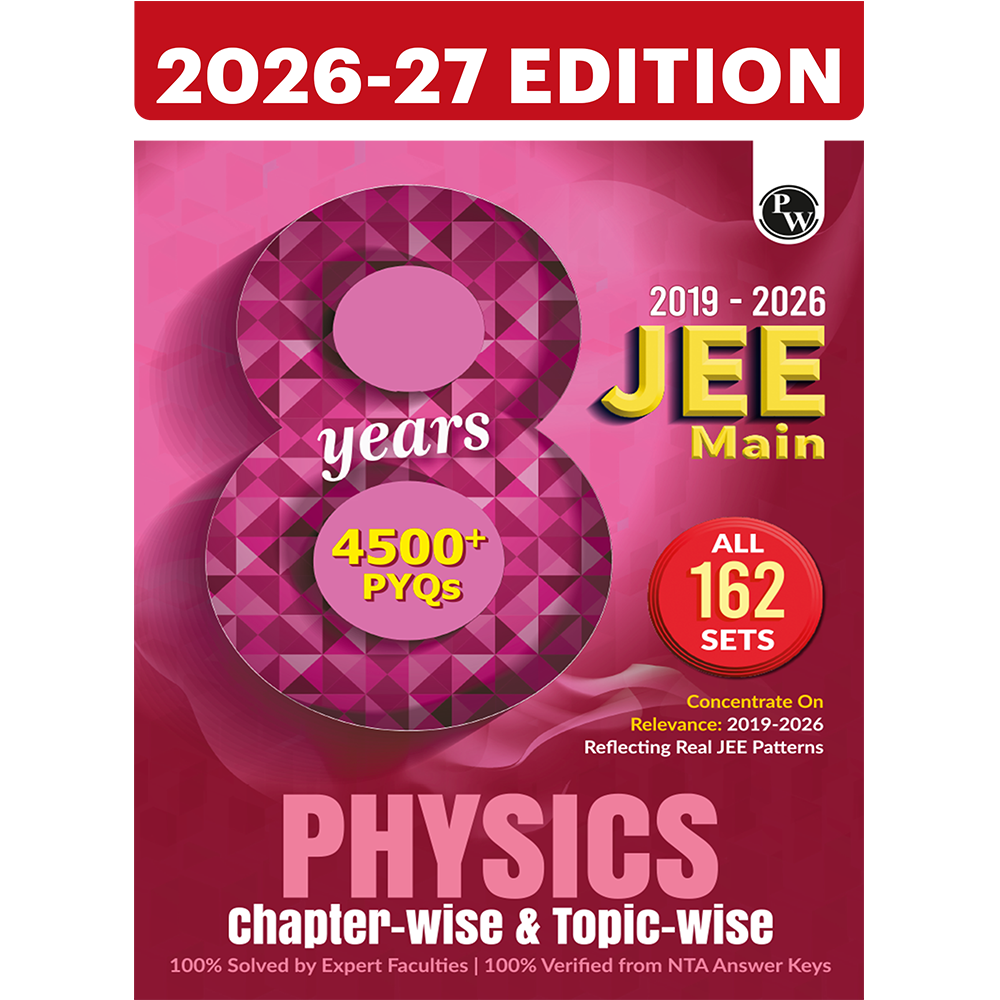
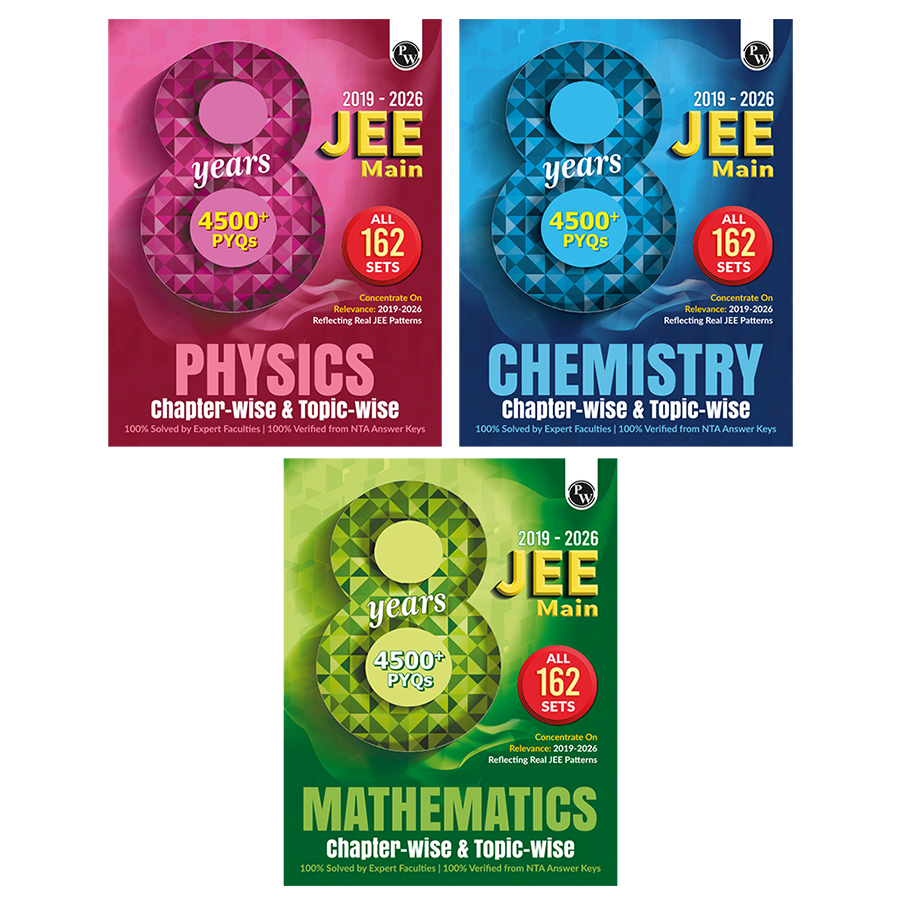
A structured JEE Main books containing 8 years (2019–2026) of questions across 162 shift sets offers the ideal structure for systematic practice. Organised chapterwise and topic-wise material with over 4500+ questions allows you to target weak areas effectively.
|
Book Feature |
Implementation Method |
Learning Benefit |
|
Topic-wise Organization |
Solve questions grouped under specific sub-topics immediately after studying the theory. |
Eliminates confusion and builds step-by-step conceptual clarity. |
|
Weightage Analysis |
Prioritise sub-topics carrying higher mark distributions across all 162 sets. |
Focuses effort on high-yield exam areas. |
|
Error-Free Solutions |
Review detailed step-by-step answer keys whenever you hit a dead end. |
Corrects calculation flaws and analytical mistakes immediately. |
Working with curated collections ensures complete alignment with current testing standards.
Study Strategy for JEE Main Semiconductor PYQ Practice
A disciplined timeline keeps your semiconductor JEE preparation on track during critical revision phases.
-
Phase 1 (Days 1–2): Revise fundamental energy band theory, charge carrier formulas, and p-n junction dynamics.
-
Phase 2 (Days 3–4): Solve topic-wise semiconductor JEE main questions focusing specifically on diodes and Zener breakdown circuits.
-
Phase 3 (Days 5–6): Practice logic gate combination problems and boolean algebra reduction techniques.
-
Phase 4 (Day 7): Attempt timed tests using full shift sets from broader JEE main physics PYQs collections to build speed and confidence under real test conditions.
Tips to Solve Circuit Based Questions in JEE Main Semiconductor PYQ
Circuit-based numericals can look tricky at first glance. Using JEE Books alongside these structured techniques can help students strengthen their concepts, practise circuit-based problems, and solve them accurately without getting stuck.
-
Identify Ideal vs Non-Ideal Diodes: Always check if the question treats a diode as ideal (zero forward resistance) or non-ideal (incorporating a knee voltage threshold).
-
Determine Bias State: Redraw the circuit replacing forward-biased ideal diodes with simple closed switches (short circuits) and reverse-biased diodes with open switches (open circuits).
-
Apply Kirchhoff's Laws: Use Kirchhoff's Voltage Law (KVL) around loops containing Zener regulators to find current values across load resistors easily.
-
Use Truth Tables for Gates: For complex logic networks, trace high (1) and low (0) signals step-by-step through each intermediate gate rather than writing long Boolean expressions.
Practice Sheet for JEE Main Semiconductor PYQ Preparation
Test your readiness with these standard problem types derived from past trend patterns:
-
Question 1: A p-n junction diode has a breakdown voltage of 10V. If connected in reverse bias with an input voltage varying between 15V and 25V across a series resistor of 1 kΩ, calculate the maximum current passing through the Zener diode when the load resistance is 2 kΩ.
-
Question 2: Identify the equivalent single logic gate represented by a circuit combining two NOR gates connected in series followed by an inverter gate.
-
Question 3: In a common-emitter amplifier, the current gain is 50. If the collector resistance is 5 kΩ and the input resistance is 1 kΩ, calculate the overall voltage gain of the circuit.
-
Question 4: Calculate the ratio of conductivity between an intrinsic semiconductor and an extrinsic n-type semiconductor at room temperature given specific electron and hole mobility values.
JEE Main Semiconductor PYQ FAQs
Why is practicing JEE main semiconductor PYQ essential for exams?
Solving real past questions builds familiarity with recurring shift patterns, improves numerical accuracy, and reveals exact topic weightage trends across multiple test sessions.
How many semiconductor PYQ items appear in each paper?
Usually, 1 to 2 direct questions appear in every shift paper, making this chapter a predictable and reliable source for securing quick marks.
Which topics yield the most marks in semiconductor JEE main questions?
Zener diodes as voltage regulators and logic gate truth tables are the most frequently asked, high-yield areas in past papers.
Are past paper collections sufficient for semiconductor JEE preparation?
Yes, practicing 8 years (2019–2026) of topic-wise past questions with detailed solutions provides comprehensive coverage of all difficulty levels and concept variations.
How do error-free solutions aid in JEE physics PYQs revision?
Detailed solutions prevent the accumulation of conceptual errors, clarify step-by-step mathematical methods, and help identify efficient problem-solving shortcuts.