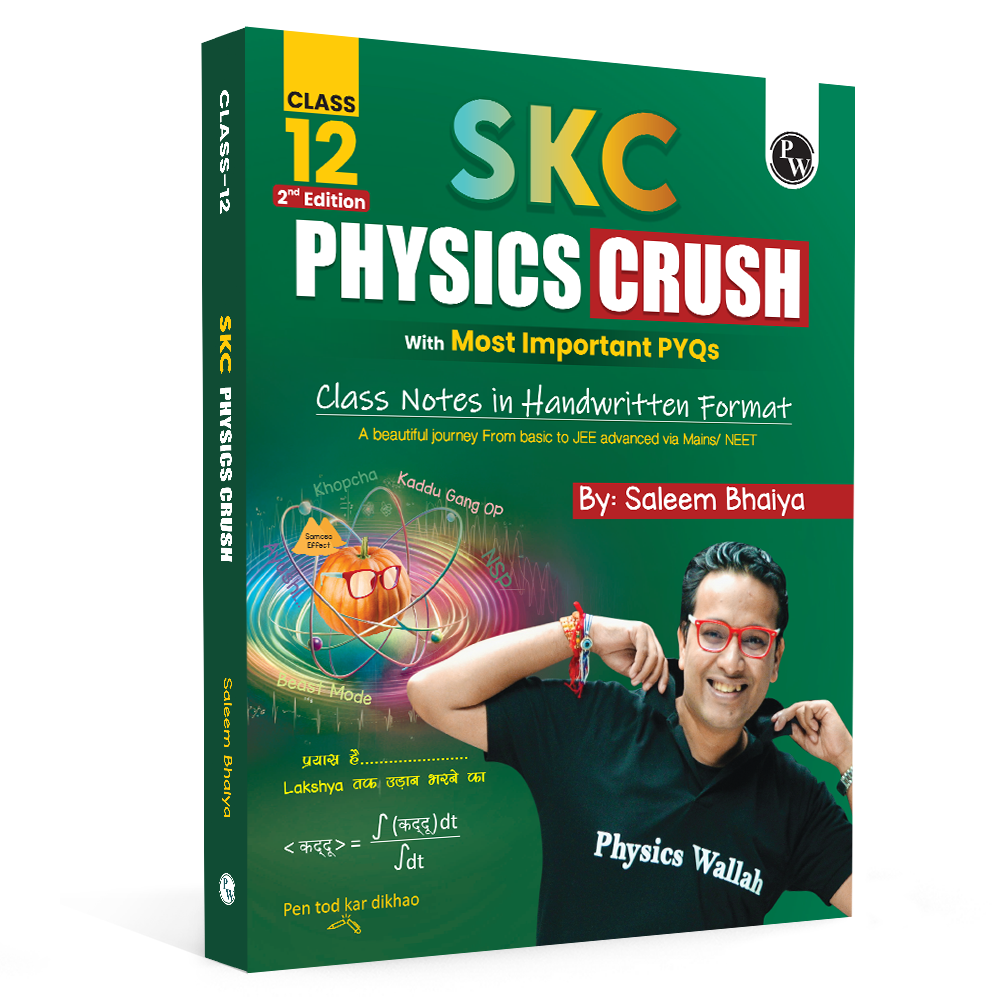
What are JEE Revision Books and How are They Different from Modules

As the mid-term season approaches, engineering aspirants face a significant mountain of syllabus to review. Managing thick textbooks alongside detailed coaching resources can feel overwhelming.
Many students struggle to decide which resource to open when time is running out before an exam. Choosing the wrong study tool during this critical mid-term phase leads to wasted hours and incomplete preparation.
Understanding how to use JEE revision notes alongside regular coursework is the secret to managing your time effectively.
What Are JEE Revision Notes?
An authentic set of JEE revision notes serves as a highly compiled, comprehensive resource designed to simplify your study sessions. Instead of presenting long paragraphs or historical contexts of a theory, these resources focus entirely on high-yield information.
They compile core formulas, definitions, and short tricks across Physics, Chemistry, and Mathematics into a single place.
These resources help you recall extensive theoretical concepts without requiring you to re-read hundreds of pages. They act as a quick-reference guide that you can browse through right before a mock test or a midterm examination. By removing the extra fluff, they allow you to focus entirely on the facts and mechanisms that directly translate to marks.
Importance of JEE Revision Notes
When you are in the middle of your academic term, you cannot afford to spend days re-reading old chapters. This is where specialized revision tools become necessary.
-
Saves Critical Study Time: You can scan an entire chapter in twenty minutes rather than spending three hours tracking down scattered definitions.
-
Enhances Active Recall: Looking at consolidated formulas forces your brain to remember the underlying derivation and application quickly.
-
Reduces Exam Anxiety: Having a single, thin booklet containing all key points provides a sense of control over a vast syllabus.
-
Improves Practice Efficiency: When solving practice papers, you can keep these summaries open next to you to verify formulas instantly without breaking your concentration.
What Do JEE Revision Notes Include?
A well-structured revision book contains specific elements that target quick memory retrieval and problem-solving.
-
Formula Sheets: Complete lists of mathematical equations and physical laws across all topics.
-
Core Definitions: Clear, concise explanations of fundamental principles and chemical laws.
-
Detailed Explanations for Complex Trends: Short, focused breakdowns of complex behaviors, such as periodic properties or organic mechanisms.
-
Important Topics and Practice Questions: Dedicated sections highlighting high-weightage topics accompanied by selected exam-style practice questions to test your application.
-
Tricks and Shortcuts: Special tips that help you eliminate wrong options quickly during multiple-choice questions.
Check Out: EaJEE Handwritten Notes For Organic, Inorganic, Physical Chemistry Combo Set of 3 Books
How Are JEE Revision Notes Different from Modules?
The fundamental difference lies in their purpose and depth. Standard study modules are designed for initial, deep learning. They introduce a topic from scratch, provide lengthy theoretical proofs, offer historical contexts, and contain hundreds of tiered practice problems categorized by difficulty levels.
Conversely, a JEE revision notes book assumes you have already studied the chapter once. It cuts out the introductory explanations and lengthy derivations to present only the final executable formulas and summaries.
Difference Between JEE Revision Notes and Modules
To help you choose the right tool for your current study phase, this table outlines the structural differences:
|
Feature |
Regular Study Modules |
JEE Revision Notes |
|
Primary Goal |
Building deep conceptual foundations from scratch. |
Rapidly recalling facts and formulas before exams. |
|
Content Depth |
Includes exhaustive explanations, proofs, and histories. |
Contains concise summaries, key points, and exceptions. |
|
Question Count |
Hundreds of problems divided into multiple exercises. |
Selected practice questions focused on recent trends. |
|
Reading Time |
Requires several hours or days to complete a chapter. |
Requires fifteen to thirty minutes per chapter. |
|
Portability |
Heavy, multi-volume books that stay on the desk. |
Thin, lightweight, and easy to carry for quick reading. |
Who Should Use JEE Revision Notes?
Not every resource fits every stage of preparation. Understanding your current standing helps you use these tools correctly.
-
Mid-Term Aspirants: Students who are currently halfway through their session and need to refresh early chapters while managing current classes.
-
Droppers and Repeater Students: Learners who already know the theory but need a compact tool to keep formulas fresh in their minds.
-
Last-Minute Finishers: Students preparing in the final weeks before the exam who need to scan the entire syllabus systematically.
-
Self-Studying Students: Candidates who want a reliable benchmark to verify whether their personal handwritten summaries cover all essential exam points.
Check Out: Maths Made EJEE Class 11 Handwritten Notes
How to Use JEE Revision Notes and Modules Together?
Balancing both resources creates the most effective preparation strategy. You should start your preparation by reading your primary study modules thoroughly to build your basic concepts. During this initial stage, solve the detailed question exercises to learn how theories apply to problems.
As you progress to the mid-term phase, transition into using JEE revision notes alongside your modules. When you encounter a challenging problem while solving module exercises, look up the formula in your revision book rather than turning back to the heavy theory pages. This method trains your brain to locate information quickly, mimicking how you will recall concepts during the actual exam.
Common Mistakes to Avoid While Using JEE Revision Notes
Avoid these frequent errors to ensure your revision remains productive:
-
Replacing Modules Entirely: Trying to learn a complex topic for the very first time from a short summary book will leave your concepts weak.
-
Passive Skimming: Merely reading through the summarized points like a storybook without actively writing down the formulas on scratch paper.
-
Ignoring Personal Inputs: Relying solely on printed text without adding your own sticky notes or highlighting your personal weak spots.
-
Postponing Till the Final Day: Waiting until the night before the main exam to open the compilation for the first time, leading to memory overload.
Read More - JEE Main 2026 Chapter Wise Weightage
JEE Revision Notes FAQs
Q1: When is the best time to start reading JEE Advanced revision notes?
Ans: You should introduce JEE advanced revision notes into your routine a few months before the exam, right after you finish your basic syllabus, to reinforce complex applications and identify weak areas.
Q2: What makes pw handwritten notes JEE different from standard text summaries?
Ans: Resources like PW handwritten notes JEE provide a more natural layout that mimics a student's actual classroom notes, making it easier to visualize steps and remember complex reactions.
Q3: How often should I scan through the PW short notes JEE during midterms?
Ans: Reviewing your PW short notes JEE twice a week for chapters completed in the past helps maintain high retention levels without disrupting your daily routine.
Q4: Should I buy separate books for JEE notes or make my own?
Ans: Combining professional printed JEE notes with your own personal margin entries offers the best results, ensuring you have an accurate, complete checklist that also covers your unique mistakes.