Why JEE Toppers Rely on Formula Handbooks for Revision
Scoring well in competitive exams requires managing a massive syllabus across three vast subjects. Many students get overwhelmed trying to revise hundreds of chapters in the final months. That is exactly why high achievers turn to a dedicated JEE handbook to simplify their study routines and boost their confidence.
Importance of a JEE Handbook
The syllabus for engineering entrance exams is monstrously huge. It covers around 90 different chapters in Physics, Chemistry, and Mathematics. Students tend to get caught in a cycle of learning new concepts and then completely forgetting the old ones. Such a lack of retention can have serious effects on performance in mock exams.
It is very inefficient to try to flip through heavy textbooks in the last months. Textbooks are for learning from scratch, not for skimming. Students need a way to reach the core concepts without getting bogged down in long derivations and long introductions.
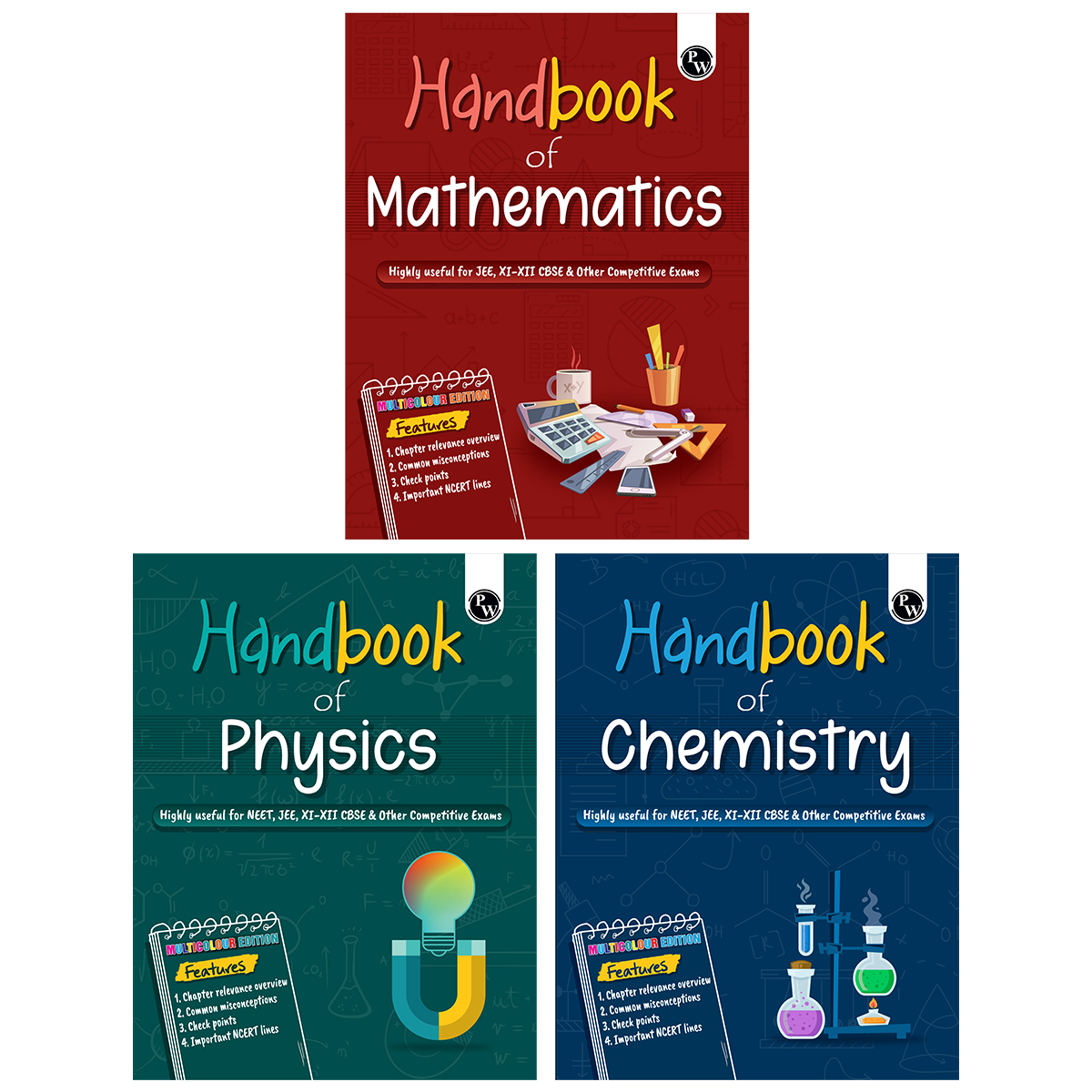
Here, an invaluable resource becomes a specialized PCM handbook. It declutters daily study sessions by consolidating all the crucial definitions, core concepts, and main equations into one handy guide. It frees students to spend less time paging and more time problem solving.
With a condensed manual, you can have a clear mental map of each topic. Students can see how different algebraic formulas or chemical principles relate to each other, rather than as separate topics for each chapter. This holistic understanding is important for answering complex, multi-concept questions.
How Does a JEE Handbook Improve Your Daily Study Routine?
A well-organised reference guide changes the way you interact with JEE books on a daily basis. Instead of rifling through a bunch of notebooks to find one equation, you have it all neatly organised. This organised format saves precious minutes during intense study sessions.
With a complete JEE formula handbook, you will not miss out on any important concept. It's a safety net to make sure you've dotted every i and crossed every t for the exam. A systematic approach reduces your anxiety and builds real exam confidence.
These small tools are used by high achievers to do a quick formula revision just before beginning their daily practice papers. Spending about ten minutes reviewing the necessary equations results in fewer calculation mistakes. Also, it keeps the mind on the application side instead of the recall side.
The compact manual is also portable, so you can continue your studies even away from your desk. Students can use short breaks to revise properties of inorganic coordination chemistry or reaction mechanisms in organic chemistry. These short, frequent interactions make a significant contribution to long-term memory.
What are the Top Revision Strategies for Using a JEE Handbook?
The difference between an average rank and a top rank often comes down to the efficiency of the revision process. Top scorers do not read chapters cover-to-cover repeatedly. Instead, a successful topper revision strategy prioritizes active recall and targeted problem-solving over passive reading.
Toppers use compact reference books to build custom error logs. When they get a question wrong during practice, they check their manual to see which specific property they forgot. They highlight that section, transforming the book into a personalized roadmap of their academic weaknesses.
Regular interaction with a structured JEE maths handbook helps transfer short-term knowledge into long-term memory banks. By reviewing the summary sheets multiple times a week, the formulas become second nature. This rapid recall is vital when working under strict exam time limits.
-
Active Recall: Testing your brain to retrieve formulas without looking at the solutions.
-
Space Repetition: Reviewing difficult chapters at calculated intervals over several weeks.
-
Error Mapping: Marking frequently forgotten equations directly in your revision guide.
-
Time Boxing: Allocating approximately fifteen minutes daily for pure formula tracking.
Dedicated study guides also prevent students from over-complicating straightforward topics. The exam often tests basic applications of fundamental principles rather than abstract theories. Having a clean, uncluttered presentation of these principles keeps the student's focus exactly where it needs to be.
How to Maximize Last-Minute Revision with a JEE Handbook?
The final weeks before the engineering entrance exam are incredibly high-pressure. Students cannot afford to waste days reading theoretical descriptions or solving random sample questions. Every single hour must be optimized to maximize potential test scores.
During this critical period, conducting a thorough JEE last minute revision becomes the number one priority. A compact manual allows you to run through the entire syllabus of a subject in around two hours. This rapid review keeps all chapters fresh in your mind simultaneously.
An organized approach is essential for successful engineering entrance preparation at this advanced stage. Instead of panicking over unread topics, students can systematically verify their knowledge against the manual. This clear tracking helps maintain a calm, focused mindset.
Using a formula manual also aids in managing exam stress. Knowing that you have a single, reliable source containing every necessary piece of information provides immense mental relief. It eliminates the fear of suddenly forgetting a vital mathematical identity or physical constant during the test.
How to Choose the Right JEE Handbook?
Not all reference guides are created equal, and choosing the right one can alter your preparation trajectory. An ideal manual must strike a perfect balance between brevity and completeness. It should be concise enough for quick reading but detailed enough to cover the syllabus.
The layout should use distinct visual aids, such as bold text for critical variables and structured bullet points for properties. This clean formatting allows your eyes to navigate the page effortlessly. It also helps create strong visual memories of the formulas.
-
Comprehensive Coverage: Ensuring every chapter from Class 11 and Class 12 is fully represented.
-
Clear Typography: Using bold headings and distinct lists to make scanning easy.
-
Accurate Data: Double-checked equations that eliminate any risk of learning incorrect details.
-
Physical Durability: A sturdy book format that withstands months of daily handling.
Ultimately, a premium JEE revision books acts as a silent mentor throughout your academic journey. It keeps your preparation organized, your revision swift, and your goals attainable. By integrating it into your daily schedule, you bridge the gap between hard work and top-tier exam results.
Read More: Physics Formulas for JEE Exams
JEE Handbook FAQ’s
How does a JEE handbook help improve problem-solving speed?
A compact manual organizes all formulas systematically, allowing for rapid mental retrieval. When you spend less time trying to remember an equation, you can allocate more time to analyzing the question logic, which directly increases your speed.
Can I rely entirely on a JEE formula handbook for my preparation?
A revision manual is designed to complement your regular studies, not replace them. It should be used alongside mainstream textbooks and practice papers to streamline your revision sessions and reinforce core concepts.
What makes a PCM handbook different from standard school notebooks?
Class notebooks often contain extensive explanations, rough work, and lengthy derivations. A specialized manual filters out this extra noise, presenting only the final formulas and key properties required to solve entrance exam questions efficiently.
When is the best time to start using a JEE handbook during the course?
While it is incredibly useful for the final months, introducing it early in your preparation helps build familiarity. Using it during weekly mock tests ensures you know exactly where every formula is located well before the actual exam day.
Why do top scorers recommend a quick formula revision before mock tests?
Reviewing formulas right before a test activates relevant neural pathways, keeping the concepts fresh. This practice minimizes basic recall mistakes and helps students start their exam with confidence and analytical clarity.