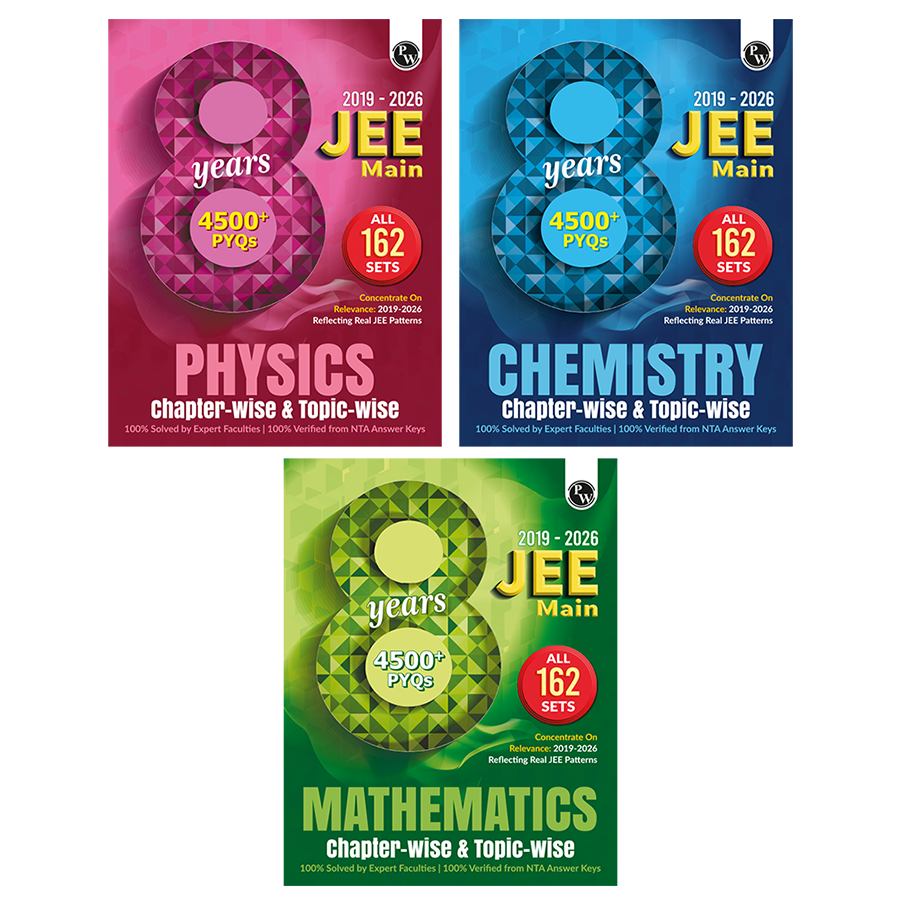
One Book for Physics, Chemistry and Maths: Inside 8 Years JEE PYQ Combo
Many candidates struggle because they keep their study sessions segregated until the final weeks. When the actual paper places a complex integration problem right next to an organic chemistry mechanism, confusion sets in.
Integrating a comprehensive JEE Main PYQ strategy into your daily routine solves this exact issue. Practicing real questions systematically bridges the gap between basic theory and actual examination performance.
Overview of JEE PYQ
Understanding the structure of past papers gives you an immediate competitive advantage. The engineering entrance exam has evolved significantly, making it essential to target the right timeframe. Focusing on papers from 2019 to 2026 ensures your practice matches the modern framework, difficulty level, and current questioning patterns.
A comprehensive collection from this 8-year period provides immense value:
-
Total Papers Available: You gain access to all 162 shift papers spanning these years, covering both Session 1 and Session 2.
-
Volume of Practice: This timeframe contains over 4,500 distinct questions, expanding into more than 13,500 total detailed practice opportunities when broken down across sessions.
-
Question Formats: The papers include both Multiple Choice Questions (MCQs) and Numerical Value Questions, perfectly mirroring the official test blueprint.
-
Authentic Evaluation: Relying on resources designed around official NTA answer keys protects you from misleading explanations and keeps your self-assessment highly accurate.
Why Should You Solve JEE PYQ for Physics, Chemistry, and Maths Together?
Studying subjects in separate silos creates a false sense of security. You might spend a whole day feeling like a genius solving physics numericals, only to realize your chemistry retention has slipped by the weekend. Practicing PCM PYQs in a single combined session changes your mental habits.
The real exam does not give you a warm-up period between subjects. By practicing all three subject areas together, your brain develops the flexibility to jump from an abstract mathematics proof to a physical chemistry thermodynamics equation instantly.
This combined method also builds genuine psychological endurance. Sitting for three hours straight requires significant mental stamina. Regular training with a combined JEE PYQ collection prepares your mind to handle the final hours of the exam without experiencing mental exhaustion.
How JEE PYQ Helps You Balance JEE Preparation?
A common trap during revision is spending too much time on your favorite subject while neglecting your weakest one. Utilizing a proper JEE PYQ resource forces a highly balanced approach to your daily study routine.
Using a systematic JEE PYQ approach highlights your hidden weaknesses. If you always skip the mathematics section during a combined paper, it reveals a confidence gap you need to address immediately.
This method transforms your regular schedule, ensuring that your JEE preparation remains balanced and comprehensive instead of one-sided.
Subject-Wise Practice Strategy with JEE PYQ
Every subject needs a distinct approach when dealing with past papers. Simply reading through solutions will not improve your skills; you need to apply targeted strategies for each discipline.
1. Physics: Developing Intuition and Application
Physics questions require you to translate complex real-world situations into mathematical formulas.
-
Identify Core Trends: Use the past papers to see how basic principles like conservation of momentum or induction are tested in different contexts.
-
Master Diverse Formats: Work heavily on both conceptual MCQs and precise numerical entries to ensure your calculation steps remain error-free.
2. Chemistry: Balancing Speed and Precision
Chemistry is often where top scorers gain their speed advantage, giving them more time to tackle the tougher maths problems.
-
Physical Chemistry: Treat this section like physics, practicing numerical questions to fine-tune your calculation speed.
-
Organic and Inorganic: Use past trends to spot exactly which reactions, mechanisms, and periodic properties show up year after year.
3. Mathematics: Building Persistence and Numerical Accuracy
The mathematics section is notoriously time-consuming and demands deep logical thinking.
-
Step-by-Step Problem Solving: Avoid looking at answers early; fight through complex calculus and coordinate geometry problems on your own first.
-
Pattern Recognition: Train your eyes to spot familiar question structures so you can choose the fastest analytical path during the exam.
How to Make a Weekly Revision Plan with JEE PYQ?
Consistency outperforms occasional bursts of intense studying every single time. A disorganized approach to past papers wastes excellent resources. Instead, set up a clear weekly routine that blends targeted chapter-wise revision with full-length practice sessions. To make your revision more effective, use JEE Revision Books that provide concise theory, formula summaries, key concepts, and exam-oriented practice. Combining structured revision resources with regular PYQ practice helps improve retention, strengthen conceptual clarity, and boost confidence for the JEE Main and Advanced examinations.
-
Monday to Wednesday (Focused Revision): Dedicate these days to specific chapters that your weekend analysis showed need work. Use topic-wise past questions to fix these weak spots.
-
Thursday and Friday (Timed Mixed Subsets): Pick small, mixed batches of physics chemistry maths PYQs from a specific year. Give yourself one hour to solve a mixed set of thirty questions to keep your subject-switching sharp.
-
Saturday (Full-Length Testing): Sit down for a full three-hour session without any interruptions. Treat this as the real exam day to test your speed and endurance.
-
Sunday (Deep Error Review): Spend at least two hours reviewing every single mistake from your Saturday test. Read through error-free, detailed solutions to understand the logic behind the steps you missed.
When to Use JEE PYQ?
Timing your practice correctly changes how well you retain information. Using past papers at the wrong stage of your preparation can actually hurt your confidence.
-
During the Main Syllabus Cycle
Do not wait until the entire syllabus is finished to open your JEE books. As soon as you complete a chapter, dive into the relevant questions from the past eight years. This immediate practice shows you exactly how that specific topic is tested in the real exam.
-
The Final Revision Stage
During the last two months before the exam, shift your focus entirely to full-length papers. At this point, past papers should become your primary study tool. Testing yourself with realistic papers from 2019 to 2026 keeps your mind aligned with modern exam trends and difficulty levels.
Tips to Follow with JEE PYQ
To get the most value out of your past papers, follow these essential tactical habits during every study session:
-
Use a Real Timer: Always run a countdown timer when working on full papers. Operating under time pressure is the only way to build real exam speed.
-
Work Without Subtitles or Hints: Keep the solutions closed until your entire practice session is completely over.
-
Categorize Your Mistakes: Group your errors into specific buckets, such as conceptual gaps, simple calculation mistakes, or poor time management.
-
Track Your Multi-Year Progress: Watch how your scores improve across different paper versions over time to build genuine confidence.
-
Focus on the Exact Solutions: When reviewing an answer, do not just check the final number. Review the entire explanation to learn cleaner, faster ways to solve the problem next time.
For quick and effective revision, students can also use the PW JEE Handbook Combo of 3 Books, which provides concise theory, formulae, shortcuts, and important concepts across Physics, Chemistry, and Mathematics. When combined with regular JEE PYQ practice, these handbooks help strengthen conceptual clarity, improve revision efficiency, and boost confidence for both JEE Main and JEE Advanced.
Common Mistakes to Avoid While Solving JEE PYQ
Many students spend hours working through past papers without seeing their marks improve because they fall into common practice traps.
Another major mistake is ignoring the numerical value questions. Many students focus entirely on MCQs because they find them less intimidating. However, numerical questions carry significant weight and require perfect calculation accuracy, making them vital to practice regularly.
Finally, do not let outdated question formats waste your time. The exam pattern shifted significantly after 2019. Spending days working on long, subjective problems from the early 2000s will not help you prepare for the fast-paced, high-precision format of the modern computer-based test.
Read More: Previous Year Question Papers of JEE Mains
JEE PYQ FAQs
How many years of past papers are enough to achieve a notable JEE score improvement?
Practicing the last 8 years of papers provides an ideal foundation because it covers the relevant 2019 to 2026 exam trends. This specific window contains 162 shift papers, giving you thousands of high-quality questions that match the modern difficulty level.
Should I practice previous year questions by individual topics or as full papers?
You should combine both methods. Use a chapter-wise approach when you are learning a topic to build a solid foundation, then switch to full papers during your final revision to train your brain to handle all three subjects together.
Why are papers from 2019 to 2026 considered better for modern JEE preparation?
Papers from 2019 to 2026 match the current computer-based testing format, modern difficulty standards, and NTA question distribution. Practicing within this window keeps you focused on current trends and avoids outdated question styles.