Semiconductor PYQs for JEE Main Revision with PW Book
Preparing for JEE Main Physics often feels overwhelming when balancing vast theoretical concepts with numerical speed. Many students struggle to identify which topics yield maximum marks with minimal revision time.
Semiconductors remain one of the most reliable, high-scoring chapters in the Physics syllabus, yet aspirants frequently lose easy marks due to misinterpreting subtle circuit diagrams or formula applications. Solving dedicated Semiconductor JEE Main PYQ sets provides the exact clarity required to overcome this exam hurdle.
Importance of Semiconductor JEE PYQ
Semiconductor physics occupies a unique position in the JEE Main syllabus. Unlike mechanics or electrodynamics, which often involve lengthy calculations and multi-step derivations, semiconductor problems test direct conceptual application. Practicing PYQ sets helps you recognize standard pattern formats that NTA repeats year after year.
Direct Scoring Potential in JEE Main Physics
In almost every shift of JEE Main, questions from semiconductors offer direct marks. Mastering these questions provides a massive advantage for several reasons:
-
Minimal Time Investment: Most semiconductor questions require less than two minutes to solve, giving you extra time for longer mathematical problems.
-
Formula-Driven Solutions: Questions regarding current density, conductivity, or diode resistance depend on straightforward mathematical relationships rather than complex calculus.
-
High Predictability: The fundamental concepts tested—such as depletion layer behavior or truth tables—follow a consistent structure across test shifts.
Decoding NTA Question Trends
Analyzing past exam papers reveals how question styles have evolved over recent years. While older papers focused heavily on theoretical definitions, modern shifts emphasize practical circuit analysis and statement-based evaluation.
Practicing recent past papers trains your mind to identify trap statements, distinguish between forward and reverse bias conditions, and evaluate logic gate outputs instantly.
Regular exposure to physics PYQs JEE collections ensures that you do not feel surprised by subtle variations in diagrammatic problems during the actual exam.
Features of Semiconductor JEE PYQ
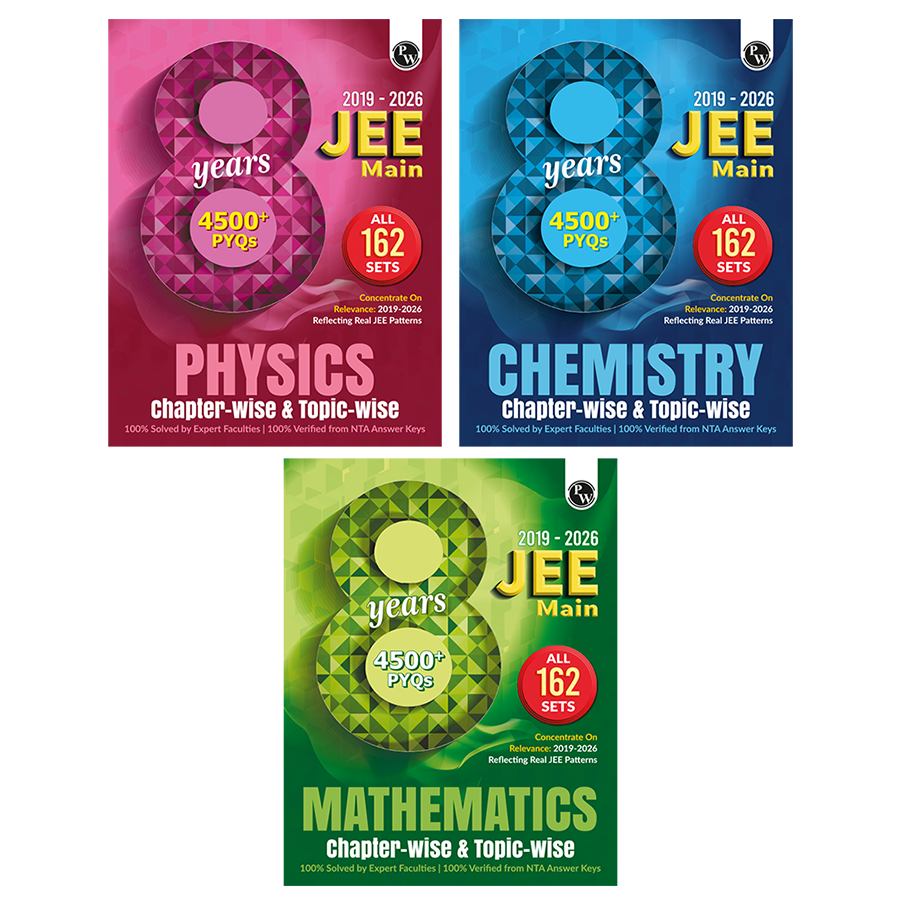
Having the right study resource makes a substantial difference in your preparation speed and accuracy. The PW JEE PYQ book is specifically engineered to align with NTA's current testing standards.
Instead of searching through mixed paper sets, the JEE PYQ book organizes previous year papers by specific chapters and sub-topics. This arrangement allows you to focus exclusively on semiconductors after finishing the theoretical concepts from your notes.
-
Comprehensive Coverage: Contains all recent shift papers organized cleanly to eliminate redundant or outdated questions.
-
Trend Analysis: Displays historical weightage data so you know exactly which sub-topics require maximum focus during revision.
-
Structured Difficulty: Questions are arranged logically, letting you build confidence with basic problems before moving to complex combination circuits.
Which Topics Are Most Important in Semiconductor JEE PYQ?
To make your preparation effective, you must categorize the chapter into distinct sub-topics. Not all sections carry equal weight in the exam, so prioritizing high-yield areas ensures optimal time allocation.
Energy Band Theory and Electrical Conductivity
Understanding energy bands forms the theoretical foundation of solid-state electronics. Questions from this topic test your grasp of band gap energy levels and charge carrier concentrations.
-
Fermi Energy Levels: Understanding how doping alters Fermi levels in n-type and p-type materials.
-
Intrinsic vs Extrinsic Carriers: Applying the law of mass action, where the product of electron and hole concentrations equals the square of intrinsic carrier concentration.
-
Electrical Conductivity Formula: Calculating conductivity based on electron mobility, hole mobility, and carrier density.
p-n Junction Diodes and Zener Diode Applications
The p-n junction diode is arguably the most frequently tested concept in semiconductor JEE main papers. Questions range from basic bias identification to complex Zener diode voltage regulation circuits.
-
Forward and Reverse Bias Characteristics: Identifying barrier potential changes, depletion width variations, and dynamic resistance calculations.
-
Half-Wave and Full-Wave Rectifiers: Calculating ripple factor, peak inverse voltage (PIV), and output frequency relationships relative to input AC signals.
-
Zener Diode as a Voltage Regulator: Finding load current, breakdown voltage limits, and series resistance values in regulated power supply circuits.
Logic Gates and Boolean Algebra
Logic gates represent the single most predictable area in electronics JEE questions. A solid understanding of basic logic gates allows you to secure guaranteed marks in minimal time.
-
Basic Gates: AND, OR, and NOT gates along with their characteristic truth tables.
-
Universal Gates: Constructing complex logic functions using only NAND or NOR gates.
-
Combination Circuits: Analyzing multi-stage gate arrangements to derive the final boolean expression or truth table output.
Topic-wise Weightage Breakdown
The following table summarizes the distribution of questions and key concepts across major semiconductor sub-topics based on recent exam trends:
|
Sub-Topic |
Average Weightage |
Key Concepts & Formulas |
Primary Question Type |
|
Logic Gates |
35% to 40% |
Truth tables, De Morgan's laws, NAND/NOR combinations |
Output state evaluation |
|
p-n Junction & Diodes |
30% to 35% |
Dynamic resistance, Rectifier efficiency, Barrier potential |
Circuit analysis & graph interpretation |
|
Zener Diode Regulation |
15% to 20% |
Breakdown voltage, Load current limits, Series resistor |
Numerical calculations |
|
Energy Bands & Doping |
10% to 15% |
Mass action law, Conductivity, Band gap energy |
Conceptual & statement-based |
Build a strong foundation for JEE Main and JEE Advanced with JEE Books that combine clear concepts, solved examples, chapter-wise questions, and focused practice. Regular use of these books can help strengthen weak areas, improve problem-solving skills, and make revision more effective.
How to Solve Semiconductor JEE PYQ Faster?
Solving semiconductor PYQs efficiently requires a systematic methodology. Developing a structured approach prevents careless errors in circuit interpretation and logic gate truth tables.
When facing diode circuit diagrams in JEE Main, follow these sequential steps:
-
Identify the Bias Condition: Check whether the p-side is connected to a higher potential than the n-side. If forward-biased, replace an ideal diode with a short circuit (or its barrier voltage source). If reverse-biased, replace it with an open circuit.
-
Apply Kirchhoff's Voltage Law (KVL): Write loop equations considering diode drop values (typically 0.7V for Silicon and 0.3V for Germanium if non-ideal).
-
Calculate Current Flow: Solve for circuit current and verify if the current direction aligns with the allowed diode conduction path.
Elimination Shortcuts for Logic Gate Diagrams
Logic gate questions can often be solved in seconds without writing lengthy Boolean equations:
-
Test Extreme Inputs: Substitute binary input combinations like (0,0), (0,1), (1,0), and (1,1) directly into the circuit diagram.
-
Eliminate Options Early: Compare intermediate output values against the options provided to rule out incorrect truth tables immediately.
-
Use De Morgan's Laws: Simplify complex combination circuits using standard identities before attempting to build full truth tables.
How to Revise Semiconductor JEE PYQ in 4 Weeks?
Integrating JEE main and advanced pyq practice into your daily study routine requires disciplined scheduling. A structured 4-week revision plan helps you master semiconductors alongside other modern physics topics.
Four-Week Practice Schedule
-
Week 1: Fundamentals & Band Theory
-
Review notes on conductivity, intrinsic/extrinsic semiconductors, and mass action law.
-
Solve 15 to 20 foundational questions to lock in key formulas.
-
Week 2: Diode Circuits & Rectifiers
-
Focus on forward/reverse bias, dynamic resistance, and half/full-wave rectifiers.
-
Solve 25 to 30 past questions involving circuit diagrams and V-I characteristics.
-
Week 3: Zener Diodes & Special Devices
-
Master voltage regulator calculations, photo-diodes, and solar cells.
-
Practice timed sets of 20 numerical problems to build speed.
-
Week 4: Logic Gates & Final Revision
-
Solve all past combination logic gate questions using truth tables and shortcuts.
-
Re-solve incorrect questions from previous weeks to test retention.
Creating an Error Notebook for Physics Revision
Maintaining a dedicated error tracking log is essential for continuous improvement:
-
Log Traps & Mistakes: Note down every instance where you misidentified diode bias or miscalculated a Boolean expression.
-
Build Short Formula Sheets: Keep key formulas—such as dynamic resistance and mass action law—on a single revision sheet for quick reference on exam morning.
-
Track Solving Time: Aim to complete a 10-question semiconductor block within 12 to 15 minutes.
Read More: Is It Difficult to Score 150 in JEE Mains?
JEE PYQ FAQs
How many questions from semiconductors appear in JEE Main Physics?
In most JEE Main exam shifts, semiconductors contribute 1 to 2 direct questions. This makes the chapter a high-yield topic given its concise syllabus and formula-driven nature.
Is solving previous years questions enough for semiconductor JEE main preparation?
Solving past questions provides complete clarity on exam patterns and recurring concepts. When paired with basic theory from NCERT or classroom notes, past paper practice is thoroughly sufficient to score full marks in this chapter.
Which sub-topic carries the highest weightage in semiconductor PYQs?
Logic gates and p-n junction diode circuits carry the highest weightage. Together, these two sub-topics account for over 70% of all semiconductor questions asked in recent JEE Main shifts.
Why choose the JEE PYQ book over online question PDFs?
The dedicated book offers organized chapterwise and topicwise sorting, verified error-free solutions, and QR code video hints. This structured format saves time compared to searching through unorganized digital PDFs.
How can I improve speed when solving electronics JEE questions?
Master shortcut methods for logic gates by testing binary inputs directly. For diode circuits, immediately identify bias states to simplify circuit diagrams before applying Kirchhoff's laws.