Top 5 Repeated JEE Main Maths PYQ for 2027 Exam
Preparing for the Joint Entrance Examination requires more than just memorizing formulas; it demands a strategic grasp of the paper pattern. Many students struggle to identify which topics carry the most weight or which question types reappear frequently. Analyzing JEE maths PYQ trends reveals that certain concepts are tested almost every year with slight numerical variations. This guide highlights the top five repeated question types based on previous years' data to streamline your revision.
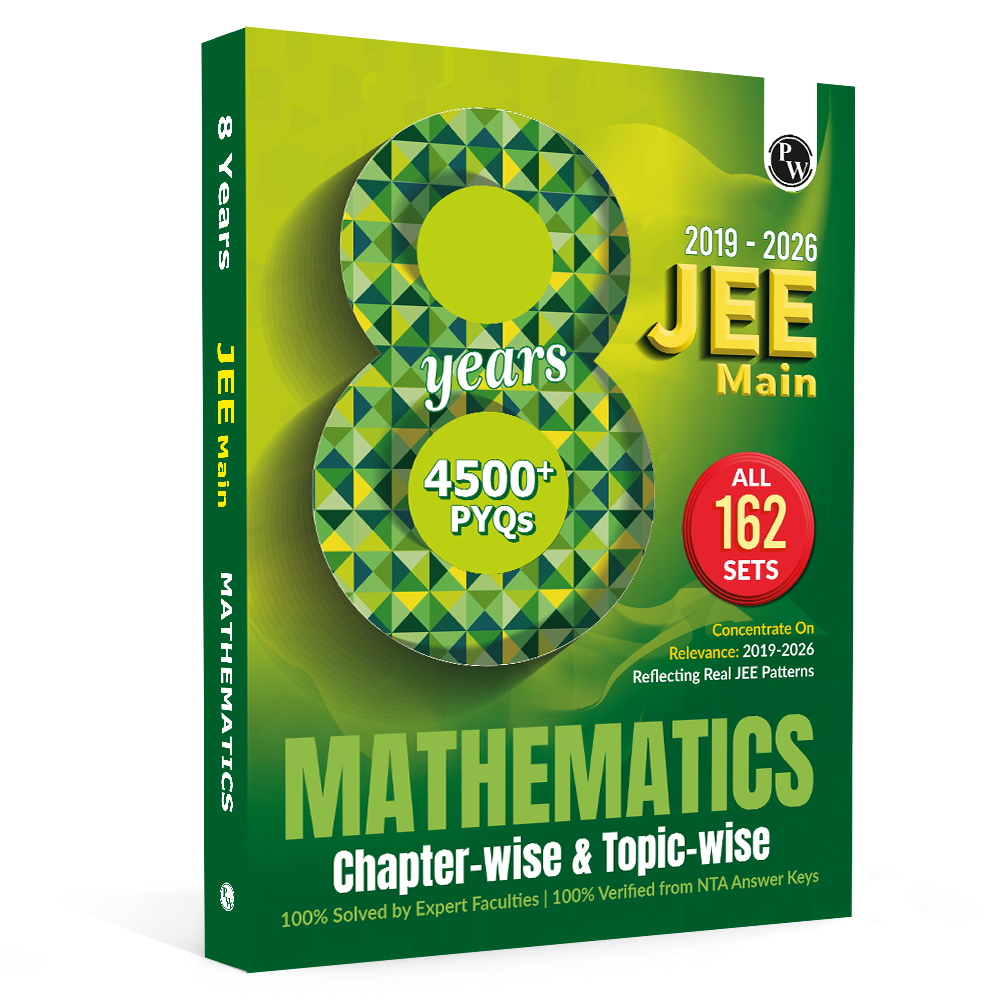
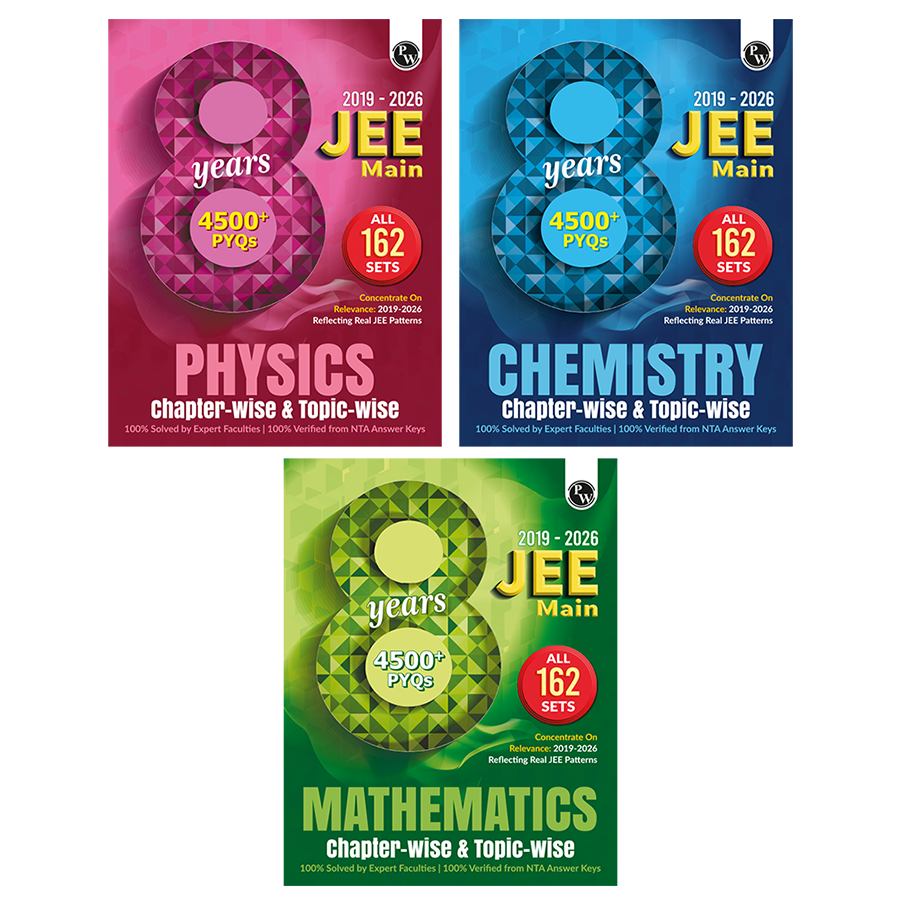
PW JEE Books — prepare with well-structured study material that combines concept building, practice exercises, and exam-oriented learning. These PW JEE books help students strengthen fundamentals, revise efficiently, and improve performance for JEE Main and JEE Advanced.
Why Solve JEE Maths PYQs
Success in competitive exams is often about studying smarter, not just harder. While the syllabus is vast, an analysis of JEE maths PYQ trends shows that examiners frequently revisit specific core concepts. Understanding why you should focus on these repeated patterns can significantly shift your preparation strategy.
-
Analyze the Paper Pattern: By solving a maths JEE main PYQ, you start to see a "blueprint" of the exam. You begin to notice that while numbers change, the logic required to solve a system of equations or a complex integral remains consistent.
-
Improve Confidence and Speed: Nothing builds confidence like seeing a familiar question type during the actual test. Regular practice of a JEE PYQ allows you to recognize the required formula instantly, saving precious minutes for tougher problems.
-
Focus on Important Topics: Not all chapters are created equal. Some sections provide a higher return on investment. Focusing on a maths PYQ JEE mains ensures you aren't wasting time on obscure topics that rarely appear in the final paper.
-
Reduce Calculation Mistakes: Maths is a subject where a single sign error can cost you marks. Repeatedly working through a PYQ of JEE Main maths trains your brain to handle multi-step calculations with greater precision under pressure.
Benefits of JEE Maths PYQ
Studying previous papers is the most effective way to understand the difficulty level of the exam. It helps you identify the "flavour" of questions that the exam conducting bodies prefer. By regularly solving a JEE Main math PYQ, you become familiar with the language of the problems, which reduces anxiety on the day of the test.
-
Know Important Chapters: You quickly learn which chapters, like Coordinate Geometry or Calculus, dominate the paper.
-
Improve Speed and Accuracy: Repeated practice of math JEE PYQ improves your calculation speed and reduces the likelihood of silly mistakes.
-
Strengthen Concepts: Often, the exact values change, but the underlying mathematical property remains the same.
-
Learn Time Management: Knowing which questions take longer helps you decide which ones to attempt first.
Repeated JEE Main Maths Questions
Here are the top 5 PYQs for JEE Main Maths students often have to solve:
Binomial Theorem Questions
One of the most consistent patterns in the maths JEE main PYQ is the calculation of a specific term in a binomial expansion. Usually, students are asked to find the term independent of x or the coefficient of a particular power of x.
This question type tests your grip on the General Term formula. To solve these efficiently:
-
Write the general term T_{r+1} = ^nC_r (a)^{n-r} (b)^r.
-
Combine all the powers of x into a single exponent.
-
Equate the total exponent of x to zero (for the independent term) or the required power.
-
Solve for r and calculate the final coefficient.
A large number of recent papers have included variations of this problem, making it an important topic for practice. To strengthen your preparation further, students can use a JEE Main PYQ PDF to solve previous year questions, understand recurring patterns, and improve speed and accuracy through targeted practice.
Determinants Questions
The "Cramer’s Rule" or the nature of solutions for a system of linear equations is a staple in the maths JEE mains PYQ. You will often encounter a set of three equations with a variable parameter (like \lambda or \mu) and be asked to find the values for which the system has:
-
A unique solution
-
Infinitely many solutions
-
No solution (Inconsistent)
|
Condition |
Type of Solution |
|
Determinant (D) is not 0 |
Unique Solution |
|
D = 0 and D_1 = D_2 = D_3 = 0 |
Infinitely Many or No Solution |
|
D = 0 and at least one D_i is not 0 |
No Solution |
Most PYQ of maths JEE mains focus on the "no solution" or "infinitely many solutions" cases. Practising these ensures you handle the determinant calculations accurately under pressure.
3D Geometry Questions
In the 3D Geometry section, the formula-based question on the shortest distance between two lines is frequently repeated. This is a high-priority JEE previous year papers topic because it involves multiple steps: finding the direction ratios, the cross product of vectors, and the dot product.
The formula involves the absolute value of the dot product of the vector joining two points on the lines and the cross product of their direction vectors, divided by the magnitude of the cross product. Because the calculation can be tedious, examiners use it to test a student's precision. Questions from 3D geometry are commonly seen across different exam shifts.
Definite Integral Questions
Calculus is a massive part of the syllabus, but the "King’s Property" (replacing x with a+b-x) is seen in nearly every JEE math PYQ. This property is typically used to simplify complex trigonometric or logarithmic functions within a definite integral.
Common patterns include:
-
Integrals ranging from 0 to \pi/2 involving \sin x and \cos x.
-
Functions where the denominator remains unchanged after applying the property.
-
Problems requiring the addition of the original integral and the transformed integral to cancel out complex terms.
Mastering these properties allows you to solve what look like "impossible" integrals in just a few lines of working.
Tangents and Normals Questions
Coordinate Geometry, specifically Parabola and Ellipse, frequently features questions regarding the equation of a tangent or a normal at a given point or with a given slope. In many PYQ sets, you will find questions that combine a circle and a parabola, asking for a common tangent.
To excel here, you should memorise:
-
The "Point Form" of tangents for all conic sections.
-
The "Slope Form" (y = mx + c) and the specific conditions for tangency (c in terms of a and m).
-
The properties of the focal chord and its relationship with tangents at the extremities.
These questions are predictable and often rely on a standard set of steps, making them vital for boosting your score.
Features of JEE Maths PYQ Book
To excel in the competitive landscape of engineering entrances, having the right resources is essential. This edition offers a PYQ collection that is specifically designed to provide students with a structured path to success. Below are the standout features that make this resource a vital part of your preparation kit:
-
Large Collection of Questions: This book includes a comprehensive compilation of the last 8 years of papers, ensuring you are exposed to every possible question variation.
-
Detailed Solutions: Every maths JEE mains PYQ is accompanied by an in-depth explanation. These solutions focus on teaching the logic behind the answer rather than just providing a final result.
-
Chapter Weightage Analysis: The content is organized to show you which topics have appeared most frequently. This helps you prioritize chapters like Calculus or Algebra where a math JEE PYQ is most likely to yield high marks.
-
Shift-wise Questions: Since the exam is conducted in multiple sessions, the book captures questions from various shifts, giving you a wider perspective on the difficulty level.
-
Quick Concept Revision: Alongside the PYQ of maths JEE mains, students find "Concept Boosters" that simplify complex theorems used in the problems, making it easier to retain information.
-
Error-Free Content: The material undergoes rigorous quality checks to ensure that every formula, graph, and calculation is 100% accurate for reliable self-study.
How to Practice JEE Maths PYQ
Simply looking at the solutions is not enough. To truly benefit from the JEE Math PYQ, follow a structured approach. Start by solving questions topic-wise to build confidence. Once you have covered the syllabus, switch to year-wise papers to simulate the actual exam environment.
-
Set a Timer: Give yourself approximately 2 minutes per question.
-
Identify Weak Areas: If you consistently fail at "Probability" PYQs, go back to the basics before trying more questions.
-
Review Errors: Don't just check the answer; understand the logic behind the correct step.
Read More: JEE Mains Maths PYQ with Solutions PDF
JEE Maths PYQ FAQs
How many years of maths PYQ should I solve for JEE Main?
It is generally recommended to solve at least the last 5 to 8 years of papers. This period covers the recent transition to the online testing format and provides enough variety in question types.
Are questions exactly repeated in the JEE Main maths section?
Exact numerical repetition is rare. However, the conceptual framework and the steps required to solve the problem are repeated very frequently across different shifts.
Which is the most repeated chapter in JEE maths PYQ?
Chapters like Sequences and Series, Matrices and Determinants, and Vector-3D Geometry consistently have the highest number of repeated question patterns year after year.
Is solving PYQs enough to get a 99 percentile in JEE Maths?
While PYQs are essential for understanding the pattern and building speed, you also need a strong conceptual foundation and practice from standard textbooks to handle new or "out-of-the-box" questions.
How should I manage time for maths during the exam?
Maths is often the lengthiest section. By practising the JEE maths PYQ, you can identify "easy-kill" questions like those from Sets, Relations, or Statistics, which should be solved in the first 15-20 minutes.