Top 5 Repeated JEE Main Physics PYQ for 2027 Exam
Aspiring engineers often feel overwhelmed by the vast syllabus of the Joint Examination. While every chapter matters, certain patterns emerge when you look at the previous years. Identifying these patterns through a consistent review of JEE Physics PYQ can help students improve revision efficiency and focus on important concepts during preparation. Students frequently struggle with which topics to prioritize when time is short. This article breaks down five specific, recurring question types that have appeared consistently over the last decade, offering a clear roadmap for your final revision stages.
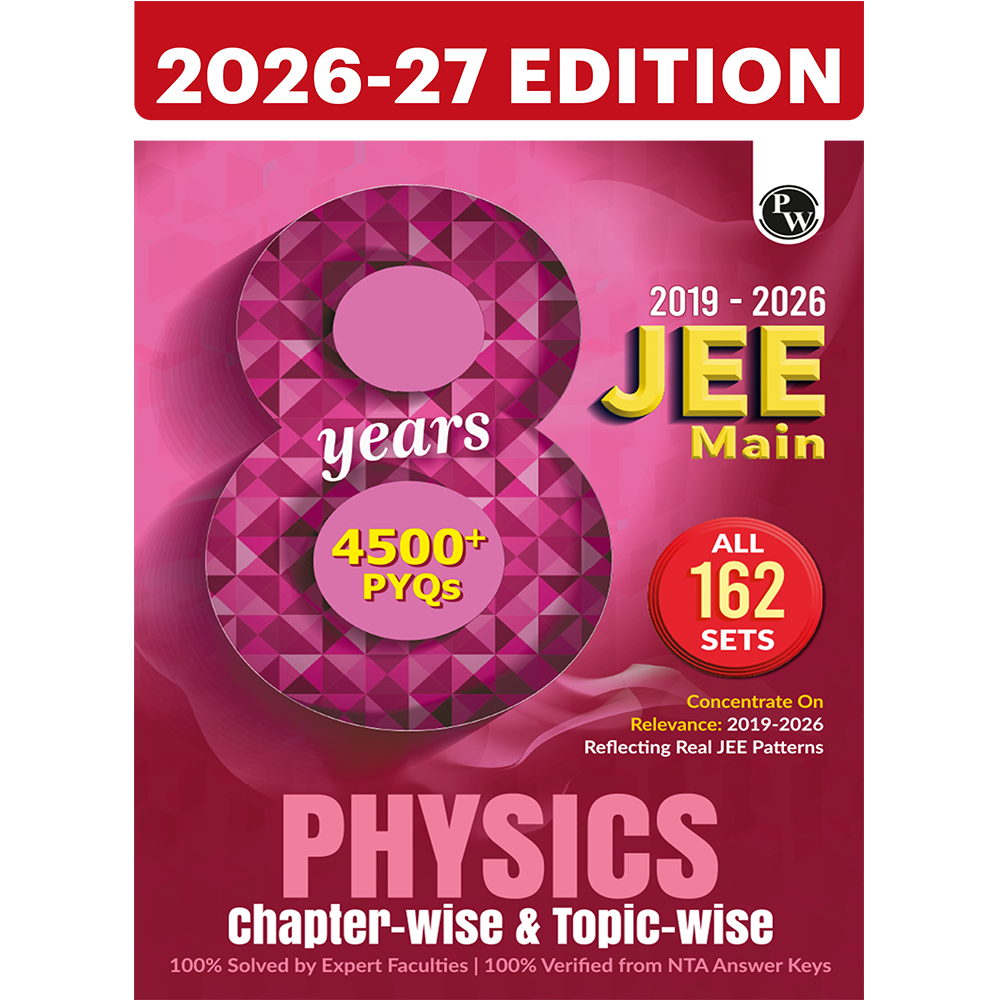
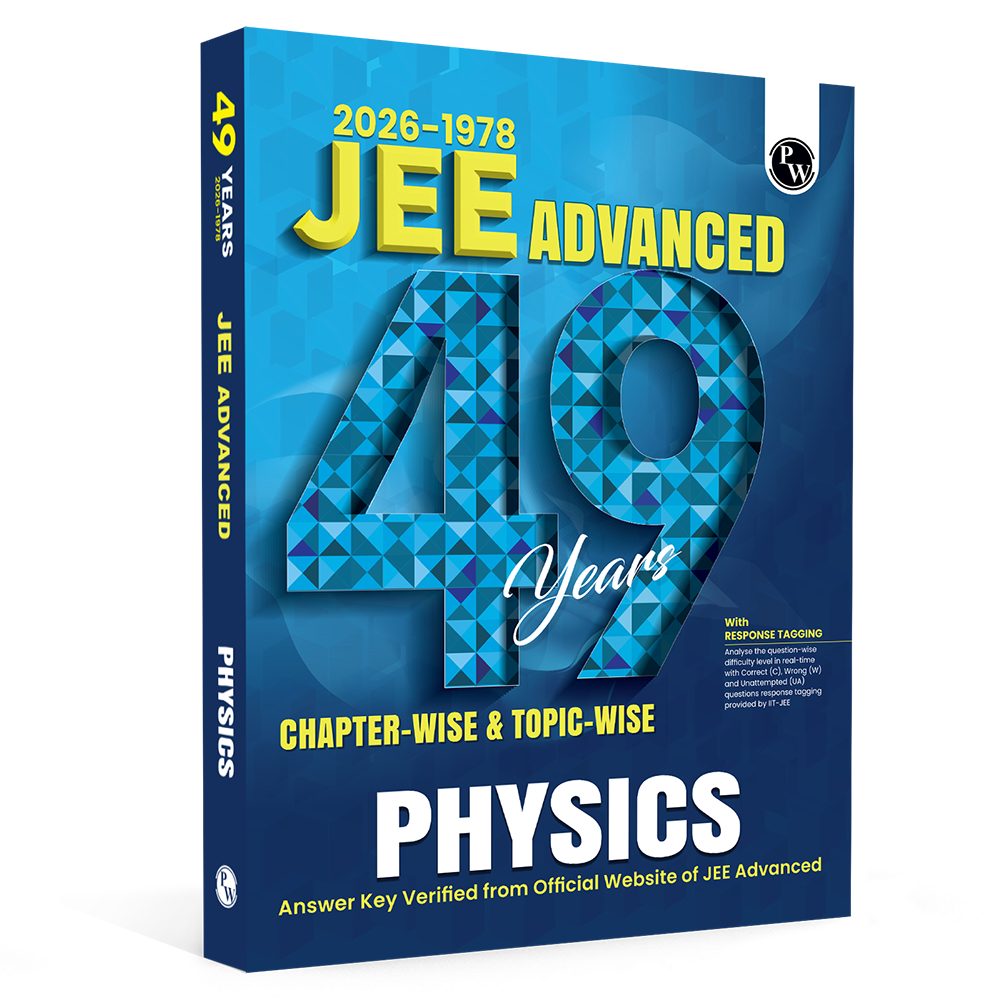
PW IIT JEE Books — build a strong preparation foundation with structured content, practice-driven learning, and exam-focused revision. From concept clarity to problem-solving improvement, these PW IIT JEE books support students throughout their JEE Main and JEE Advanced journey.
Why Solve JEE Chemistry PYQ?
Practicing previous questions is not just about testing your knowledge; it is about understanding the mindset of the paper setter. When you dive into JEE Physics PYQ, you notice that the difficulty level often remains consistent for specific topics. This familiarity reduces exam-day anxiety and improves your problem-solving speed.
-
Understand Question Patterns: You begin to see how examiners twist simple concepts into complex-looking problems.
-
Improve Time Management: Solving timed sets of JEE Main PYQ Physics helps you gauge how much time to allocate to each section.
-
Identify Important Chapters: It becomes clear which chapters contribute the most to the total marks.
-
Build Exam Confidence: Getting the right answer on a real exam question provides a much-needed psychological boost.
Many commonly asked questions are based on repeated concepts, making PYQ practice highly useful for revision.
Repeated JEE Main Physics Questions
Here are the top 5 PYQs for JEE Main physics students often have to solve:
1. Projectile Motion and Horizontal Range
Kinematics remains a staple of the JEE Main. Specifically, questions regarding projectile motion, the maximum height reached, and the horizontal range are seen almost every year. Examiners often combine these with relative motion or a change in momentum.
Key concepts often repeated include:
-
Finding the angle of projection when the range and maximum height are equal.
-
Calculating the change in velocity between the point of projection and the highest point.
-
Problems involving a projectile fired from a moving platform or height.
The math involved is usually straightforward, involving basic trigonometric identities. However, the catch usually lies in the sign convention or the frame of reference used. Regularly practicing from a JEE Mains PYQ Physics PDF allows you to see the various ways these kinematics equations are applied.
2. Logic Gates and Semiconductor Devices
This is one of the more scoring topics in terms of the "effort-to-marks" ratio. Questions on logic gates and semiconductor devices are commonly seen across many JEE Main shifts.
Commonly asked formats include:
-
Truth Tables: Identifying the final output for a combination of NAND, NOR, and OR gates.
-
Zener Diodes: Calculating the voltage across a load resistor in a Zener regulator circuit.
-
Transistors: Basic questions on the common-emitter configuration and current gain.
Because this topic is strictly defined, the variations are limited. Students who have gone through the JEE Mains PYQ chapterwise physics will find that they can solve these questions more quickly with regular practice, saving precious time for tougher sections like Electromagnetism or Mechanics.
3. De Broglie Wavelength and Photoelectric Effect
Modern Physics is a goldmine for scoring. The dual nature of matter and radiation consistently provides questions that are formula-based but require careful calculation.
Specific recurring themes:
-
Calculating the de Broglie wavelength of an electron accelerated through a specific potential difference.
-
Finding the ratio of wavelengths for different particles (like an alpha particle and a proton) moving with the same kinetic energy.
-
The Einstein Photoelectric Equation relating the stopping potential to the frequency of incident light.
|
Concept |
Typical Question Variable |
Formula Context |
|
De Broglie Wavelength |
\lambda |
h / p or h / \sqrt{2mK} |
|
Stopping Potential |
V_0 |
eV_0 = hf - \phi |
|
Work Function |
\phi |
Threshold frequency (f_0) |
These questions often involve small numerical values and powers of ten, so accuracy in calculation is vital. Reviewing JEE PYQ physics shows that the examiners often use standard constants that allow for some cancellation, making the math simpler than it first appears.
4. Current Electricity and Kirchhoff’s Laws
Circuit-based questions are commonly asked in JEE Main Physics. These questions usually require the application of Kirchhoff’s Voltage Law (KVL) and Kirchhoff’s Current Law (KCL) to find the current through a branch or the potential difference between two points.
Focus areas include:
-
Wheatstone Bridge: Identifying balanced and unbalanced conditions.
-
Potentiometer: Finding the balancing length or the internal resistance of a cell.
-
Meter Bridge: Calculating unknown resistance and the effect of shifting the jockey.
-
Combination of Cells: Determining the equivalent EMF and internal resistance for series and parallel connections.
The trick in these problems is often the simplification of the circuit. If you can identify symmetry or series-parallel combinations quickly, the problem becomes much easier. This skill is best developed by looking at the JEE chapter wise PYQ for electricity.
5. Thermodynamics and Heat Engines
Thermal physics is another section where questions are repeated with high frequency. Specifically, the First Law of Thermodynamics and the efficiency of the Carnot Engine are favorites among paper setters.
Look out for these repeated types:
-
PV Diagrams: Calculating work done in cyclic processes (isobaric, isochoric, isothermal, and adiabatic).
-
Carnot Efficiency: Finding the temperature of the source or sink when the efficiency changes.
-
Specific Heat Capacities: Relationships between $C_p$ and $C_v$ for different types of gases (monatomic, diatomic, polyatomic).
The questions are often interlinked with the Kinetic Theory of Gases. Understanding the degrees of freedom and how they relate to internal energy is crucial. When you solve JEE Main Physics PYQ, you will notice that the sign of "work done" (by the gas vs. on the gas) is the most common place where students lose marks.
How to Use JEE Physics PYQ for Revision
Simply having the questions is not enough; you must use them strategically. A common mistake is reading the solution before attempting the problem yourself.
-
Practice with a Timer: Set a timer for 60 minutes and attempt 25–30 questions from a single chapter.
-
Review Your Mistakes: If you get a question wrong, identify if it was a conceptual error or a calculation mistake.
-
Track Important Topics: Note down the sub-topics that appear in the last five years of papers.
-
Use Reliable Study Material: Refer to consolidated books or digital platforms to get verified solutions and detailed explanations.
By focusing on these top 5 repeated areas, you streamline your preparation and ensure that you are not caught off guard by the most common question formats in the JEE Main.
Read More: JEE Mains Physics PYQ PDF with Solutions
JEE Physics PYQ FAQs
How many years of JEE Physics PYQ should I solve?
It is generally recommended to solve at least the last 5 to 10 years of papers. This range covers the transition to the online testing format and gives a clear picture of the current difficulty level and question trends.
Is solving JEE Main PYQ Physics enough to clear the cutoff?
While solving previous questions is vital for understanding patterns and improving speed, it should be used to supplement your conceptual learning. It helps you secure marks in high-yield areas, but a thorough reading of standard textbooks is necessary for a high rank.
Where can I find a reliable JEE Mains PYQ Physics PDF?
Reliable PDFs and solved papers are available on major educational platforms and official exam portals. Using a curated book or resource ensures the solutions are accurate and the questions are sorted by year and shift.
Which chapter has the most JEE PYQ physics questions?
Historically, chapters like Modern Physics, Current Electricity, and Heat & Thermodynamics have the highest frequency of questions. These areas often contribute an important share of Physics questions in many exam papers.
Do questions actually repeat in JEE Main?
Exact numerical values rarely repeat, but the "type" and "logic" of the questions repeat very frequently. By learning the method used in a JEE chapter wise PYQ, you will be able to solve the new variations presented in the actual exam.