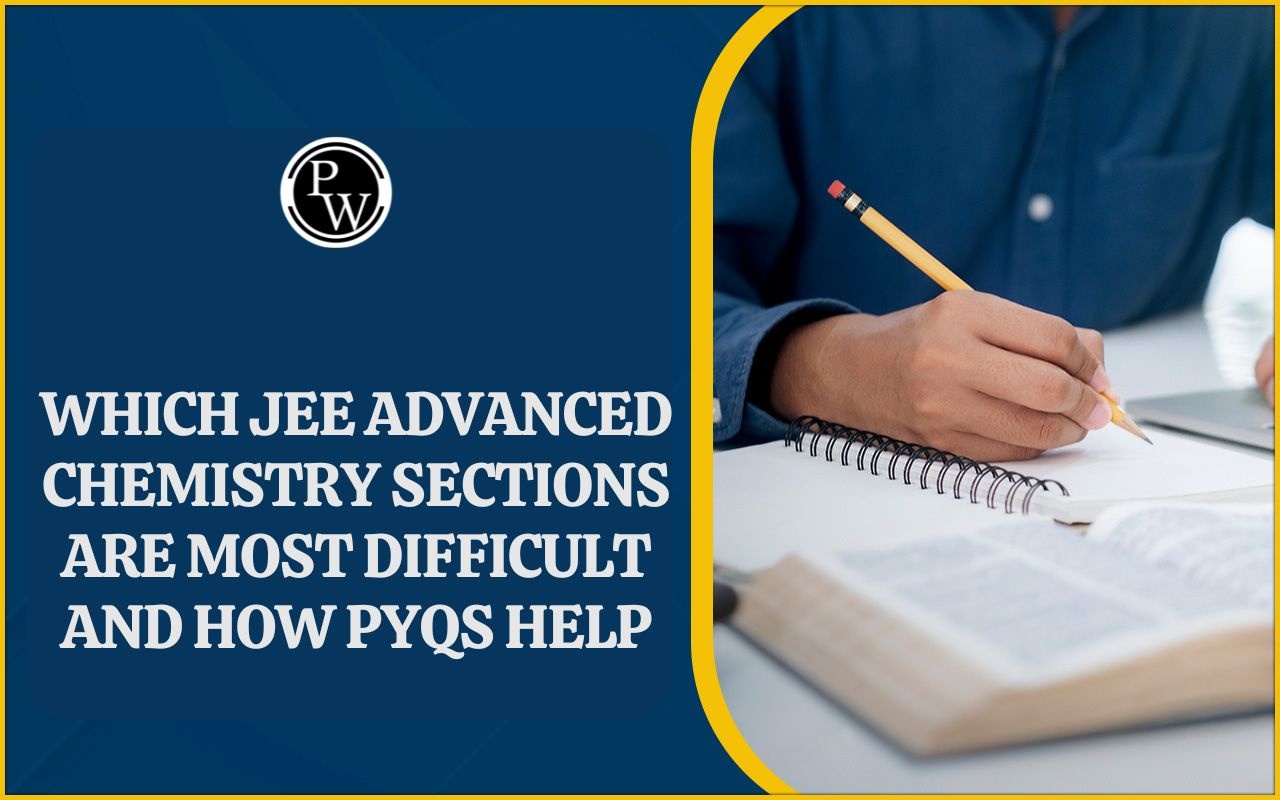
Which JEE Advanced Chemistry Sections are Most Difficult and How PYQs Help
The balance between theory and numerical accuracy is a huge challenge for engineering aspirants preparing for the Indian Institutes of Technology. Many students often struggle to know what to focus on critically in the syllabus. This leads to inefficient study schedules and lost marks. Targeted JEE Advanced chemistry PYQ strategy is the perfect approach to decode this tricky exam pattern.
Importance of JEE Advanced Chemistry PYQ
JEE Advanced Chemistry requires a balance of conceptual understanding, logical application, and accurate recall. Some sections involve complex reactions, multi-step calculations, and deeper theoretical applications that can be challenging for aspirants. Analysing JEE Advanced Chemistry PYQ helps students understand which topics are frequently tested, how questions are framed, and what level of application is expected in the exam.
By practising JEE Advanced Chemistry PYQ, students can identify difficult areas, improve their approach to problem-solving, and focus their revision on concepts that require more practice. PYQs also reveal common question patterns and help aspirants develop confidence in handling challenging Chemistry problems under exam conditions.
Most Difficult Chemistry Topics Based on JEE Advanced Chemistry PYQ Analysis
The joint entrance examination does not distribute difficulty levels evenly across the syllabus. Data from past question trends reveals that physical and organic topics carry a substantial portion of the highly complex questions, while inorganic topics generally require structured memory retention.
An estimation of the section-wise distribution and their historical occurrence helps students understand where the most rigorous problem-solving parameters lie.
|
Chemistry Section |
Approximate Syllabus Weightage |
Estimated Historical Difficulty Rating |
|
Physical Chemistry |
Around 43% |
High to Very High |
|
Organic Chemistry |
Around 31% |
High (Complex Multi-Step Mechanisms) |
|
Inorganic Chemistry |
Around 26% |
Moderate to High (Concept Extraction) |
High-Risk Topics in Physical Chemistry
Physical chemistry in the advanced stage shifts away from basic formula application to deeply layered multi-concept problems.
-
Ionic Equilibrium: This is widely considered one of the trickiest segments due to concurrent equilibrium states, complex buffer solutions, and solubility products working simultaneously.
-
Chemical Thermodynamics and Energetics: Questions frequently merge first and second-law equations with real gas behaviours or electrochemical cells.
-
Electrochemistry: This section often combines Faraday's laws with concentration variations, Nernst equation limits, and molar conductivity variations.
Toughest Elements in Organic Chemistry
Organic chemistry requires a strong grasp of visualization and logical deduction because questions rarely focus on a single named reaction.
-
Aldehydes, Ketones, and Carboxylic Acids: This segment holds around the highest complexity rating because it serves as the ultimate ground for multi-step synthesis paths.
-
General Organic Chemistry (GOC) and Isomerism: Stereoisomerism questions involving spatial configurations, optical purity, and conformation stability require extreme precision.
-
Mixed Reagent Pathways: Questions routinely present a single starting material subjected to roughly three to four distinct chemical reagents, demanding flawless recall of reaction mechanisms.
Complex Patterns in Inorganic Chemistry
While considered high-scoring by many, specific chapters involve multi-layered reasoning instead of straightforward rote learning.
-
Coordination Compounds: Splitting fields, structural isomerism, and magnetic behaviour calculations create multi-correct options that are highly prone to negative marking.
-
Qualitative Salt Analysis: Tracking distinct colour changes, gas evolutions, and precipitate formations across various groups demands a structured mental map.
Benefits of Solving JEE Advanced Chemistry PYQ
Attempting to clear this examination with just textbook theories is insufficient because the question formats are deliberately designed to test deep logical boundaries. Working with a dedicated JEE advanced chemistry PYQ framework is a proven method to bridge the gap between basic theory and actual exam execution.
Decoding the Shifting Exam Patterns
The examination structure is highly dynamic, featuring single-correct choices, multiple-correct options, matrix matchings, and integer-type values. Regularly practising a chemistry PYQ JEE advanced resource helps students get accustomed to these shifts so they do not feel overwhelmed during the actual test.
Mastering the Multiple-Correct Option Matrix
Multiple-choice questions with more than one correct option are highly risky due to partial marking rules and heavy negative penalties. Reviewing a historic organic chemistry JEE advanced PYQ collection shows that missing even one hidden structural trait can result in zero or negative marks. Consistent practice teaches you when to confidently pick an option and when to stop to prevent losing marks.
Enhancing Solving Speed and Numerical Precision
Physical chemistry problems often involve lengthy calculations with tricky decimal values. Working through a structured physical chemistry JEE advanced PYQ database trains your mind to complete multi-step approximations without making silly mathematical errors under strict exam timelines.
How to Get the Most Out of JEE Advanced Chemistry PYQ?
To get the maximum benefit from past papers, students must adopt a methodical, structured workflow rather than randomly attempting questions.
Step 1: Chapter-Wise Isolation
Do not jump straight into full-length papers at the start of your preparation. Focus on completing a single chapter, and then immediately open your JEE advanced PYQ chemistry archives to solve every question linked to that topic from the past years. This method instantly exposes your conceptual blind spots.
Step 2: Time-Bound Practice Sessions
If you are doing past papers, set a strict time limit. For example, if you are working on a set of fifteen integer-type questions, give yourself around thirty-five to forty minutes. This helps to give the actual pressure of the examination hall.
Step 3: Deep Error Diagnosis
If you get a question wrong, don’t just look at the final answer key. Follow the stepwise reaction mechanisms or the actual thermodynamic derivation to see exactly where your logic went wrong.
Best Resources for JEE Advanced Chemistry PYQ Practice
Having the right study material is critical to ensure that your preparation remains aligned with the official examination syllabus.
Look for Chapter-Wise and Topic-Wise Segregation
Using a book that offers nearly five decades of compiled past questions, organized by topic, lets you see exactly how a single concept has evolved over the years. This structural setup is highly efficient for targeted revisions.
Utilize Performance and Trend Analysis Data
Advanced books have critical data insights like average time metrics per question and student success rates from previous exam papers. These insights allow you to clearly distinguish manageable questions from the highly complex traps.
Comparing JEE Advanced Chemistry PYQ and Physics PYQ
When balancing your preparation schedule, it helps to understand how the difficulty dynamics of chemistry contrast with those of other core subjects like physics.
|
Parameters |
Chemistry Section Dynamics |
Physics Section Dynamics |
|
Primary Challenge |
Remembering specific reagent exceptions, mixed reaction paths, and complex equilibrium calculations. |
Understanding advanced calculus applications, rotating frames, and multi-field electromagnetic systems. |
|
Preparation Resource |
Demands thorough usage of a high-quality chemistry PYQ JEE advanced book to map multi-step paths. |
Requires rigorous practice with a dedicated JEE adv physics PYQ reference for core formula derivations. |
|
Time Allocation |
Often allows you to score points faster if your concept recall is swift and precise. |
Generally consumes more time per problem due to step-by-step mathematical derivations. |
For physics, a JEE adv physics PYQ book will help you get better at complex physics concepts and vector math. For chemistry, you need a dual approach: quick conceptual recall and calculated physical approximations. The last but not the least key to get a top rank in the final merit list is to keep the same intensity of practice in both the subjects.
FAQs
Which section is usually considered the hardest in JEE Advanced Chemistry?
Organic and physical chemistry are generally considered the most difficult sections. Specifically, chapters like aldehydes and ketones, ionic equilibrium, and electrochemistry frequently feature complex, multi-concept problems that carry a high risk of negative marking.
How many years of past papers should I practice for this exam?
It is highly recommended to practice around forty to fifty years of past questions. Utilizing an extensive collection like a chapter-wise JEE advanced chemistry PYQ book, helps you analyze long-term pattern trends and master every possible question format.
Why do students lose marks in the multiple-correct question format?
Students often drop marks due to partial marking traps and negative penalties. Practicing with an authentic JEE advanced PYQ chemistry resource helps you build the necessary precision to evaluate each option independently and avoid guessing.
Is physical chemistry tougher than organic chemistry in the advanced exam?
Physical chemistry demands deep numerical accuracy and formula derivation, whereas organic chemistry requires visualizing multi-step reaction mechanisms. Both are equally challenging, and practicing a dedicated physical chemistry JEE advanced PYQ collection is essential to build strong calculation speed.
Can I clear the chemistry cutoff by only preparing inorganic chemistry?
No, relying solely on inorganic chemistry is highly risky. The advanced exam frequently blends concepts across all three sections, meaning a comprehensive study plan supported by a reliable organic chemistry JEE advanced PYQ guide is vital for a safe score.