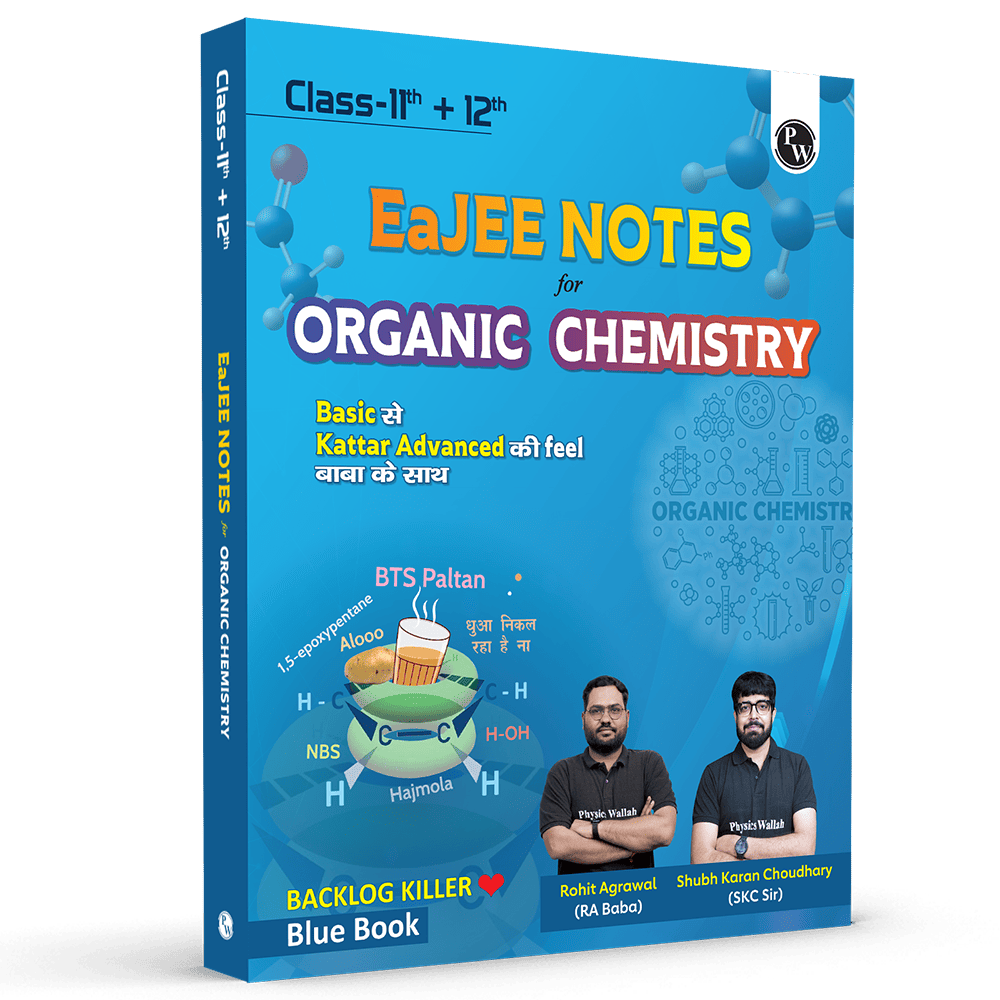
Who are EAJee Organic Chemistry Notes Designed for — JEE Main or Advanced

Preparing for the Joint Entrance Examination requires an absolute mastery over reaction paths, structures, and synthesis patterns. Many engineering aspirants struggle to find a single resource that balances basic concept-building with high-level analytical application.
This leaves students balancing multiple textbooks, wasting precious time. If you are trying to understand whether the JEE organic chemistry notes fit your specific preparation phase, this comprehensive structural breakdown provides the answer.
Importance of JEE Organic Chemistry Notes
Many students find textbooks difficult because they contain long explanations and complex language.
Handwritten notes make learning easier by presenting information in a simple and visual format.
The notes feel like classroom teaching rather than textbook reading.
Features of JEE Organic Chemistry Notes
Let’s discuss some of the best features of the JEE Organic Chemistry notes that will help with your exam preparations in the best way:
3000+ Practice Questions with PYQs
These notes include more than 3000 practice questions and JEE PYQs. They help students improve concepts, increase problem-solving speed, and prepare effectively for both organic chemistry for JEE Main Advanced.
Mechanisms for Every Reaction
Every reaction is explained with a detailed mechanism. These handwritten notes help students understand electron movement, bond formation, and reaction pathways in a simple and easy-to-follow format.
BTS Reaction Explanations
Each reaction includes BTS (Behind The Scenes) explanations that highlight important reaction behavior, exceptions, and key concepts. These insights help students understand reactions better and solve questions more accurately.
Chapter Summaries for Quick Revision
Every chapter comes with a short summary covering the most important points. These summaries are useful for quick revision before tests, mock exams, and JEE examinations.
Real Classroom Learning Experience
The notes are designed to feel like a real classroom session. Simple explanations and practical insights make learning easier and help students understand concepts more clearly.
Quick Reference Appendix
A quick reference appendix helps students find important reactions, reagents, and concepts easily. It is especially useful for fast revision before exams.
Multicoloured Handwritten Notes
These handwritten notes use multiple colours to make learning more visual and engaging. The colourful format helps students understand complex topics faster and remember them for longer.
Who Should Use JEE Organic Chemistry Notes?
These notes are useful for students preparing for both JEE Main and JEE Advanced. The content follows a step-by-step learning approach. Students first learn the basics and then move towards advanced concepts and reaction mechanisms.
For JEE Main Students
Students preparing for JEE Main can use these notes to:
-
Learn important concepts quickly
-
Revise named reactions easily
-
Improve speed and accuracy
-
Understand important exam topics
-
Prepare for direct and concept-based questions
The notes include summaries, quick revision sections, and important reactions that are commonly asked in exams.
For JEE Advanced Students
Students preparing for organic chemistry for jee advanced can use these notes to:
-
Understand detailed reaction mechanisms
-
Learn stereochemistry clearly
-
Study advanced reaction pathways
-
Solve multi-step reaction problems
-
Improve analytical thinking
The detailed explanations help students tackle difficult and unfamiliar questions confidently.
How Multicolored JEE Organic Chemistry Notes Help?
One of the biggest advantages of these notes is their multicolored handwritten format. Different colors help students understand reactions more clearly and improve visual retention during revision. When combined with a JEE Revision Book, students can organize concepts better, revise more efficiently, and connect theory with problem-solving in a structured way.
Easy Reagent Identification
Important reagents and catalysts are highlighted clearly so students can remember reaction conditions easily.
Better Electron Movement Tracking
Different colours are used for reaction arrows and electron movement. This helps students follow reaction mechanisms step by step.
Easy-to-Find Exceptions
Special cases and exceptions are highlighted separately. This reduces mistakes during exams. The visual format improves memory and makes revision much faster.
How to Use JEE Organic Chemistry Notes for JEE Main
Success in organic chemistry for JEE Main depends on speed, accuracy, and regular revision. These notes include several features that help students prepare effectively.
Use Chapter Summaries
Every chapter includes a short summary with important concepts and reactions. These summaries are useful before tests and mock exams.
Revise Using the Appendix
The quick reference appendix helps students find important reactions and reagents quickly. This is especially useful during last-minute revision.
Solve Practice Questions Daily
The notes include a large collection of practice questions. Regular practice improves speed and helps students identify weak areas.
|
JEE Main Question Type |
Notes Feature |
Benefit |
|
Named Reactions |
Highlighted reagents |
Faster recall |
|
Concept Questions |
BTS explanations |
Better understanding |
|
Numerical and Integer Questions |
Quick reference appendix |
Faster revision |
This structure helps students prepare for different question types effectively.
How JEE Organic Chemistry Notes Help in JEE Advanced?
The Advanced exam tests understanding rather than simple memorisation. Students need to know how reactions work, not just the final products. This is where organic chemistry for JEE Advanced becomes more challenging.
Detailed Reaction Mechanisms
Every reaction includes step-by-step mechanisms.
Students can follow:
-
Electron movement
-
Intermediate formation
-
Bond breaking
-
Bond formation
-
Rearrangement reactions
This helps students understand reactions deeply.
BTS Reaction Insights
A unique feature of these notes is the BTS (Behind The Scenes) section.
These sections explain why reactions behave differently under certain conditions.
Topics include:
-
Solvent effects
-
Steric effects
-
Temperature changes
-
Reaction exceptions
These explanations are very useful for solving difficult Advanced-level questions.
How is the Chapterwise Division in the JEE Organic Chemistry Notes?
Yes. The notes are organized as complete JEE chapterwise organic chemistry notes, helping students study chapter by chapter without confusion. Resources such as the EaJEE Handwritten Notes Combo Set of 3 Books further support structured preparation by presenting concepts in an organized sequence, making revision smoother and helping students track progress more effectively across all chemistry sections.
This section covers:
-
Inductive effect
-
Resonance
-
Electromeric effect
-
Hyperconjugation
These concepts form the base of organic chemistry.
Isomerism
Students learn:
-
Structural isomerism
-
Geometrical isomerism
-
Optical isomerism
Visual diagrams make these concepts easier to understand.
Hydrocarbons
This section covers:
-
Alkanes
-
Alkenes
-
Alkynes
-
Their properties and reactions
Functional Groups
Separate chapters cover:
-
Alkyl Halides
-
Alcohols
-
Phenols
-
Ethers
-
Aldehydes
-
Ketones
-
Carboxylic Acids
-
Nitrogen Compounds
Biomolecules and Polymers
Important exam topics such as amino acids, carbohydrates, and polymers are explained in a simple way.
This chapter-wise structure makes studying organized and stress-free.
How to Manage Time with JEE Organic Chemistry Notes?
Many students spend a lot of time making their own notes while preparing for JEE. Although creating notes can be helpful, it often takes hours of valuable study time. In many cases, students miss important concepts, leave chapters incomplete, or spend more time writing than actually learning.
Using expert-made JEE organic chemistry handwritten notes helps save both time and effort because everything is already arranged in a clear and easy-to-follow format. Instead of creating notes from scratch, students can focus directly on understanding concepts, practicing questions, and revising important topics.
These notes provide everything needed for effective preparation in one place, including:
-
Complete theory for every chapter
-
Detailed reaction mechanisms explained step by step
-
Quick revision notes for faster review
-
BTS (Behind The Scenes) explanations for deeper understanding
-
More than 3000 practice questions
-
Previous Year Questions (PYQs)
Because all the important information is already organized, students do not have to search through multiple books, PDFs, or websites. This makes studying more efficient and reduces confusion during preparation.
The chapter-wise structure also helps students move through the syllabus in a systematic way. Whether you are preparing for JEE Main or JEE Advanced, these notes help you learn faster, revise more effectively, and spend more time solving questions instead of making study material. This can make a big difference during the final months before the exam when every hour of preparation matters..
Read More: Chemistry All Formulas for JEE Preparation
JEE Organic Chemistry Notes FAQs
Can I use these notes for JEE Advanced preparation?
Yes. These notes are designed to support students preparing for both JEE Main and JEE Advanced. The notes include detailed reaction mechanisms, step-by-step electron movement, stereochemistry concepts, and advanced reaction pathways that are important for organic chemistry for JEE Advanced.
How do JEE organic chemistry handwritten notes help visual learners?
JEE organic chemistry handwritten notes are very helpful for visual learners because they use a multicoloured format, clear diagrams, and easy-to-follow reaction mechanisms. Different colours are used to highlight reagents, catalysts, electron movement, and important reaction steps.
Are there enough questions for organic chemistry for JEE Main?
Yes. These notes include more than 3000 practice questions along with a large collection of Previous Year Questions (PYQs). This provides excellent preparation for JEE Main by helping students practice different question types and difficulty levels.
Are these complete JEE chapterwise organic chemistry notes?
Yes. These are complete JEE chapterwise organic chemistry notes that cover all major topics included in the JEE syllabus. This structured approach makes learning easier and helps students build strong concepts from basic to advanced levels.
Why are these notes easier than textbooks?
These notes are easier to study than traditional textbooks because they use simple language, colourful diagrams, and classroom-style explanations. Instead of long and difficult paragraphs, information is presented in a clear and easy-to-understand format. Important concepts, reaction mechanisms, and exceptions are highlighted so students can focus on what matters most.