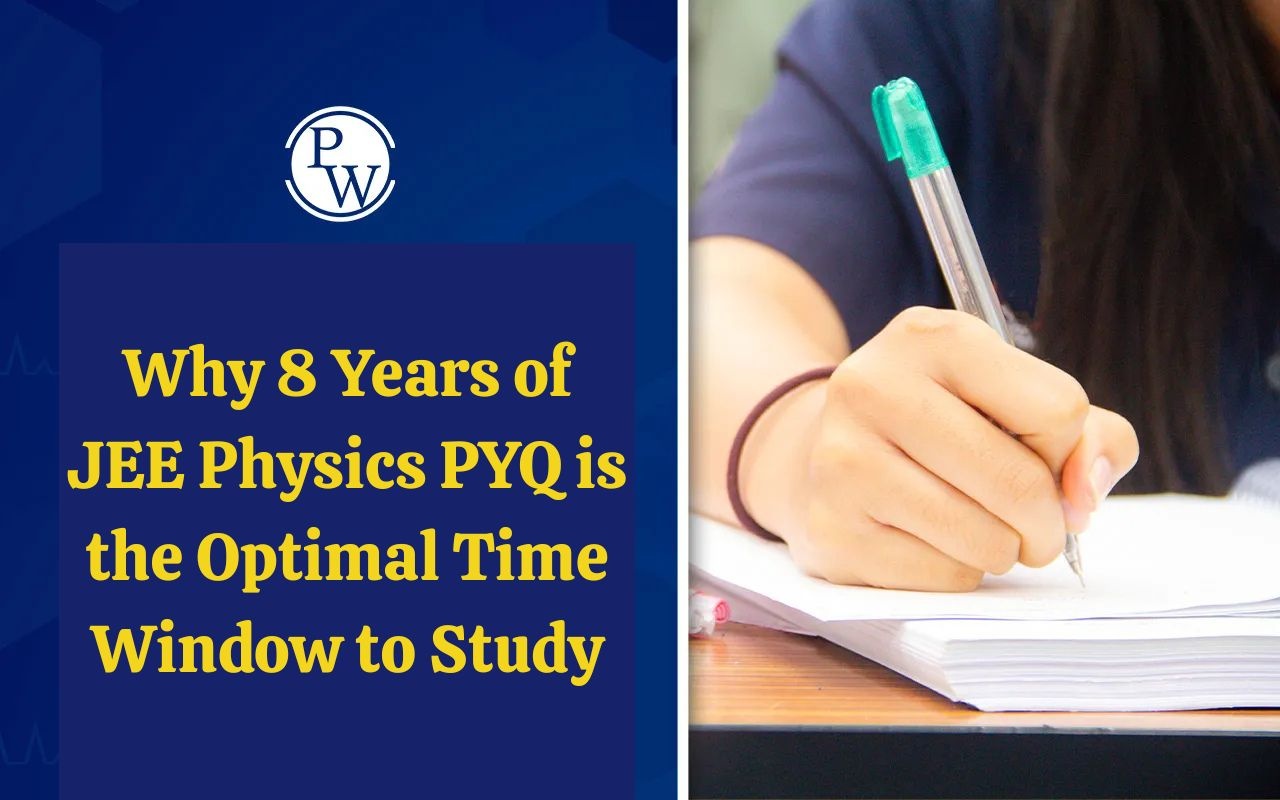
Why 8 Years of JEE Physics PYQ is the Optimal Time Window to Study
Preparing for national engineering entrances requires a strategic balance between past trends and recent exam patterns. Focusing on an 8-year time frame of JEE main physics PYQ provides aspirants with the exact volume of questions needed to understand the current testing standards without feeling overwhelmed by outdated syllabi.
JEE Main Physics PYQ Overview
The Physics PYQ serves as the most authentic blueprint for engineering aspirants across the country. Over the last few years, the National Testing Agency (NTA) has significantly modified the structure, difficulty level, and variety of questions asked in the exam. This makes past questions an essential component of a regular study routine.
By analysing these papers, students can understand how theoretical concepts translate into application-based numerical items. Instead of relying purely on mock tests created by external sources, practicing official questions gives candidates a direct look into the minds of the paper setters.
It helps students familiarise themselves with the language, task options, and marking schemes used in the actual exam.
How 8 Years of JEE Main Physics PYQ Helps You Prepare Better
Focusing on an 8-year window for PYQ ensures that candidates practice with highly relevant material.
The period from 2019 to 2026 represents a massive shift in the engineering entrance ecosystem, introducing multiple shifts per session and the inclusion of numerical value questions.
-
Reflects Modern Exam Patterns: The exam pattern underwent a massive overhaul in recent years. Going back further than 8 years often introduces outdated question formats that no longer match the current distribution of marks.
-
Massive Question Pool: With multiple shifts conducted every year, an 8-year span provides access to over 162 unique question paper sets. This translates to more than 4,500 premium questions to practice.
-
Avoids Redundancy: Older papers may include patterns or topics that are less aligned with the current syllabus, leading to a waste of precious preparation time.
-
Accurate Difficulty Benchmarking: The difficulty level of the physics section has stabilised over the last eight years. Studying this specific timeline ensures students prepare for the exact level of complexity they will face on exam day.
8 Year JEE Main Physics PYQ Features
An objective analysis of the past 8 years of Physics PYQ reveals distinct structural benefits that can change how a candidate approaches their daily study sessions.
1. Topic-Wise and Chapter-Wise Categorisation
The modern 8-year compilation breaks down a massive pool of questions into distinct chapters. Using a curated JEE mains PYQ chapterwise physics framework allows students to finish a chapter from their textbook and immediately test their understanding against actual exam questions from that exact topic.
2. Inclusion of Multiple Question Formats
The last 8 years perfectly capture the transition of the exam into a dual-format paper. Candidates get to practice both standard Multiple Choice Questions (MCQs) and the newer Numerical Value Questions, which require precise calculation and step-by-step problem-solving.
3. Clear Trend Distribution
An 8-year review offers a stable sample size to see which parts of mechanics, electrodynamics, optics, and modern physics receive consistent weightage year after year.
Benefits of JEE Main Physics PYQ
Dedicated practice of Physics PYQ from the past 8 years delivers clear competitive advantages to serious engineering aspirants.
-
Development of Critical Thinking: Solving actual exam questions teaches students how to combine multiple physics formulae to solve a single complex problem.
-
Elimination of Exam Anxiety: Working through official questions builds genuine confidence. Students realise that the actual exam is manageable if their core concepts are clear.
-
Improved Question Selection Skills: With 162 sets of papers available, students learn to identify which questions are quick to solve and which ones are designed to be time-consuming traps.
-
Error-Free Solution Learning: Aligning practice with verified answer keys helps students understand the exact step-marking logic and accurate calculation methods required to score high marks.
When to Use 8 Years of JEE Main Physics PYQ?
Timing is critical when integrating JEE Main PYQs into an engineering preparation schedule. Using these resources at the wrong stage can lead to confusion or false confidence.
|
Preparation Stage |
How to Utilise the 8-Year Papers |
|
Initial Chapter Completion |
Solve chapter-specific questions immediately after finishing classroom notes. |
|
Mid-Term Assessment |
Use random question sets to check long-term retention of older chapters. |
|
Pre-Board Seasons |
Balance subjective school preparation with objective past papers. |
|
Final Months Before Exam |
Solve full 3-hour shift papers under strict exam-like conditions. |
How to Use 8 Years of JEE Main Physics PYQ?
To get the most out of the PYQ, students must move away from casual reading and adopt an active problem-solving methodology.
-
Attempt Without Solutions: Always try to solve a question at least twice on your own before looking at the printed explanation or step-by-step guide.
-
Time Each Session: Use a stopwatch when solving a block of questions. Aim to spend no more than two to three minutes on a single physics numerical item.
-
Maintain a Error Log Book: Write down every formula mistype, calculation error, or conceptual misunderstanding discovered during practice in a separate notebook.
-
Cross-Reference with Reference Material: If a particular topic from JEE PYQ physics causes repeated errors, immediately go back to your theory notes to fix the conceptual gap.
Study Plan with JEE Main Physics PYQ
A structured study routine ensures that students do not get lost in the sheer volume of questions available across 162 exam sets.
Step 1: The Theory-to-Practice Transition
Never jump into past papers without reading the basic theory first. Finish your class notes, learn the core derivations, and then open the JEE chapter wise PYQ physics archive to start your practice.
Step 2: High-Weightage Prioritisation
Begin with chapters that yield the maximum number of questions every year. Topics like Modern Physics, Current Electricity, and Semiconductor Devices consistently show up across all shifts and should be prioritised.
Step 3: Mixed Bag Testing
Once you finish a unit like Mechanics, do not just solve questions from individual sub-topics. Mix the questions together to train your brain to identify which specific formula applies to an unlabelled question.
Common Mistakes While Using JEE Main Physics PYQ
Many students fail to improve their scores despite having access to high-quality PYQs due to poor study habits.
-
Memorising the Answers: Physics requires conceptual application. Memorising the final numerical answer or option key of a past question is completely useless, as numbers change every year.
-
Over-Reliance on Digital Files: Flipping through a JEE mains PYQ physics PDF on a mobile screen often leads to passive reading. Physics demands physical rough work, calculation, and active writing.
-
Ignoring the Numerical Section: Many students only practice MCQs and leave out the integer-type questions, missing out on crucial practice for sections where there are no options to guide guessing.
-
Starting with Outdated Papers: Beginning preparation with questions from the early 2000s can misguide students regarding the current difficulty level and style of questions.
FAQs
Why is an 8-year window better than a 20-year window for JEE Main PYQ Physics?
An 8-year window focuses purely on the modern NTA pattern, multiple shifts, and current syllabus guidelines. Older papers often contain deleted topics and question formats that do not match the current exam style.
How should I manage the time limit when solving past physics questions?
You should aim to solve each physics question within 2 to 2.5 minutes. Timing your practice sessions helps you build the speed and accuracy needed to handle the real test environment effectively.
Are numerical value questions from past years important?
Yes, numerical value questions make up a significant portion of the current exam structure. Practicing past integer-type items helps you avoid calculation errors and improves your precise problem-solving skills.
How does chapter-wise separation of past questions help in preparation?
A chapter-wise layout allows you to test your understanding of a specific topic immediately after studying its theory, helping you identify and fix your weak areas before moving on to the next chapter.