How to Find Your Weak Topics Through AIBE Previous Year Papers
Mid-term assessment periods often bring a sudden realization: reading theoretical legal textbooks is quite different from answering objective exam questions under pressure. Many candidates feel confident during initial reading, only to struggle when faced with scenario-based questions, case law applications, or updated statutory provisions.
If you feel uncertain about where your preparation stands midway through your schedule, evaluating your current accuracy is essential. Solving AIBE previous year papers offers an honest reflection of your subject grasp. By analyzing where you make repeated errors across authentic questions, you can transform vague study hours into targeted revision sessions that boost confidence.
Importance of AIBE Previous Year Papers
Working through actual historical test materials provides direct exposure to the structure, difficulty, and phrasing used by examiners. Systematic AIBE question practice helps bridge the gap between abstract textbook knowledge and practical test execution.
-
Understanding Real Exam Trends: Reviewing past papers reveals how question distributions shift across constitutional law, criminal procedure, civil procedure, and corporate regulations.
-
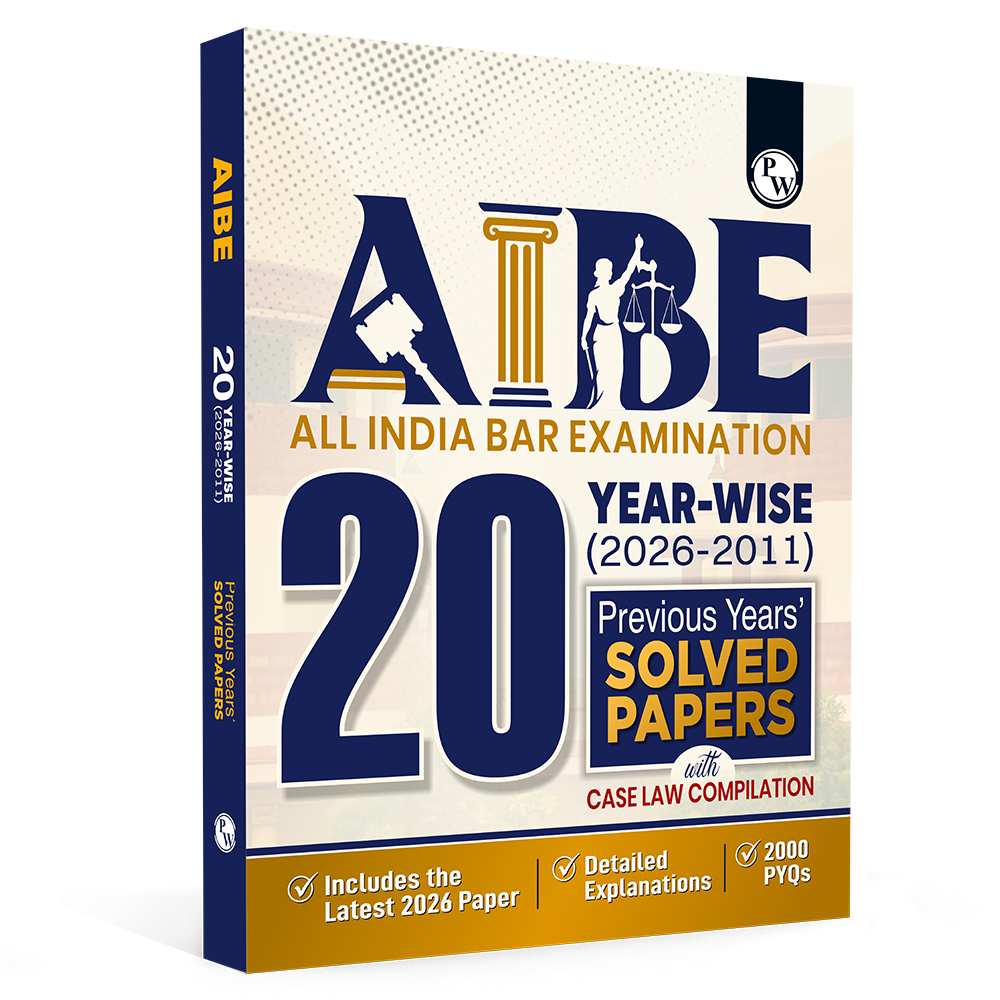
Exposure to Updated Statutes: Comprehensive resources covering 20 yearwise solved papers (2011–2026) incorporate recent statutory changes such as BNS, BNSS, and BSA 2023 alongside standard subjects.
-
Detailed Solution Analysis: Accessing step-by-step answers allows you to trace the exact rationale behind correct choices, clarifying why incorrect choices were wrong.
-
Case Law Familiarity: Dedicated compilations within past paper sets help reinforce essential legal precedents frequently tested in scenario questions.
How Do AIBE Previous Year Papers Help You Find Weak Topics
Analyzing your mock test results reveals explicit patterns in performance. Using AIBE PYQs exposes areas where memory fails, concepts remain hazy, or timing lapses occur during test attempts.
-
Differentiating Confusion from Guesswork: Regular practice helps separate genuine subject understanding from accidental correct guesses.
-
Identifying Recurrent Subject Gaps: When you track wrong answers over multiple papers spanning 2011 to 2026, specific legal subjects consistently emerge near the bottom of your scoring sheet.
-
Measuring Conceptual versus Procedural Errors: Error tracking helps determine whether a mistake stemmed from misinterpreting a principle or confusing a procedural timeline.
How to Use AIBE Previous Year Papers to Check Your Weak Areas
Using AIBE 20 Years PYQ material and Judiciary Books requires an organized approach rather than random reading. Mid-term revision works best when divided into thematic blocks.
-
Attempt Papers Under Exam Conditions: Complete a full set of 100 questions from a past year paper without checking notes or legal commentaries mid-way.
-
Categorize Your Responses: Mark every question into three distinct buckets: Completely Confident, Educated Guess, or Unaware.
-
Cross-Check Solutions: Match your answers against the detailed step-by-step solutions provided in standard reference collections.
-
Log Mistakes into a Topic Matrix: Create a chart listing every subject (e.g., Family Law, Law of Tort, Evidence Act/BSA) and tally every incorrect or guessed attempt under its respective head.
-
Calculate Subject-Wise Accuracy Rates: Divide correct responses by total attempted questions per subject to isolate areas falling below acceptable performance thresholds.
When to Solve AIBE Previous Year Papers for Topic-Wise Practice
Timing your practice sessions determines how effectively you retain information during mid-term study schedules.
|
Phase of Study |
Primary Objective |
Paper Practice Strategy |
|
Mid-Term Diagnostic Phase |
Uncover unknown conceptual gaps |
Attempt 2–3 full past papers from recent years (2020–2026) to establish baseline scores. |
|
Topic-Wise Remediation |
Strengthen specific weak subjects |
Solve sets of 2000 solved questions grouped specifically by topic area. |
|
Final Revision Phase |
Build speed and exam confidence |
Complete remaining full-length papers under strict timing constraints. |
Study Strategy with AIBE Previous Year Papers for Weak Topics
Once you identify compromised areas using AIBE weak topics diagnostic logs, restructure your study strategy using this balanced cycle:
-
Targeted Bare Act Reading: Revisit relevant statutory sections, state modifications, and schedules for subjects yielding low accuracy scores.
-
Review Updated Legislations: Ensure your revision incorporates recent legal codes, including BNS, BNSS, and BSA 2023, which replace older criminal frameworks.
-
Analyze Case Law Compilations: Re-read landmark judgements and recent rulings tied directly to subjects where scenario-based questions caused confusion.
-
Re-test via Focused Question Sets: Solve targeted question subsets from the 2000 solved questions archive to verify that accuracy in problem areas improves.
Tips to Find Weak Topics Using AIBE Previous Year Papers
Refining your review technique with an AIBE PYQ PDF makes finding problem areas faster and more accurate.
-
Track Speed Alongside Accuracy: Note questions that take over two minutes to solve, even if answered correctly; long resolution times indicate weak conceptual familiarity.
-
Pay Attention to Subtle Distinctions: Distinguish between misreading the question text and missing core statutory principles.
-
Maintain an Error Journal: Write down every incorrect question along with its step-by-step explanation to prevent repeating similar mistakes on future attempts.
-
Utilize Updated Study Guides: Choose authentic yearwise solved paper compilations (2011–2026) that reflect modern exam patterns and new law integrations.
Common Mistakes to Avoid While Using AIBE Previous Year Papers
Avoid these common traps during your mid-term study period to ensure your AIBE preparation yields accurate diagnostic feedback:
-
Memorizing Answers Without Reading Explanations: Learning answer keys by rote without studying detailed step-by-step solutions prevents you from solving modified questions on similar topics.
-
Ignoring Outdated Statutes: Studying past questions without checking their alignment with new criminal laws (BNS, BNSS, BSA 2023) leads to learning obsolete statutory provisions.
-
Practicing Exclusively in Open-Book Mode: Relying on Bare Acts during early diagnostic attempts masks underlying weaknesses that need attention before test day.
-
Skipping Subject-Wise Error Analysis: Marking papers without logging wrong answers by topic leaves you without clear data on where to focus revision efforts.
AIBE Previous Year Papers FAQs
How many years of past papers should I solve for AIBE ?
Solving 20 yearwise papers spanning from 2011 to 2026 provides comprehensive coverage of question trends and exam patterns.
How do I know if a topic is truly a weak area?
If your accuracy score in a specific subject remains consistently below 60% across 3 to 4 past papers, that topic requires dedicated revision.
Do past papers cover new legal codes like BNS, BNSS, and BSA 2023?
Updated solved paper compilations integrate recent updates for BNS, BNSS, and BSA 2023 alongside traditional subject coverage.
Is solving 2,000 past questions enough to pass the exam?
Practicing 2000 solved questions alongside studying detailed step-by-step solutions builds strong conceptual clarity and improves exam speed.
Should I analyze solutions even for questions I answered correctly?
Yes, reading detailed step-by-step solutions verifies whether your underlying legal logic was sound or if you simply guessed correctly.