Improve Kids Handwriting with Cursive Writing Journey Books
Learning cursive writing helps children develop better motor skills and faster note-taking abilities. By using structured workbooks, kids can move from simple letter formation to writing full sentences with confidence and flow. This article explores how these resource turn a complex task into an enjoyable daily habit.
Check Out: PW Kids' Books
Importance of Cursive Writing Books
Writing by hand is a core part of early education. While typing is common today, cursive writing requires a specific type of hand-eye coordination that helps the brain process information more deeply. It is not just about making letters look pretty; it is about building a connection between thought and action.
Many parents notice that children struggle with messy print handwriting or slow writing speeds during exams. Introducing a cursive handwriting workbook early on can solve these issues. These books provide the necessary repetition and structure to help children understand the tilt, spacing, and connection of letters, which are the foundations of legible penmanship.
Features of the Cursive Writing Books
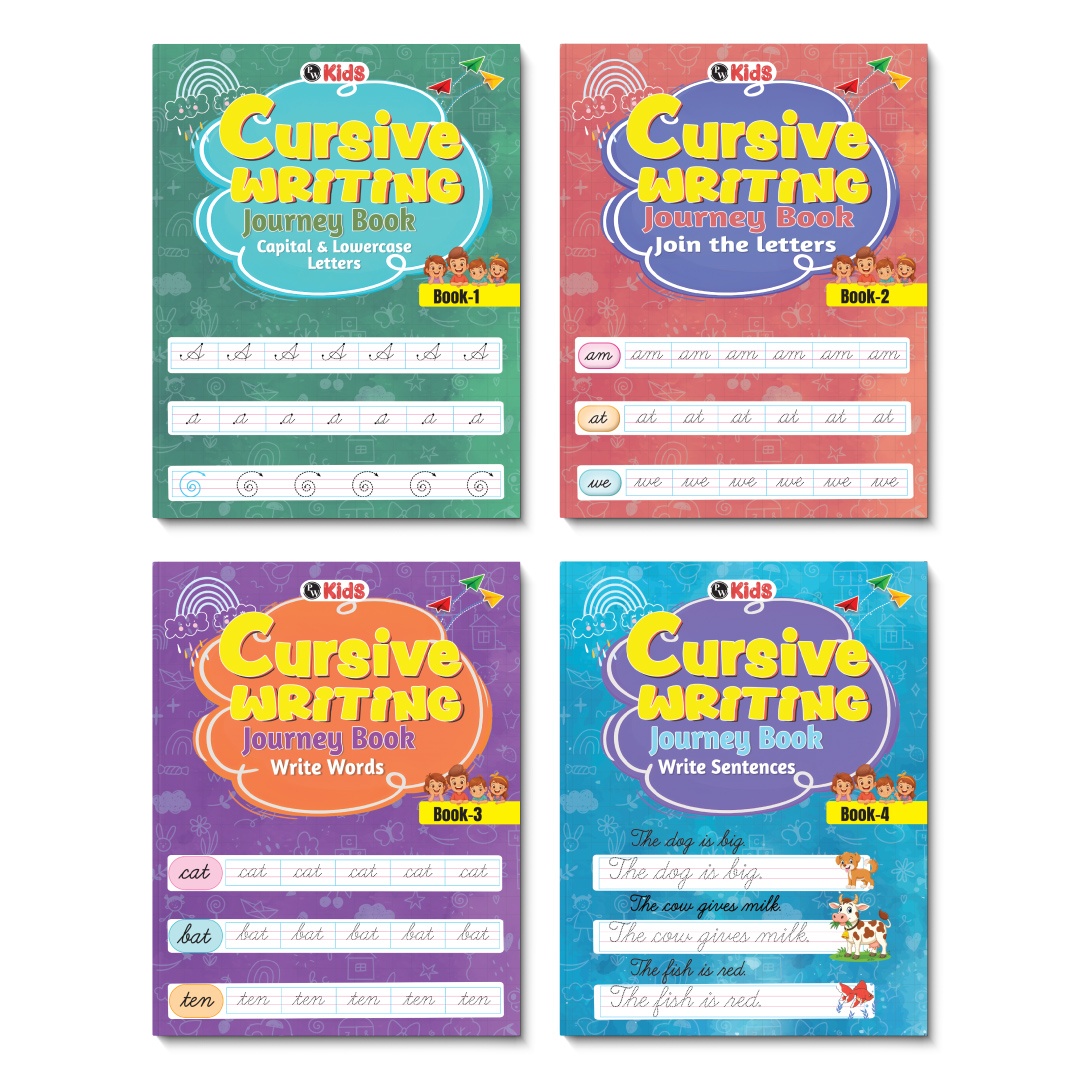
When selecting tools for handwriting skills development for kids, the quality of the material matters. Kids Cursive Writing books are designed to be a step-by-step companion for young learners. They take a child from the very basics to advanced sentence construction without feeling overwhelmed.
|
Feature |
Description |
|
Guided Patterns |
Dotted lines that show exactly where to start and end a stroke. |
|
Progressive Difficulty |
Starts with individual letters and moves to joining words. |
|
Visual Cues |
Arrows and numbers to indicate the direction of the pen movement. |
|
Practice Space |
Plenty of blank ruled lines to replicate the guided examples. |
The set is structured to ensure that the child does not get bored. It includes engaging exercises that make the process of cursive writing feel like a creative journey rather than a repetitive chore.
How to Improve Handwriting with Cursive Writing?
Consistency is the most important factor when trying to improve children's handwriting. It is better to practice for 15 minutes every day than for two hours once a week. Setting up a dedicated workspace with the right table height and lighting can also make a significant difference.
-
Check the Grip: Ensure the child is using a tripod grip (holding the pen between the thumb and index finger, resting on the middle finger).
-
Focus on Posture: The child should sit straight with feet flat on the floor to maintain stability while writing.
-
Start with Patterns: Before writing letters, let the child draw waves, loops, and circles to loosen up the wrist.
-
Use the Right Tools: A high-quality English cursive writing book for kids provides the exact framework needed for steady progress.
-
Encourage Patience: Cursive is a skill that takes time. Celebrate small wins, like a perfectly formed 'f' or a well-connected word.
Benefits of Cursive Writing Books
Using a dedicated English cursive writing book for kids offers several advantages that general notebooks cannot provide. These books are designed with specific line heights and guided paths to assist in the development of muscle memory.
-
Better Finger Dexterity: The continuous strokes of cursive require children to use smaller muscles in their hands.
-
Reduced Letter Reversals: Because cursive letters look very different from one another, children are less likely to mix up letters like 'b' and 'd'.
-
Increased Writing Speed: Once the pen does not have to lift off the paper for every letter, the speed of writing increases naturally.
-
Enhanced Focus: Following the loops and curves of a cursive handwriting workbook encourages a child to stay patient and focused on the task at hand.
Check Out: Kids Activity Books
How to Choose Cursive Writing Books for Kids
Not all workbooks are created equal. Some are too cluttered, while others lack enough practice space. When looking for cursive writing books for kids, look for those that use high-quality paper to prevent ink from bleeding through. The layout should be clean and easy for a child to follow without constant adult supervision.
A good workbook will also include "warm-up" pages. These pages help the child get into the rhythm of writing before they start the actual lesson. By using a cursive handwriting workbook that is age-appropriate, you ensure the child remains motivated and sees visible improvement in their schoolwork and personal notes.
Role of Visual Memory in Cursive Writing
Developing cursive writing skills is as much a mental exercise as it is a physical one. Before a child can connect letters fluently, their brain must form a clear mental map of each character's unique shape. Visual memory allows a student to recall the "pathway" of a letter without having to pause and think, which is essential for achieving a high writing speed.
When children use an English cursive writing book for kids, they aren't just tracing lines; they are training their brains to recognise the flow of symbols. This mental recognition is what eventually leads to "automaticity"—the ability to write thoughts down without focusing on the movement of the hand.
-
Letter Recognition: Identifying the subtle differences between cursive ‘r’, ‘n’, and ‘m’ to avoid confusion.
-
Spacing Awareness: Mentally estimating the gap between words to keep the page looking clean.
-
Slant Consistency: Maintaining a uniform tilt, which is a hallmark of professional-looking penmanship.
By focusing on these visual aspects, handwriting improvement books for kids ensure that the transition from conscious effort to natural habit happens much faster.
Check Out: Reading Books
Mistakes to Avoid in Cursive Writing
Every child faces specific challenges when they first start their cursive writing journey. Recognising these hurdles early allows parents and teachers to provide the right support before poor habits become permanent. Most issues stem from either physical tension or a lack of understanding of how letters "anchor" to the lines on the page.
One frequent problem is the "heavy hand," where a child presses too hard on the paper. This leads to hand fatigue and prevents the smooth, gliding motion required for cursive. Using a high-quality cursive handwriting workbook helps address this by providing plenty of "trace-and-copy" exercises that encourage a lighter, more rhythmic touch.
|
Common Challenge |
Simple Solution |
|
Cramped Letters |
Use a cursive handwriting workbook with wider lines to encourage larger, clearer strokes. |
|
Inconsistent Slant |
Rotate the workbook slightly (around 30 degrees) to align with the natural arc of the arm. |
|
Weak Connections |
Practice "air writing" large loops before moving to the english cursive writing book for kids. |
|
Poor Grip |
Use triangular pencil grips to ensure the fingers stay in the correct tripod position. |
Addressing these technical points through consistent use of handwriting skills development for kids tools ensures that the student doesn't feel frustrated. Instead of seeing a messy page, they see a series of small, solvable puzzles that lead to beautiful, flowing script.
Read More: Benefits of Encyclopedia Books for Kids
Kids Handwriting with Cursive Writing Books FAQs
What is the right age to start cursive writing?
Most educators suggest starting around age 7 or 8, once a child has a firm grasp of letter-sound correspondence. However, using cursive writing books for kids can begin earlier if the child shows interest in drawing loops and patterns.
How long does it take to see results?
With daily practice of approximately 15 to 20 minutes, you can expect to see a noticeable change in a child's cursive writing within 4 to 6 weeks.
Are these books suitable for left-handed children?
Yes, the layouts in a standard cursive handwriting workbook are designed to help both right-handed and left-handed children understand letter connections and spacing.
Why is cursive better than print for speed?
In cursive writing, the pen rarely leaves the paper between letters within a word. This flow reduces the time spent repositioning the hand, leading to a faster overall writing pace.
Can these books help older children with messy writing?
Absolutely. Using handwriting improvement books for kids is an effective way for older students to "reset" their habits and learn to write more legibly and with greater discipline.