CLAT Syllabus 2027 - Important Topics and Preparation Books
The CLAT syllabus is a full test of a candidate's reasoning and aptitude skills, not only their ability to memorise things. It has five main parts: English Language, Current Affairs (which includes General Knowledge), Legal Reasoning, Logical Reasoning, and Quantitative Techniques. Students need to be able to read and understand what they read well in order to do well on the CLAT test, which is mostly focused on passages.
To get into one of the top National Law Universities (NLUs), you need more than just hard work. You also need to know how the clat test works and how the CLAT 2026 syllabus is changing. As the competition gets tougher every year, people who want to take the 2027 cycle need to start by figuring out how important certain topics are and picking the correct resources. If you want to know what's going on lately or plan ahead for 2027, this PW Store guide is the best way to go.
Check out: PW Law Books
Understanding the CLAT Exam Pattern
Before going over the CLAT exam syllabus, you need to know how the test is set up. The Common Law Admission Test (CLAT) is a test that you take with a pencil and paper.
|
Feature |
Details |
|
Total Marks |
120 |
|
Number of Questions |
120 (Multiple Choice Questions) |
|
Duration |
2 Hours (120 Minutes) |
|
Marking Scheme |
+1 for correct answer; -0.25 for incorrect answer |
|
Medium |
English |
The clat exam pattern emphasizes "comprehension-based" testing. This means even the Quantitative and Legal sections will be presented in the form of passages.
Section-wise Breakout of the CLAT Syllabus
The clat exam syllabus 2026 and 2027 are divided into five distinct sections. Each requires a unique approach and specific skill sets.
A. English Language (22-26 Questions)
This section tests your ability to read and comprehend complex texts.
-
Core Topics: Reading Comprehension, Vocabulary, Grammar, Contextual Meaning, and Inference-based questions.
-
Prep Tip: Focus on improving your reading speed. Aim to read editorials from The Hindu or The Indian Express daily.
B. Current Affairs including GK (28-32 Questions)
This is the highest-weightage section in the clat syllabus. It tests your awareness of national and international events.
-
Core Topics: Contemporary events of significance from India and the world, Arts and Culture, International Affairs, and Historical events of continuing significance.
-
Prep Tip: Do not just memorize facts. Understand the "background" and "legal implications" of current news stories.
C. Legal Reasoning (28-32 Questions)
The heart of the clat exam syllabus, this section does not require prior knowledge of law but tests your ability to apply legal principles to factual situations.
-
Core Topics: Torts, Contracts, Criminal Law, Constitutional Law, and International Treaties.
-
Prep Tip: You don't need to be a lawyer, but you must be comfortable with "Legal Logic." Practice identifying the 'Principle' and 'Fact' in provided passages.
D. Logical Reasoning (22-26 Questions)
This section evaluates your ability to identify patterns, rectify illogical arguments, and draw conclusions.
-
Core Topics: Analogies, Syllogisms, Critical Reasoning (Strengthening/Weakening arguments), and Cause and Effect.
-
Prep Tip: Focus heavily on Critical Reasoning. Most questions revolve around identifying the author's premise and conclusion.
E. Quantitative Techniques (10-14 Questions)
Though it has the lowest weightage, this section is often the "rank-decider."
-
Core Topics: Data Interpretation (Caselets, Tables, Graphs), Ratios, Percentages, and Averages.
-
Prep Tip: The clat 2026 syllabus standard for Math is Class 10. Focus on speed and mental calculation.
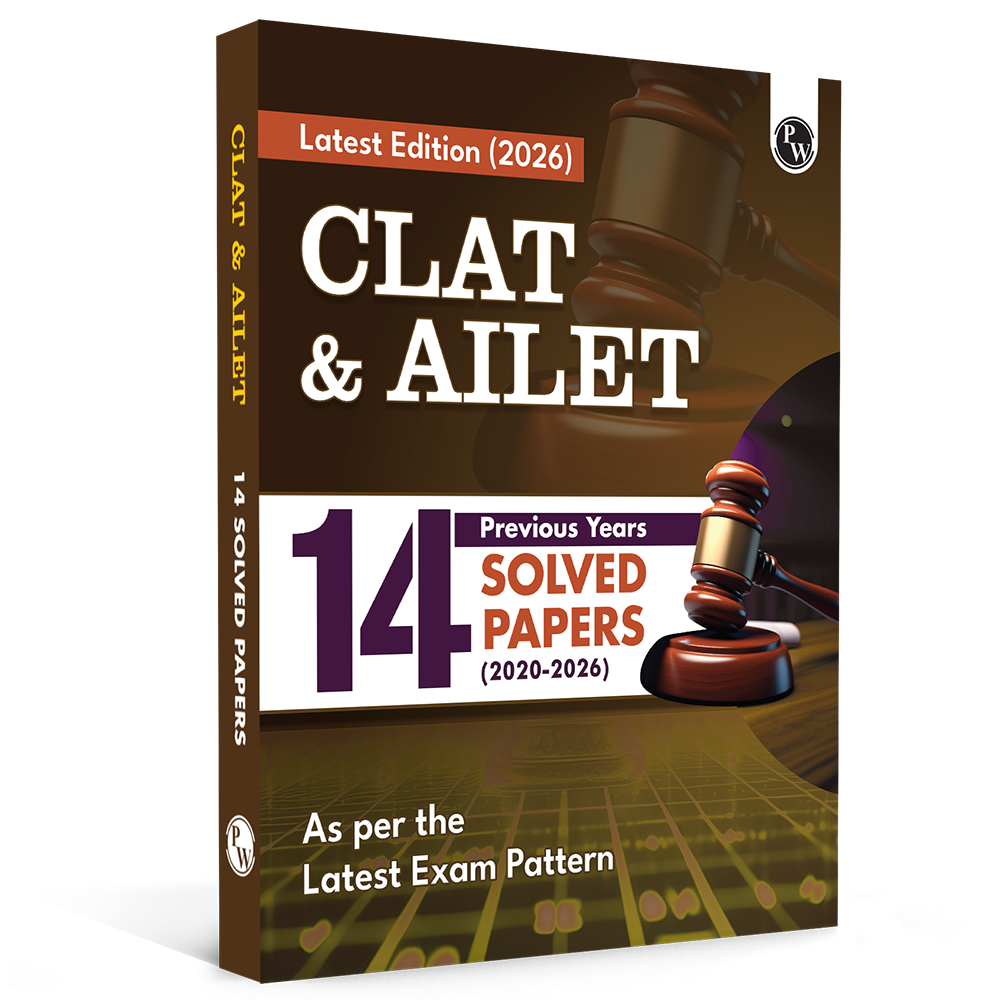
Check Out: CLAT & AILET 14 Previous Years Solved Papers
Recommended Books for CLAT Exam Preparation
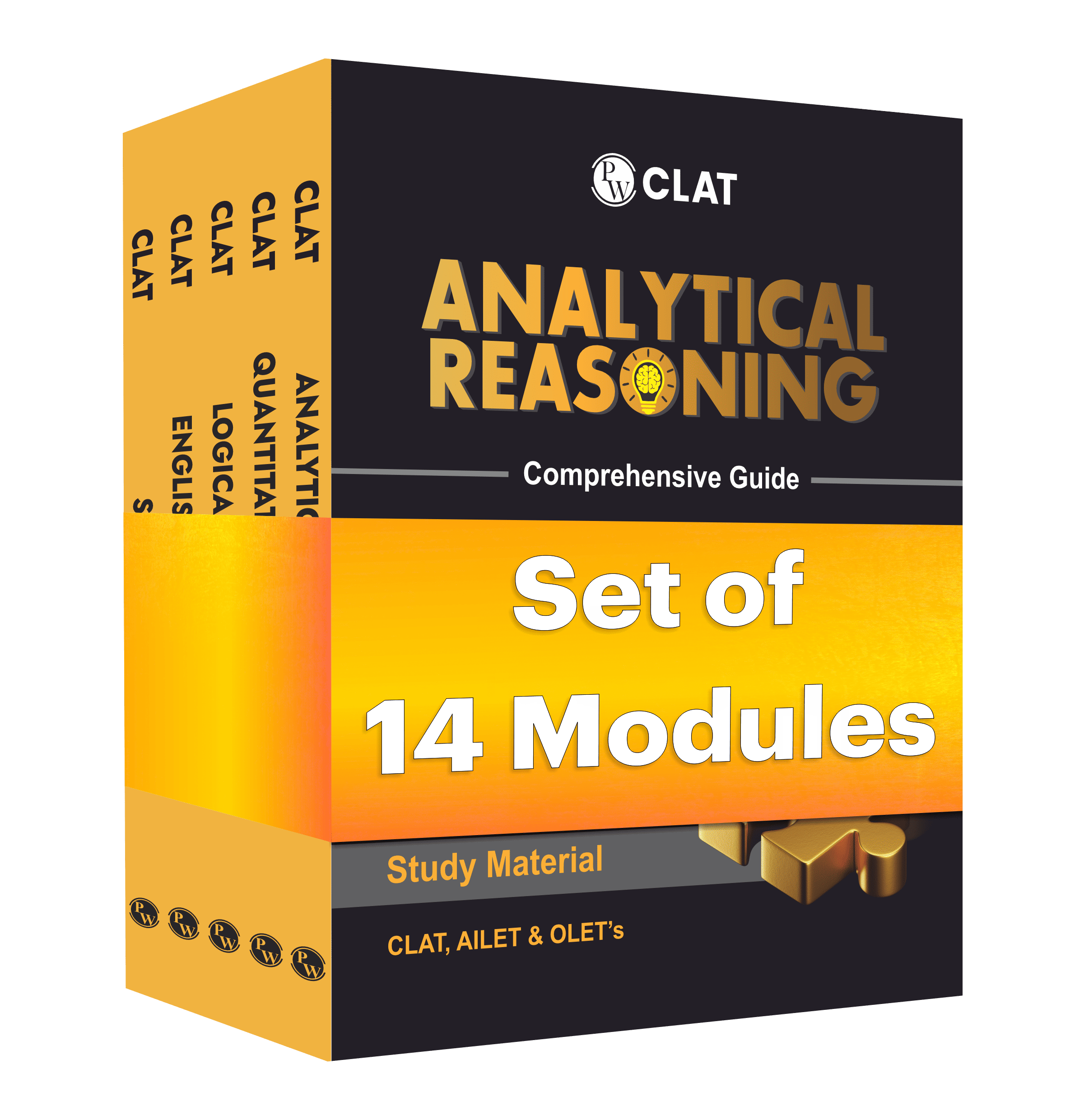
Choosing the right study material is 50% of the battle. At PW Store, we recommend a mix of foundational books and practice-heavy modules.
| Products | Links |
| CLAT Complete Module Set of 11 For CLAT, AILET & OLETs Exams 2026 | Link |
| CLAT Complete Quantitative Techniques Module Set of 2 Books | Link |
| CLAT Complete Logical Reasoning Module Set of 2 Books | Link |
| CLAT Complete English Module Set of 2 Books | Link |
Strategic Timeline for CLAT 2027 Aspirants
If you are beginning your clat exam preparation now, follow this phase-wise approach:
Phase 1: Foundation (Months 1-4)
Understand the clat syllabus deeply. Start reading one quality newspaper daily. Focus on building vocabulary and basic mathematical concepts.
Phase 2: Sectional Mastery (Months 5-8)
Start solving sectional tests. Move from basic logical reasoning to complex critical reasoning passages. In Legal Reasoning, familiarize yourself with common legal terms (Latin maxims).
Phase 3: Mock Season (Months 9-12)
Take at least two full-length mocks per week. Analyze every mock meticulously. The goal is to identify which sections are time-consuming and where you are losing marks due to negative marking.
Evolution of the CLAT Syllabus: 2026 vs 2027
While the core subjects remain the same, the clat syllabus 2026 saw an increase in the complexity of "Inference-based" questions in both the English and Logical sections. For 2027, experts predict:
-
Greater emphasis on Social Issues: Passages may be drawn from sociology and modern history.
-
Integrated Questions: A current affairs passage might have questions that test your legal reasoning or logical deduction.
-
Data-Heavy Quant: Expect more complex caselets involving multi-layered percentages.
Read More: 6-Month Study Plan for CLAT Exam Preparation and Books
Common Pitfalls to Avoid while studying CLAT Syllabus
Here are the 3 common mistakes a student should avoid while preparing for the CLAT Exam:
-
Ignoring the Newspaper: You cannot clear CLAT with only monthly digests. The exam tests your ability to process information at high speed—a skill only developed by daily reading.
-
Over-preparing for Math: Don't spend 5 hours a day on Math. It only carries 10% weightage. Balance your time according to the section's marks.
-
Falling for "Rote Learning": Unlike other exams, the clat exam syllabus is designed to penalize those who try to memorize answers. Focus on "Logic" and "Process."
Conclusion
The CLAT syllabus is a long-term project, not a short-term one. To be successful, you need to be able to keep up with what's going on in the world and be able to think critically when time is running out. If you learn the clat exam pattern and keep up with your study, you can go from wanting to be a lawyer to being one at a top NLU.
We have carefully chosen study resources and practice tests at PW Store that are in line with the trends in the clat 2026 syllabus and the issues that will come up in 2027. Start your trip today, learn new words, and let logic lead the way!
CLAT Syllabus FAQs
1. Has the clat syllabus changed for 2027?
The core sections remain the same as the clat syllabus 2026, but the difficulty level and the length of passages are expected to increase. Always refer to the official Consortium of NLUs website for the most recent updates.
2. Is there a certain book that you need to read for the legal part of the CLAT exam?
A.P. Bhardwaj is a popular choice, however the ideal method to get ready for the current CLAT is to employ passage-based practice modules from specialised coaching centers like PW.
3. How much time is sufficient for clat exam preparation?
A year is the best amount of time. But a lot of kids start in Class 11 (2-year program) to get a big head start on reading speed and remembering general knowledge.
4. Is there a penalty for wrong answers on the CLAT 2027?
Yes, same with the 2026 clat test syllabus, the 2027 exam will use a negative marking system, which means that for every bad answer, 0.25 points will be taken away.
5. What does it mean to get a "good score" on the CLAT?
If the paper is hard, getting 90 or more out of 120 usually places you in the top 3-5 NLUs.