How to Spot Important Concepts While Solving NDA PYQs
Cracking the entrance exam for the National Defense Academy requires a planned strategy and not mere unguided efforts. Many candidates studied theory for months but are unable to clear the threshold. The key to closing this gap is effective analysis of earlier papers. When you tackle real test questions you identify the patterns that repeat, the themes with high weightage and the main curriculum sections. A structured NDA PYQ book enables you to recognize important topics quicker, manage your study hours better, and generate real confidence.
Why an NDA PYQ Book Is Useful for Exam Preparation
Analyzing past exam questions without proper organization leads to confusion and wasted effort. A well-designed PYQ book arranges past papers systematically so you can recognize trends across subjects instantly.
-
Focus on High-Weightage Chapters: Subject-wise compilation emphasizes chapters with the highest weightage over the years.
-
Saves Critical Revision Time: No time is wasted finding actual test items, so you can get straight to practice.
-
Reflects the Actual Exam Pattern: It familiarizes you with the actual difficulty levels, application of formulas and wording of questions.
-
No more guesswork: You’ll know exactly which concepts are important and which aren’t, so you don’t waste time studying the wrong material.
How to Organize NDA PYQs by Topic Using an NDA PYQ Book
Random practice rarely yields optimal results. Categorizing NDA previous year questions into specific focus areas helps you build targeted mastery.
Step-by-Step Question Sorting Strategy
-
Group by Core Subjects: Separate mathematics items from General Ability Test sections first.
-
Sort into Specific Chapters: Divide algebra, calculus, trigonometry, and general sciences into dedicated groups.
-
Isolate Sub-Topics: Further divide chapters into core sub-topics like matrices, modern history, or mechanics.
-
Identify Question Styles: Note down whether questions are formula-driven, conceptual, or direct factual statements.
Organizing questions this way allows you to spot repeating numerical values, common historical periods, and standard grammar rules tested year after year.
How to Find Important Maths Topics in an NDA PYQ Book
The Mathematics paper demands both speed and conceptual clarity. Analyzing NDA maths PYQs systematically reveals precise patterns in topic weightage and formula application.
Key Focus Areas in Mathematics
|
Section |
High-Yield Topics |
Strategic Focus Area |
|
Algebra |
Matrices, Determinants, Quadratic Equations |
Properties, determinant values, roots analysis |
|
Calculus |
Definite Integrals, Limits, Differential Equations |
Standard forms, properties, rate of change |
|
Trigonometry |
Heights & Distances, Inverse Functions |
Trigonometric identities, triangle properties |
|
Coordinate Geometry |
Straight Lines, Conic Sections |
Slope-intercept forms, circle equations, tangents |
|
Probability & Stats |
Bayes' Theorem, Standard Deviation |
Conditional probability, mean and variance |
-
Track Formula Repeatability: Identify standard identity applications that appear repeatedly across exam cycles.
-
Look for Standard Shortcuts: Observe where direct shortcuts reduce multi-step calculations to quick steps.
-
Identify High-Frequency Graphs: Note recurring calculus and trigonometry graph problems to save time on test day.
How to Find Important GAT Topics Using an NDA PYQ Book
The General Ability Test covers diverse subjects like English, Physics, Chemistry, General Science, History, Geography, and Current Affairs. Spotting trends in NDA GAT PYQs keeps your preparation targeted.
GAT Sectional Breakdown
English Focus Strategy
-
Spotting Errors: Concentrate on subject-verb agreement, prepositional usage, and tense consistency.
-
Vocabulary Sections: Analyze recurring synonyms, antonyms, and idioms to identify common word families.
General Knowledge Focus Strategy
-
Physics & Chemistry: Prioritize fundamental mechanics, optics, electricity, acid-base reactions, and basic bonding concepts.
-
Geography: Focus on physical geography, ocean currents, Indian river systems, and major climate zones.
-
History: Concentrate on Modern Indian History, freedom movements, and prominent historical personalities.
How to Track Your NDA PYQ Practice and Revision
Using an NDA PYQ book becomes more effective when you track the concepts and question types that need repeated revision. Create a simple tracker with columns for the topic, number of questions attempted, accuracy, common mistakes, and revision date.
Every time you finish a practice session, keep track of the concepts you struggled with. The following is not the complete list of all errors and inaccuracies, but a list of topics where the accuracy is low or the same error recurs. Try to revise these ideas weekly and try to reattempt the NDA Previous Year Questions relating to these concepts to check your improvement.
How to Practise Better With an NDA PYQ Book
A comprehensive NDA books bridges the gap between passive reading and active problem-solving. Practice must remain structured to build accuracy.
-
Solve Chapter-Wise First: Complete theoretical preparation of a unit before attempting topic-specific questions.
-
Maintain an Error Log: Note down every wrong attempt, formula miss, or time delay for systematic review.
-
Simulate Real Timings: Practice solving questions under timed conditions to improve speed and stress tolerance.
-
Review Detailed Solutions: Never skip reading written explanations, even for correctly answered questions.
How to Use Solved Papers With an NDA PYQ Book
Attempting past items without standard solutions leaves conceptual gaps unaddressed. Utilizing a proper collection of NDA solved papers provides structured guidance.
Effective Solution Review Process
-
Attempt Independently: Solve questions on your own before checking answer keys.
-
Compare Methodology: Match your solution method against step-by-step written explanations.
-
Identify Efficient Techniques: Learn shortcut methods to replace lengthy calculation steps.
-
Reinforce Weak Concepts: Re-read theoretical concepts for every question missed during practice.
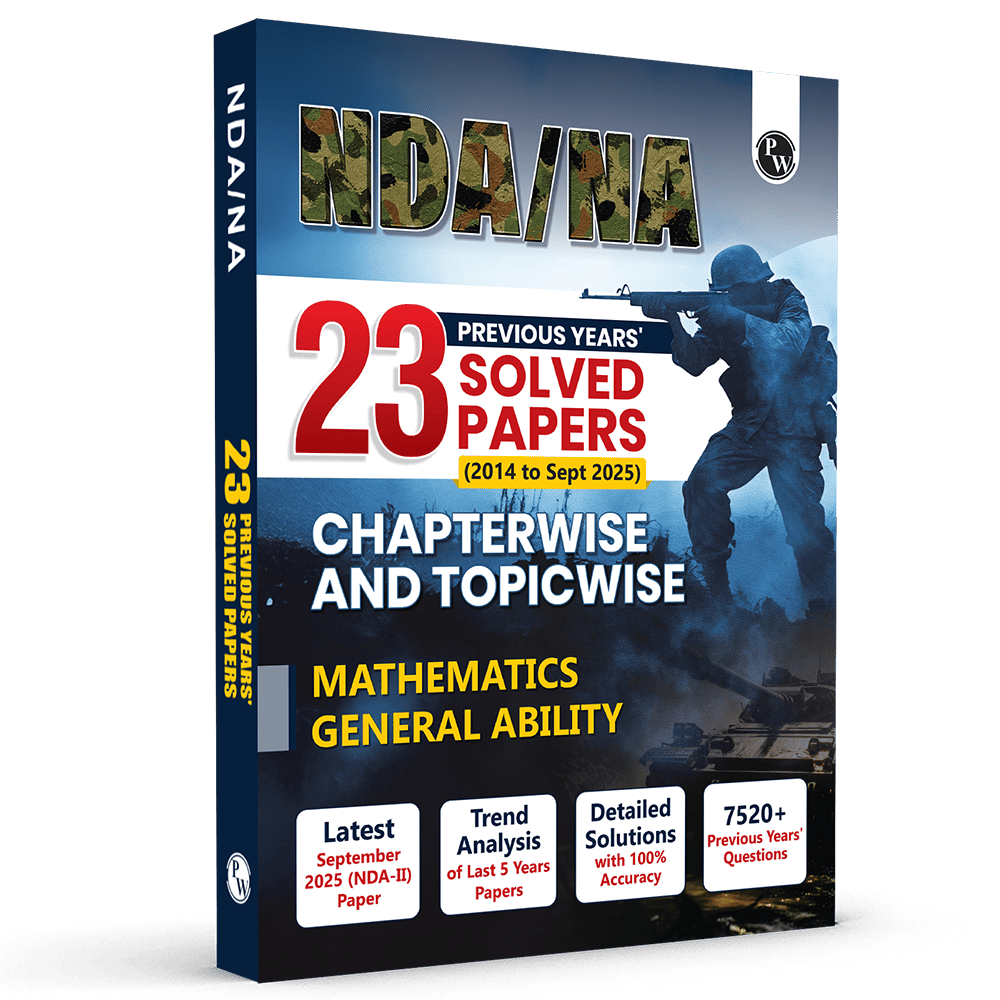
You will get access to solved collections from 2014 till September 2025 to have complete coverage of latest pattern modifications, weightage changes and updated difficulty levels.
Also Check - Defence Books
Step-by-Step Method to Build Speed Using NDA Practice Questions
Regular work on targeted NDA practice questions converts theoretical understanding into rapid, accurate test execution.
-
Start with Basic Difficulty: Begin with direct concept-testing items to solidify baseline understanding.
-
Transition to Complex Problem: Once you establish the basics, go onto questions with several concepts.
-
Use elimination methods: Multi-Statement GAT Items: Learn to eliminate the clearly erroneous choices.
-
Conduct Weekly Revision: Re-attempt previously missed items weekly to ensure long-term memory retention.
How to Improve Speed With an NDA PYQ Book
During the final stage of preparation, an PYQ book can help you revise important concepts without going through every chapter from the beginning. Focus on questions you previously answered incorrectly, frequently repeated concepts, and topics where your accuracy is still inconsistent.
Create a last review sheet with crucial formulas, prevalent GAT themes, commonly used grammar rules and commonly asked questions. Try these NDA PYQs in timed situations to enhance your recall and make sure you can apply the ideas swiftly in the actual test.
Read More: How to Prepare for NDA Exam Using Previous Papers?
NDA PYQ Book FAQs
How many years of past papers are sufficient for NDA preparation?
Solving 10 to 12 years of past papers (2014 to 2025) provides comprehensive coverage of recurring patterns, question formats, and subject weightage needed for thorough preparation.
Can I clear NDA Maths just by solving a PYQ book?
While past papers reveal crucial trends and high-yield concepts, you must first learn basic theoretical formulas and concepts before relying on practice sets for speed and accuracy.
How do solved past papers help in the GAT section?
The preparation is concentrated as solved GAT papers repeat grammar rules, commonly tested vocabulary, and core recurring topics in history, geography and general science.
What is the best way to analyze missed questions in past papers?
Maintain a special error notebook. Write down the missing key formula or concept, examine the written explanation, then try the problem again in 2 days to see if you have mastered it.
Should I practice past papers topic-wise or year-wise first?
Start with topic-by-topic practice and covering daily curriculum. For final revision, go to whole year-wise papers to build up speed and stamina for the actual test format.