NDA Fill in the Blanks Questions for English Exam Preparation

Boost your English score in the forthcoming defense entrance exams with systematic grammatical rules, targeted practice sets and proven elimination procedures to fill in the blanks. Many applicants find it difficult to score high marks in the GAT English paper due to the unexpected nature of the sentence completion patterns. NDA fill in the blanks questions are solved methodically so that you can improve your command over basic grammar principles, established prepositions and vocabulary in context.
NDA Fill in the Blanks Questions Overview
The English paper tests an applicant's command over syntactic harmony, structural accuracy, and vocabulary depth. These questions assess how accurately a candidate applies rules of grammar in realistic contexts.
According to the official UPSC NDA examination notification, the English section carries 200 marks and assesses grammar, vocabulary, comprehension, and cohesion, making these areas important for practising NDA English fill in the blanks questions.
The question setters have created these things within a range of categories:
-
Prepositional Pairs: Testing fixed prepositions after certain verbs, adjectives or nouns (e.g. abstain from, habituated to)
-
Tense Consistency: Checking for agreement between primary and dependent phrases in past, present and future tenses.
-
Agreement of Subject and Verb: Making sure that singular and plural subjects are suitably matched with their verbs.
-
Vocabulary and Idioms: Choosing words that express the precise tone and meaning of the given passage.
Focusing on structural logic instead of intuitive guesses, consistent accuracy across all inquiry kinds comes.
Grammar Rules for NDA Fill in the Blanks Questions
To do well, candidates should focus on basic grammatical rules that are usually tested in NDA fill in the blanks.
|
Grammar Concept |
Focus Area |
Common Exam Example |
Key Strategy |
|
Fixed Prepositions |
Verb + Preposition combinations |
He insisted ___ going there. (on) |
Memorise standard verb-preposition pairings. |
|
Conditionals |
Subordinate clause structures |
If he had worked hard, he ___ passed. (would have) |
Match past perfect with modal perfects. |
|
Subject-Verb Agreement |
Collective nouns & compound subjects |
Neither the teacher nor the students ___ present. (were) |
Align verb with the nearest subject in 'nor' structures. |
|
Articles & Determiners |
Specific vs. non-specific modifiers |
He is ___ honest officer. (an) |
Focus on initial vowel sounds rather than letters. |
Learning these core principles eliminates hesitation when evaluating tricky options under time pressure. Practising with NDA Books can help you strengthen your concepts and improve your decision-making skills for the exam.
Importance of Practising NDA Fill in the Blanks Questions
Daily practice of NDA English practice questions helps the aspirants translate their academic knowledge into quick problem-solving skills. Mental reflexes are trained through concentrated effort to recognize contextual signals rapidly.
Core Benefits of Daily Practice:
-
Enhanced Speed: Quick identification of missing parts of speech saves valuable minutes during the examination.
-
Error Reduction: Spotting subtle distractors prevents negative marking in complex multiple-choice formats.
-
Retention of Rules: Applying rules repeatedly solidifies memory far better than passive reading.
Consistent revision through structured practice sets establishes a strong foundation for high scores in the verbal section.
How to Solve NDA Fill in the Blanks Questions Step by Step
Dealing with NDA grammar questions demands a systematic elimination approach, which helps you swiftly identify the proper choice.
-
First read the full sentence: Hold off on filling in the blank. Get the general context and tone.
-
Determine the part of speech: Identify whether the missing word has to be a noun, verb, adjective, preposition or conjunction.
-
Examine Contextual Indicators: Look for contrast markers such as although, however, or notwithstanding that that reflect changes in meaning.
-
Remove Inconsistent Choices: Delete any choices that break the rules of subject-verb agreement or tense consistency.
-
Replace and Check: Put your chosen option back into the phrase and check it sounds right and makes sense.
NDA Fill in the Blanks Questions for Mock Test Practice
Taking a full-length NDA English mock test under timed settings helps you experience the actual exam environment, thereby improving your stamina and time management skills.
-
Create Strong Time Frames: Practice in real exam conditions – 30-45 seconds each sentence completion question.
-
Pick Not Guess Unsafe: Maintain a positive accuracy ratio . Use reasoning to eliminate instead of random guesses .
-
Do a thorough post-test analysis: Analyze each error to see where you are lacking in terms of grammar or vocabulary.
Simulated examinations enable applicants to discover knowledge gaps early on, enabling them to adapt their study strategies successfully before the exam day.
NDA Fill in the Blanks Questions With Answers and Explanations
Evaluating targeted sets of NDA fill in the blanks with answers provides immediate feedback, reinforcing correct reasoning and explaining why plausible distractors fail.
-
Deconstruct Explanations: Don’t just read the answer key, read the rule breakdown behind each correct choice.
-
Keep an Error Log: Note down all the wrong answers and the related grammar rule for a quick revision weekly.
-
Detect Patterns in Questions: Identify common examiner sentence forms across past years.
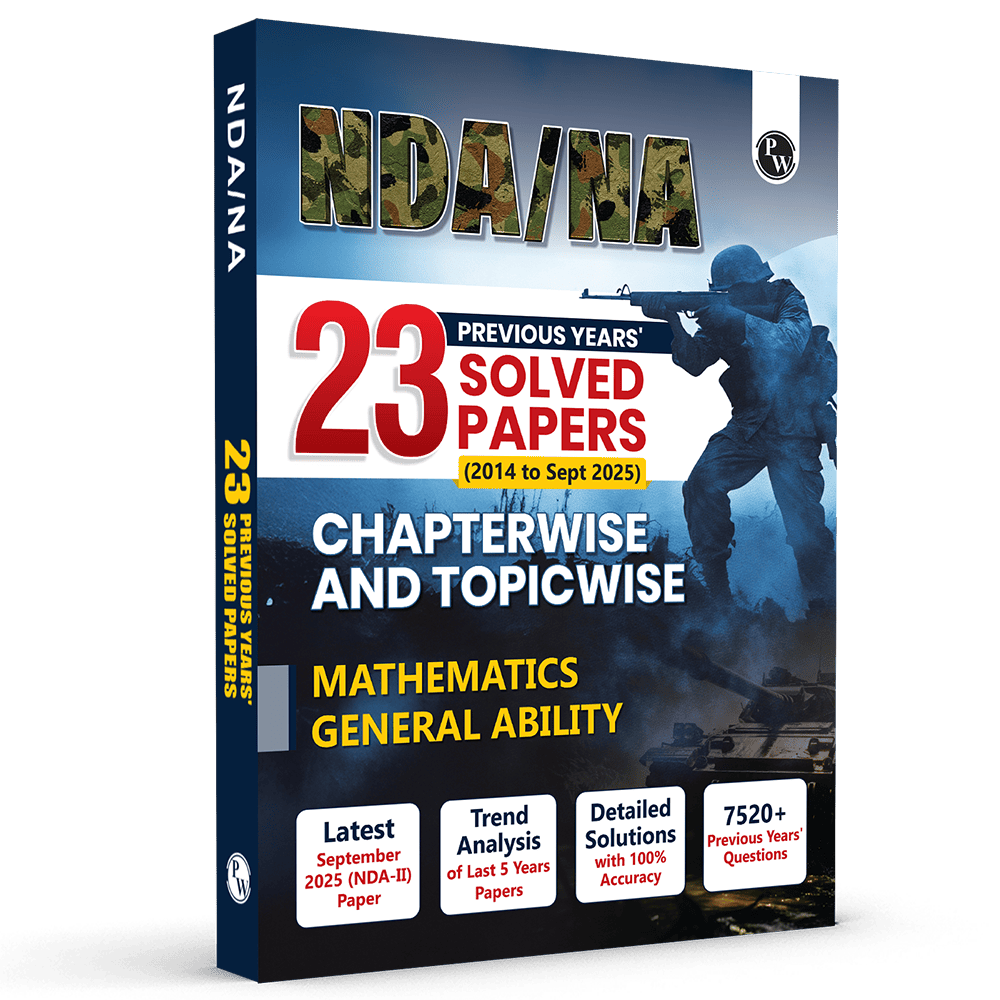
Every wrong attempt can become a learning opportunity when you analyse your mistakes carefully. Practising with NDA PYQ Books helps you understand question patterns, identify weak areas, and work towards improving your score steadily.
Preparation Tips for NDA Fill in the Blanks Questions
To do well in the English paper, one has to strike a balance between systematic learning of rules and active exposure to the language. Candidates should mix formal grammar practice with frequent reading of mainstream publications. Reading good writing gives you an instinctive knowledge of acceptable sentence structures, collocation patterns, and idiomatic language.
Additionally, managing time efficiently during the examination guarantees that simple, high-scoring questions are never left unattempted. Allocating the first few minutes to sentence completion items builds momentum and confidence for longer comprehension passages.
Read More: Prepare for an NDA Exam Using Previous Papers
NDA English Question FAQs
What grammar topics are most important for NDA English fill in the blanks questions?
The most frequently tested topics include fixed prepositions, subject-verb agreement, tenses, conditional sentences, articles, and conjunctions.
How many sentence completion items usually appear in the examination?
The English section typically contains 5 to 10 sentence completion questions, making up a significant portion of the total verbal marks.
How can I improve my accuracy in vocabulary-based fill in the blanks?
Enhance contextual vocabulary by reading editorial articles daily, learning word usage in full sentences, and practicing previous year question sets.
What is the elimination method in solving NDA English questions?
The elimination method involves identifying the required part of speech, ruling out grammatically incorrect options, and selecting the choice that fits the context logically.
Are previous year question papers sufficient for English preparation?
Previous year papers are crucial for understanding the exam pattern, but combining them with structured chapter-wise theory and practice exercises yields the best results.