High-Weightage Chemistry Chapters Based on NEET PYQ Book
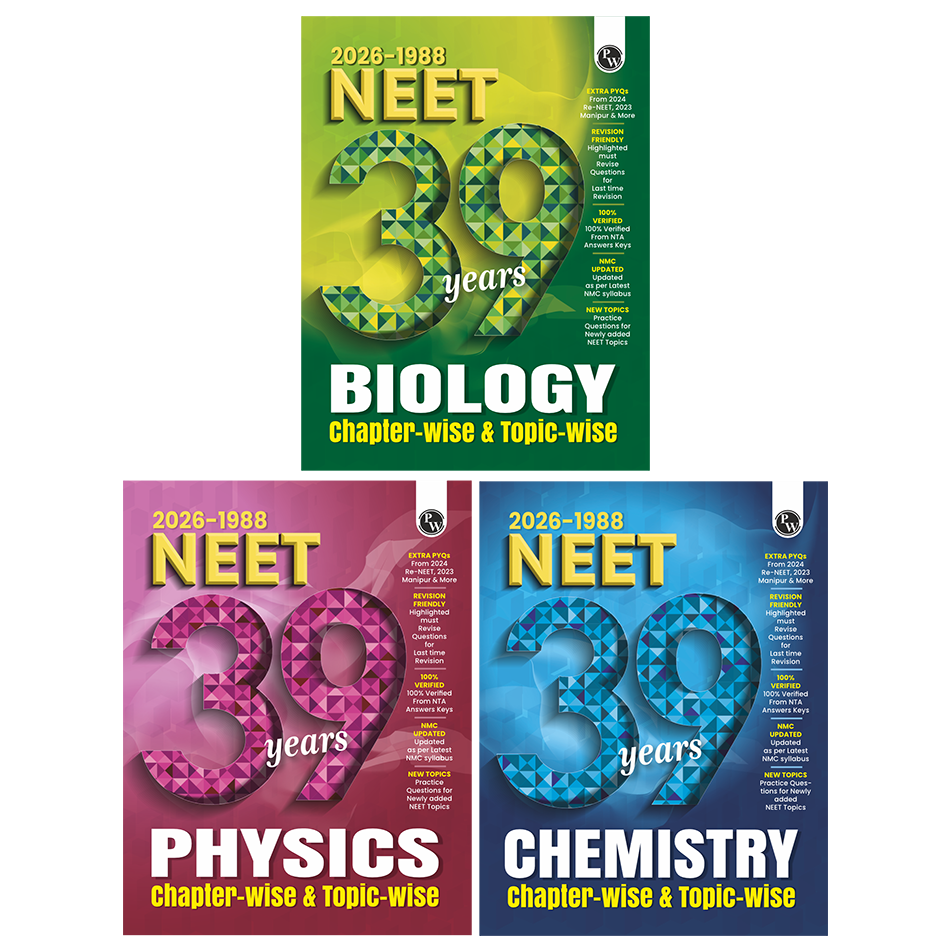
Preparing for NEET requires a strategic focus on high-yield topics to maximize your overall score. Relying on a reliable NEET PYQ Book allows aspirants to spot repeating trends, analyze chapter weightage, and master core concepts effectively. Chemistry is often considered a scoring subject, provided you prioritize the right areas across Physical, Organic, and Inorganic branches.
By analyzing past trends, students can streamline their revision, focus on chapters with maximum mark distribution, and practice problem-solving speed. This guide breaks down the essential chemistry topics to focus on using previous year question books.
Importance of a NEET PYQ Book for Chemistry Preparation
Studying without analyzing previous trends often leads to wasted effort on low-yield topics. A curated NEET PYQ Book acts as a roadmap, showing precisely where NEET paper setters focus their attention year after year.
-
Identifies Repeating Patterns: Question patterns in NEET often repeat with slight variations in numerical values or phrasing. Practicing past papers helps you identify these recurring concepts.
-
Improves Speed and Accuracy: Solving physical chemistry calculations under timed conditions builds formula recall speed and reduces numerical calculation mistakes.
-
Clarifies Question Intent: Inorganic and organic chemistry questions frequently test tricky exceptions. Working through real exam questions reveals how concepts are tested in multiple-choice formats.
-
Reduces Exam Stress: Familiarity with the actual difficulty level boosts confidence and prevents panic during the main exam.
What are the High-Weightage Physical Chemistry Topics in NEET PYQ Book?
Physical Chemistry demands conceptual clarity combined with numerical problem-solving skills. Analyzing a dedicated NEET previous year papers shows that specific chapters consistently carry heavy weightage and require rigorous formula practice.
Chemical Bonding and Molecular Structure
This chapter forms the foundation of both Physical and Inorganic Chemistry. Questions frequently cover hybridisation, VSEPR theory, molecular orbital theory (MOT), and dipole moments. Expect around 3 to 4 questions directly or indirectly linked to this chapter.
Chemical and Ionic Equilibrium
Equilibrium is a high-yield area that tests mathematical application. Focus areas include:
-
Calculating pH of buffer solutions and salt hydrolysis.
-
Solubility product (Kₛₚ) expressions and the common ion effect.
-
Le Chatelier’s principle and the relationship between equilibrium constants (Kₚ and K𝑐).
Electrochemistry and Chemical Kinetics
These physical chemistry units are direct and scoring. Electrochemistry focuses on the Nernst equation, molar conductivity variations, and Faraday’s laws of electrolysis. Chemical Kinetics consistently tests zero-order and first-order rate laws, half-life formulas, and Arrhenius activation energy calculations.
Thermodynamics
Thermodynamics tests concepts related to state functions, enthalpy changes, entropy, and Gibbs free energy ($\Delta G$). A solid understanding of spontaneous vs non-spontaneous conditions ensures easy marks in this section.
What are the Important Organic Chemistry Chapters in NEET PYQ Book?
Organic Chemistry carries massive weightage in NEET. Solving NEET chemistry PYQ modules helps aspirants understand reaction mechanisms, named reactions, and acid-base strength comparisons.
General Organic Chemistry (GOC)
GOC is the absolute backbone of organic chemistry. Without mastering GOC, tackling advanced mechanisms becomes difficult. Key topics to practice include:
-
Electronic effects: Inductive effect, Resonance/Mesomeric effect, Hyperconjugation, and Electromeric effect.
-
Stability of intermediates: Carbocations, carbanions, and free radicals.
-
Acidic and basic strength order comparisons of organic compounds.
-
Isomerism: Structural isomerism, geometrical isomerism, and optical isomerism (chirality and R/S naming).
Hydrocarbons
Hydrocarbons link directly to GOC concepts. Questions regularly appear on electrophilic addition reactions of alkenes and alkynes (Markovnikov and anti-Markovnikov rules), ozonolysis, and aromatic electrophilic substitution in benzene.
Aldehydes, Ketones, and Carboxylic Acids
This chapter carries high weightage in the Class 12 organic syllabus. A systematic review of chemistry PYQs shows heavy emphasis on named reactions such as:
-
Aldol condensation and Cannizzaro reaction.
-
Clemmensen and Wolff-Kishner reduction.
-
Tollens' and Fehling's tests for distinguishing functional groups.
-
Haloform reaction and Hell-Volhard-Zelinsky (HVZ) reaction.
Amines and Biomolecules
Amines test basic strength comparisons, Hoffmann bromamide degradation, and Gabriel phthalimide synthesis. Biomolecules is a memory-based, high-scoring chapter covering structure of proteins, carbohydrates, DNA/RNA differences, and vitamins.
What are the Important Inorganic Chemistry Chapters in NEET PYQ Book?
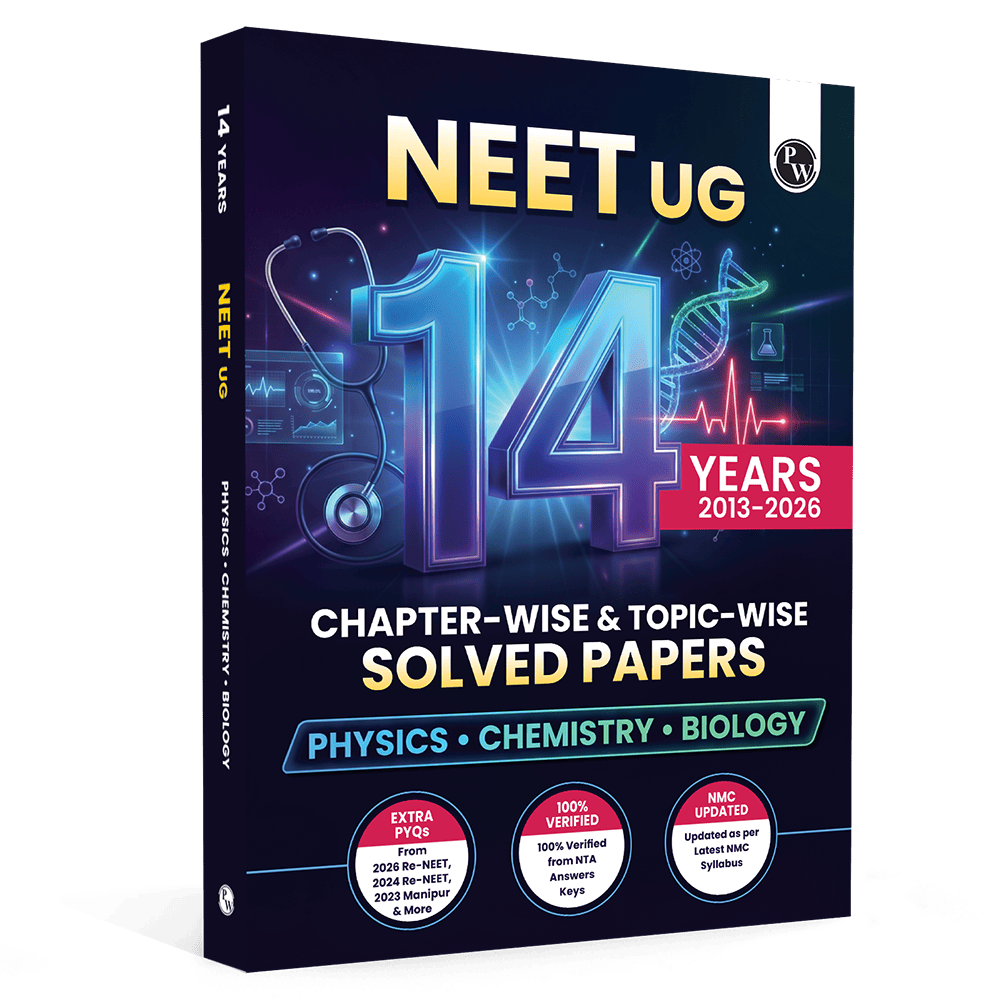
Inorganic Chemistry relies heavily on NCERT line-by-line reading and trend recognition. Solved questions from a PW 14 Years NEET PYQ manual highlight key trends and exceptions that appear repeatedly.
Coordination Compounds
Coordination Chemistry is one of the highest-yielding chapters in the entire NEET Chemistry paper. Ensure thorough command over:
-
IUPAC nomenclature of coordination complexes.
-
Valence Bond Theory (VBT) - predicting geometry and magnetic behavior.
-
Crystal Field Theory (CFT) - d-orbital splitting, crystal field stabilization energy (CFSE), and spectrochemical series.
-
Isomerism in coordination complexes (Structural and Stereoisomerism).
p-Block and d-and-f-Block Elements
These chapters require regular revision of periodic trends, oxidation states, and specific chemical reactions. Focus closely on:
-
Structure of oxoacids of phosphorus, sulfur, and halogens.
-
Trends in hydrides, oxides, and halides across groups.
-
Color, magnetic properties, and catalytic behavior of transition metals in the d-block.
-
Potassium permanganate (KMnO₄) and potassium dichromate (K₂Cr₂O₇) reactions.
Periodic Classification and Chemical Periodicity
A foundational unit that makes learning block elements easier. Focus on exception trends in ionization enthalpy, electron gain enthalpy, atomic radii, and electronegativity scales.
How to Analyze Trends Using NEET PYQ Book Sets?
Simply solving questions is not enough; analyzing your performance transforms passive practice into real score improvements. Incorporating NEET previous year questions into your study routine requires a disciplined evaluation approach.
Step 1: Chapter-Wise Solving
Choose a specific chapter -> Solve past 10-15 year questions -> Mark incorrect attempts
Step 2: Error Categorization
Categorize mistakes into: Conceptual Error, Calculation Mistake, or Misreading the Question
Step 3: NCERT Revision
Re-read the specific NCERT section corresponding to incorrect questions
Step 4: Re-Test
Attempt un-mastered questions again after 3 days to verify retention
When practicing from your NEET books, track your errors in a dedicated notebook. Divide mistakes into three distinct categories:
-
Conceptual Errors: Misunderstanding the underlying formula or theory.
-
Fact Recall Errors: Forgetting inorganic exceptions or reagents in organic mechanisms.
-
Silly Errors: Misreading "incorrect statement" as "correct statement" or making basic arithmetic slips.
Set a target of solving 45 chemistry questions in 45 to 50 minutes. Building time management skills early prevents time crunches during the actual NEET exam day.
Chemistry Revision Strategy with NEET PYQ Book
Combining revision with structured practice using NEET PYQ resources ensures complete coverage of the syllabus. Follow this weekly strategy to stay on track:
Step 1: NCERT First Pass
Read the NCERT chemistry chapter thoroughly. Focus on bold terms, in-text examples, summary boxes, and table data, especially for Inorganic and Organic units.
Step 2: Solve Topic-Wise Previous Questions
Immediately after completing a chapter, open your NEET PYQ Book and attempt topic-wise questions. This reinforces theoretical concepts with practical application.
Step 3: Highlight Trick Questions
Mark questions that required extra time or multiple attempts. These marked questions should form the core of your rapid revision material during the final month before NEET.
Read More: NEET Handwritten Revision Notes PDF with Solutions
NEET PYQ Book FAQs
Which chemistry chapters have the highest weightage in NEET?
Chemical Bonding, General Organic Chemistry (GOC), Coordination Compounds, Aldehydes & Ketones, and Equilibrium carry the highest weightage, consistently accounting for a significant portion of the chemistry paper.
How many previous years' questions should I solve for NEET Chemistry?
Solving at least 10 to 15 years of NEET previous year questions is recommended to understand changing exam patterns, question trends, and high-yield topic areas.
Is NCERT enough along with a NEET PYQ Book for scoring 160+ in Chemistry?
Yes, thorough command over NCERT concepts combined with rigorous practice from a reliable past-year question collection is sufficient to score 160 or higher in NEET Chemistry.
How does practicing NEET chemistry PYQ improve calculation speed in Physical Chemistry?
Repeated practice helps you memorize common square roots, logarithmic values, and formula rearrangements, drastically reducing time spent on numerical calculations during the exam.
Should I practice chapter-wise or full-length PYQs first?
Start with chapter-wise solved questions alongside your regular preparation. Once the entire syllabus is complete, switch to solving full-length previous year papers in a strict 3-hour exam environment.