When is the Ideal Time to Start the NEET Test Series in your Prep

Medical aspirants frequently ask when they should start solving full-length papers. Starting too early can lead to frustration because of incomplete syllabus coverage, while starting too late reduces the time available for meaningful practice. Finding the right timeline to begin your NEET test series plays an important role in converting theoretical learning into strong exam performance.
Students should first build conceptual clarity chapter by chapter and then gradually move toward mixed and full-length tests. Along with regular mock tests, using NEET Study Materials helps strengthen concepts, improve revision, and provide focused practice across Physics, Chemistry, and Biology. This balanced approach supports better retention, stronger accuracy, and improved confidence before the actual exam.
What Is the Right Time to Start a NEET Test Series
The ideal timeline to begin a full-fledged test series depends entirely on your current syllabus coverage and your overall exam preparation cycle. For most aspirants, December to January is considered an effective period to begin full-length mock testing.
Starting a test series for NEET during these months gives you a balanced window of 4 to 5 months. This period provides sufficient time to identify your weak conceptual areas, improve your biological diagram recognition, and perfect your physical chemistry calculation speed.
If you are a dropper student who has already completed the syllabus once, you can start full-length tests as early as October or November. If you are a Class 12 student managing board exams, you should balance your schedule by taking part-syllabus tests until December and switching to full-length mocks by January.
How to Align Your Syllabus With a Test Series
You do not need a 100% complete syllabus to begin testing, but attempting full mock papers with half-baked preparation can hurt your confidence. The most practical approach is to align your study tracker with a structured preparation timeline.
-
At 50% Syllabus Completion: Focus exclusively on chapter-wise and topic-wise evaluation papers to check your core understanding.
-
At 70% to 80% Syllabus Completion: Transition directly into unit tests and part-syllabus mock exams that combine multiple chapters.
-
At 90%+ Syllabus Completion: Launch your full-length test series schedule, treating every single test as the actual exam day.
Finishing your main core topics by December allows you to join an intensive NEET test series 2026 routine smoothly, giving you a distinct advantage over students who delay testing until March.
Why Early Topic Wise Testing Improves NEET Test Series Performance
Waiting until the entire syllabus is finished before touching a test series book is a risky strategy. True preparation requires a two-phase testing approach that scales up as your knowledge grows.
Phase 1: Build a Strong Conceptual Foundation First
During the initial months of your preparation, use chapter-wise tests from a test series resource. This approach helps you fix misconceptions in high-weightage topics like Mechanics or Genetics right after studying them.
Phase 2: Move to Full Length Exam Simulation
Once you enter the final 4 months before the exam, shift your focus to full-length papers. This phase trains your brain to switch focus rapidly between Physics formulas, Chemistry reactions, and Botany classifications over a continuous three-hour period.
What to Look for in a Quality NEET Test Series Book
Not all evaluation materials are created equal, and choosing the wrong level of questions can derail your focus. A high-quality preparatory resource must contain specific structural features to be worth your time.
-
Strict NCERT Alignment: Questions must stay closely tied to NCERT textbooks, as they form the foundation of the final medical entrance paper.
-
Balanced Difficulty Spread: The papers must contain a realistic mix of simple, moderate, and highly analytical questions to mirror the true difficulty level.
-
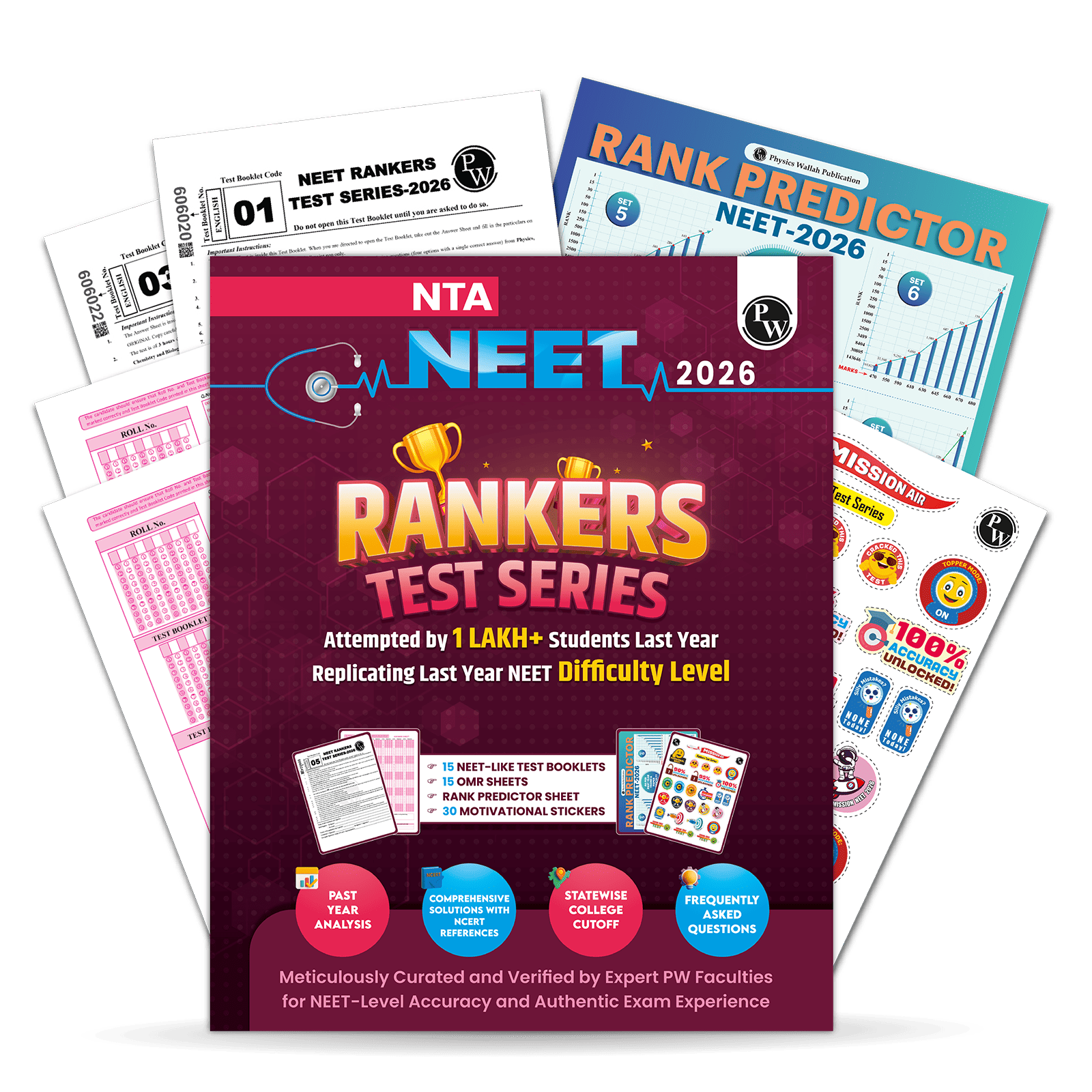
Offline Simulation Tools: quality books provide actual physical OMR sheets and solution booklets to replicate real exam hall conditions.
These books include detailed step-by-step solutions, rank predictors, and actual NEET OMR sheets to help you practice filling options accurately under time pressure.
How to Analyze Your NEET Test Series Results Effectively
Simply solving papers without analyzing your mistakes will not improve your score. You need a systematic review method after every test to ensure your marks increase over time.
1.Calculate Your Initial Accuracy:Do this within 2 hours of the test.
Count your total correct answers, incorrect responses, and unattempted questions. Calculate your net score out of 720 to establish a clear baseline.
2.Categorise Every Error:Takes around 1 to 2 hours.
Review every wrong answer and label it under one of three categories: Silly Mistakes (reading errors), Time Management Failures, or Conceptual Gaps.
3.Cross-Reference with Textbooks:Spend 15 minutes per complex question.
Open your NCERT books or reference notes for every conceptual error you made. Re-read the topic and update your short notes immediately to prevent repeating the mistake.
4.Re-Attempt the Missed Questions:Do this 48 hours after the test.
Try solving the questions you got wrong or left unattempted a second time without looking at the solutions. This confirms whether you have actually mastered the concept.
How to Manage Time During a NEET Test Series 2026
Managing your time across Physics, Chemistry, and Biology is a critical skill that you can only build through regular practice in a test series. The common approach is as follows: Along with following a proper time strategy, students can also practise with the NEET Rankers Test Series 2026 to improve speed, accuracy, and subject-wise time management under real exam-like conditions.
|
Subject |
Ideal Time Allocation |
Recommended Question Strategy |
|
Biology (Botany + Zoology) |
40 to 45 Minutes |
Answer direct NCERT-based questions quickly; avoid overthinking factual items. |
|
Chemistry |
40 to 50 Minutes |
Divide time equally between quick Inorganic facts and Physical Chemistry calculations. |
|
Physics |
60 to 70 Minutes |
Dedicate the maximum time here for step-by-step numerical solving and formula applications. |
|
OMR Shading Buffer |
15 to 20 Minutes |
Shade the OMR sheet in slots after completing each subject section rather than waiting until the final minutes. |
How Often Should You Take a NEET Test Series Mock Test
Your test frequency should increase as the final exam date approaches. Taking too many tests early on causes burnout, while taking too few near the end leaves your time-management skills unrefined.
The Mid-Session Routine (4 to 5 Months Before Exam)
At this stage, attempting one full-length mock test every two weeks is ideal. Spend the intervening 13 days fixing the weak areas identified in your last test and completing your remaining syllabus topics.
The Final Sprint Routine (Last 45 Days)
Increase your pace to two or three full-length papers every week. Sit down precisely in the exam timings to train your biological clock to operate at peak concentration during official exam hours.
Read More: Struggling in Class 11 Biology? PW Immunity Booster for NEET 2026 Can Help
NEET Test Series FAQs
1. Can I crack the medical entrance exam by only solving a test series?
No, it is an evaluation tool, not a replacement for primary learning. You must first build a strong conceptual foundation using NCERT textbooks and regular lectures, then use mock tests to refine your speed, accuracy, and paper-solving strategy.
2. When should I start using a full-syllabus test series for NEET?
You should start a full-syllabus test series roughly 3 to 4 months before the exam date. For most students, the ideal window opens around December or January, right after finishing 80% or more of their core preparation syllabus.
3. Why should I choose the test series 2026 books over online PDFs?
The physical books contain high-quality printed OMR sheets and structured solution booklets. Practising on actual paper helps you avoid common online-to-offline translation mistakes and reduces exam-day anxiety by perfectly mimicking real hall conditions.
4. How many papers should I solve from a NEET mock test 2026 resource?
You should aim to solve at least 15 to 20 full-length papers from a reliable mock test 2026 book. Continuous practice across this volume of papers ensures you face a wide variety of multiple-choice questions, covering every possible question mutation the NTA might use.
5. Does the official NTA NEET test series style include tough questions?
Yes, a well-structured test series model includes a balanced mix of direct NCERT questions, match-the-following types, assertion-reason items, and highly analytical numeric problems. This variety ensures you are prepared for unexpected changes in difficulty levels on the actual exam day.