How to Use Med Easy Zoology Notes for NEET Preparation?

Preparing for the medical entrance exam can feel overwhelming due to the sheer volume of diagrams and terminology. Many students struggle to condense heavy textbooks into something manageable.
This is where NEET Zoology notes become essential. By focusing on high-yield topics and structured data, you can navigate through the animal kingdom and human physiology without getting lost in unnecessary details.
Check Out: PW NEET Books
Importance of NEET Zoology Notes
Many toppers swear by zoology handwritten notes because they feel more personal and easier to digest. Handwritten formats often use different colours and spatial arrangements that the human brain finds easier to track than standard printed text.
When you use handwritten notes, you are essentially looking at a refined version of the syllabus. These notes often include "side notes" or "warning boxes" that tell you where students commonly make mistakes.
For example, a note might clarify the difference between 'asymmetry' and 'radial symmetry' in a way a textbook might overcomplicate. This level of clarity is vital for avoiding negative marking in the NEET exam.
Features of NEET Zoology Notes
Having notes is incredibly helpful for modern students. It allows for portability and instant access during breaks or travel. Digital notes also offer the "search" functionality, which is a lifesaver when you need to find a specific term like 'Sertoli cells' or 'Genetic Drift' instantly.
-
Portability: Carry your entire library on a tablet or phone.
-
Searchability: Find any keyword within seconds.
-
Interactivity: Many PDF versions allow you to click on links for further explanation or video solutions.
While physical books have their charm, a NEET Zoology notes PDF ensures that you are never away from your study material, making it easier to utilise small pockets of time throughout the day.
How to Study with NEET Zoology Notes?
To make the most of your zoology notes, you must integrate them into a daily routine. Start by aligning your note-taking with your video lectures or classroom sessions. When a teacher explains a concept like the cardiac cycle, immediately open your notes to see how that information is summarised.
-
Initial Reading: Go through the chapter once to understand the layout.
-
Active Recall: Cover the page and try to replicate the diagrams from memory.
-
Contextual Linking: Connect different chapters, such as linking 'Animal Kingdom' classifications with 'Structural Organisation in Animals'.
This systematic approach ensures that the notes of NEET Zoology are not just stored on your shelf but are actively helping you build a mental map of the subject.
Success in biology depends on how many times you can revise the entire syllabus. NEET Med Easy Zoology Notes allow you to finish a chapter revision in under 15 minutes.
-
Morning Drills: Spend 20 minutes every morning looking at the 'Animal Kingdom' tables.
-
Post-Test Analysis: After taking a mock test, refer to your notes to see why you missed a specific question.
-
Flashcard Creation: Convert the bullet points from these notes into digital flashcards for on-the-go learning.
By keeping your revision cycles short and frequent, you ensure that the information stays in your long-term memory, which is crucial for a subject as fact-heavy as zoology.
Benefits of Using NEET Zoology Notes
Using structured notes of NEET Zoology offers a significant advantage over traditional textbooks. The series is designed specifically to reduce the cognitive load on students by presenting information in a "bite-sized" format. Instead of reading long, winding paragraphs about the endocrine system or evolution, you get access to flowcharts that map out pathways clearly.
These notes act as a bridge between the NCERT syllabus and the actual exam pattern. They highlight the points where examiners frequently frame questions, such as specific enzyme functions or evolutionary milestones. By using these focused resources, you spend less time highlighting books and more time actually memorising the facts that matter.
Important Chapters Covered in NEET Zoology Notes
Not all chapters are created equal. Your notes of NEET Zoology should help you prioritise high-weightage topics.
-
Human Physiology: This is the most significant chunk. Ensure your notes have detailed cycles for respiration, circulation, and excretion.
-
Human Reproduction: Focus on the hormonal control and embryonic development stages.
-
Animal Kingdom: This chapter requires extensive classification tables, which are a hallmark of good notes of NEET Zoology.
-
Evolution: Look for timeline charts and evidence-based summaries.
Focusing on these core areas using your notes will guarantee a significant portion of your biology marks.
Check Out - NEET Revision Books
NCERT vs NEET Zoology Notes
While NCERT is the "Bible" for medical aspirants, notes of NEET Zoology provide the necessary "extra edge." NCERT provides the facts, but the notes provide the interpretation and the comparison.
|
Feature |
NCERT Textbooks |
NEET Zoology Notes |
|
Language |
Descriptive and Academic |
Concise and Bulleted |
|
Focus |
General Theory |
Exam-Oriented Patterns |
|
Visuals |
Basic Diagrams |
Enhanced Charts and Mind Maps |
|
Speed |
Slow Reading |
Fast Revision |
By using both in tandem, you ensure that your foundation is strong while your exam temperament is sharp. Use the textbook for your first deep dive and the notes of NEET Zoology for every subsequent study session.
How to Use NEET Zoology Notes for Mock Tests
Mock tests are the true test of your preparation. Before every mock test, do not try to read your full books. Instead, take your zoology short notes for NEET and scan through the "must-remember" facts.
After the test, if you find you got a question wrong on 'Cocking of Myosin Head', go back to that specific section in your notes. Mark that section with a star or a red pen. This turns your notes into a personalised map of your weaknesses, making your next revision even more efficient.
Check Out: NEET Previous Year Papers
Revision Tips for NEET Zoology Notes
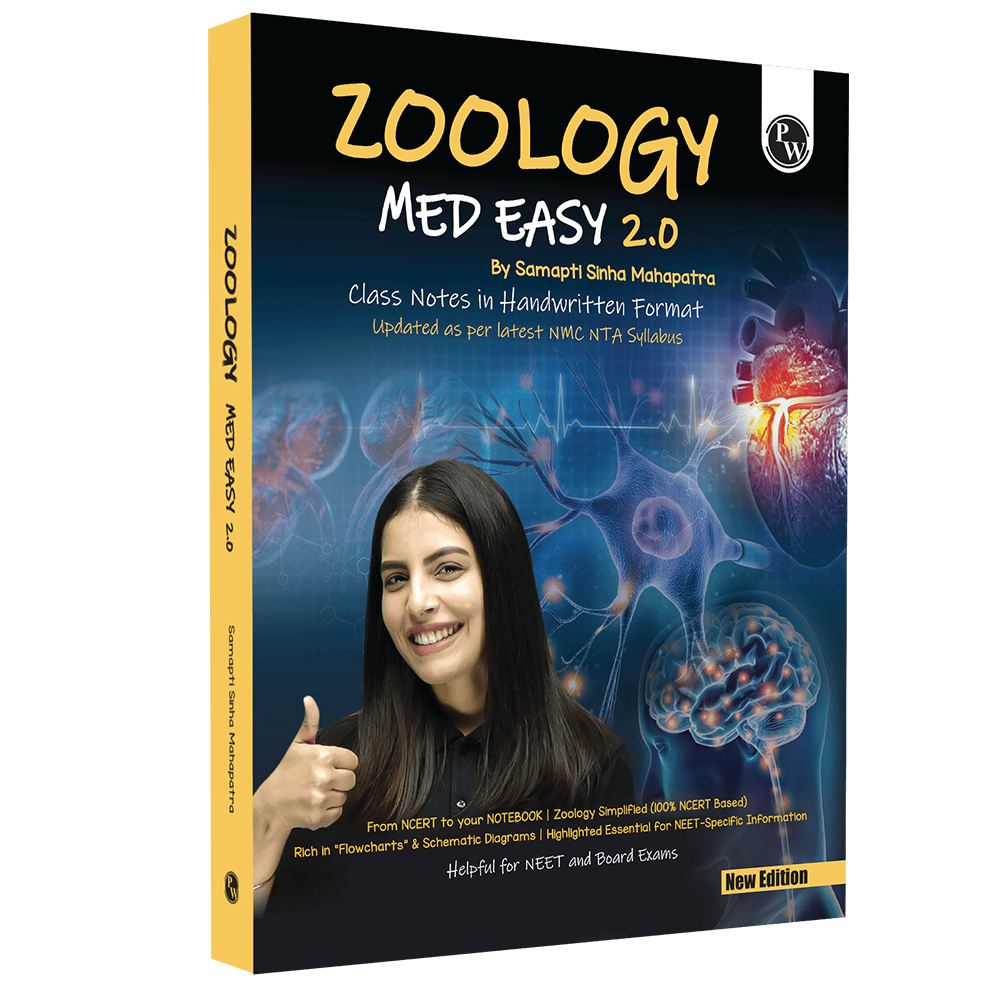
The zoology Med Easy PW resources are tailored for the final months leading up to the exam. During this period, you cannot afford to reread 500-page books. These notes serve as the perfect revision tool because they focus on visual learning.
-
Flowcharts: Use them to remember the stages of meiosis or the digestion process.
-
Comparison Tables: Ideal for distinguishing between different phyla or hormonal disorders.
-
Mnemonics: These notes often include memory aids to help you remember the examples of various animal classes.
Because the zoology notes content is curated by experts, it filters out the noise, allowing you to focus on the 20% of the syllabus that usually yields 80% of the marks.
Read More: NEET Handwritten Revision Notes PDF with Solutions
NEET Zoology Notes FAQs
1. Are notes of NEET Zoology enough to score 340+ in Biology?
While notes of NEET Zoology are essential for revision and speed, they should be used alongside the NCERT. The notes help you memorise the NCERT content more effectively, which is the key to a high score.
2. Is it better to use notes of the NEET Zoology PDF or a physical book?
A physical book is better for long study sessions to reduce eye strain, but notes from the PDF are excellent for quick revisions and searching for specific topics on the go.
3. How often should I revise zoology short notes for NEET?
You should revise high-weightage chapters from your zoology short notes for NEET at least once a week. Frequent exposure is better than one long study session.
4. Do the notes of NEET Zoology cover the latest syllabus?
Yes, professional notes of NEET Zoology are updated regularly to reflect the latest changes in the NTA NEET syllabus and exam pattern.