How to Use Most Wanted NEET Chemistry for Last-Minute Physical Chemistry Revision

Many students find the last few weeks before the exam a big hurdle in mastering Physical Chemistry. There is much pressure to handle complex formulae, numerical work, and theoretical ideas within a limited time.
In this article, we will tell you how you can use the NEET Mission 100 chemistry book to ease your preparation, speed up your formula recall, and increase your problem-solving speed.
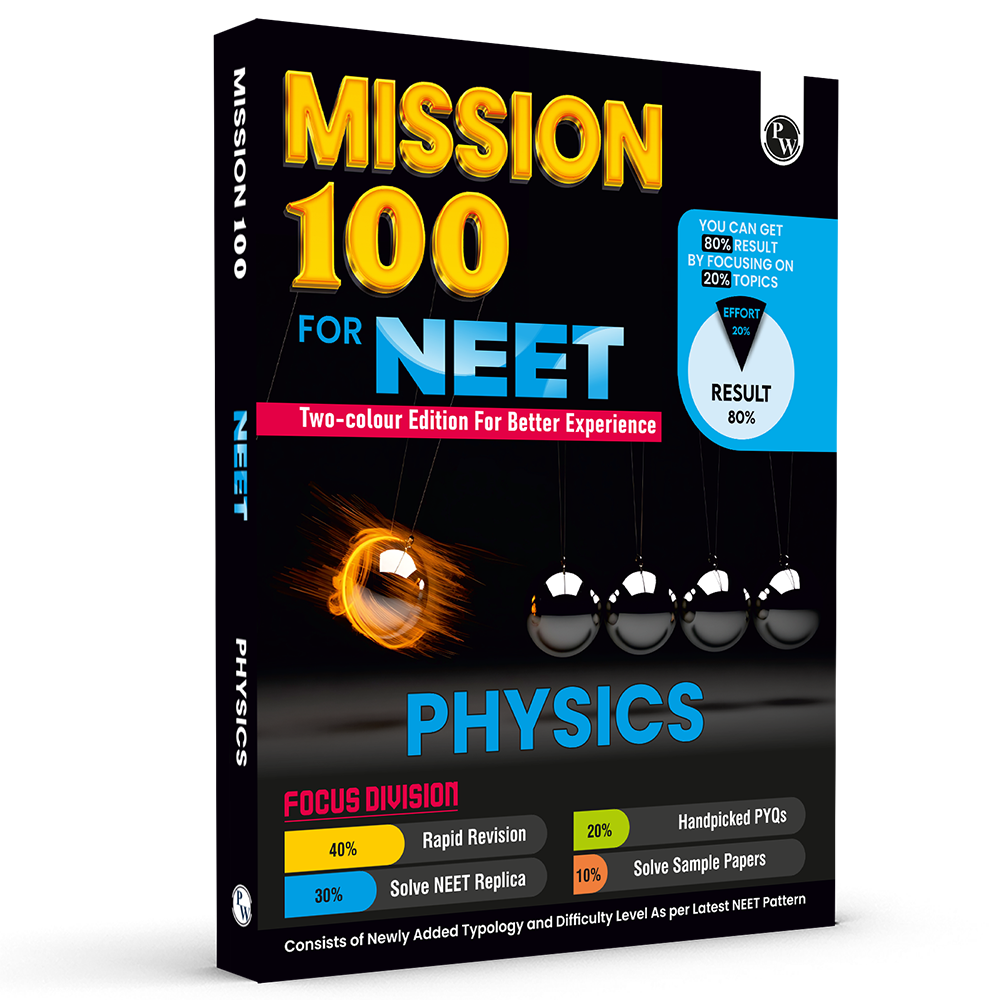
Importance of the NEET Mission 100 Chemistry book
When time is limited, your study material must be highly targeted and efficient. The NEET Mission 100 Chemistry book is specifically engineered to eliminate fluff and focus purely on exam-oriented preparation. It breaks down massive chapters into manageable portions, allowing you to review essential concepts at a glance.
This resource serves as a dedicated NEET chemistry revision book, compressing the vast syllabus into high-priority summaries. It helps you avoid the trap of re-reading familiar chapters and instead guides you directly toward your weak areas. By providing structured, crisp notes, you ensure your final rounds of study remain highly productive.
How to Use NEET Mission 100 Chemistry Book?
A smart revision plan is incomplete without analyzing past exam papers. Working through real test questions provides direct insight into the actual difficulty level and trends of the medical entrance test.
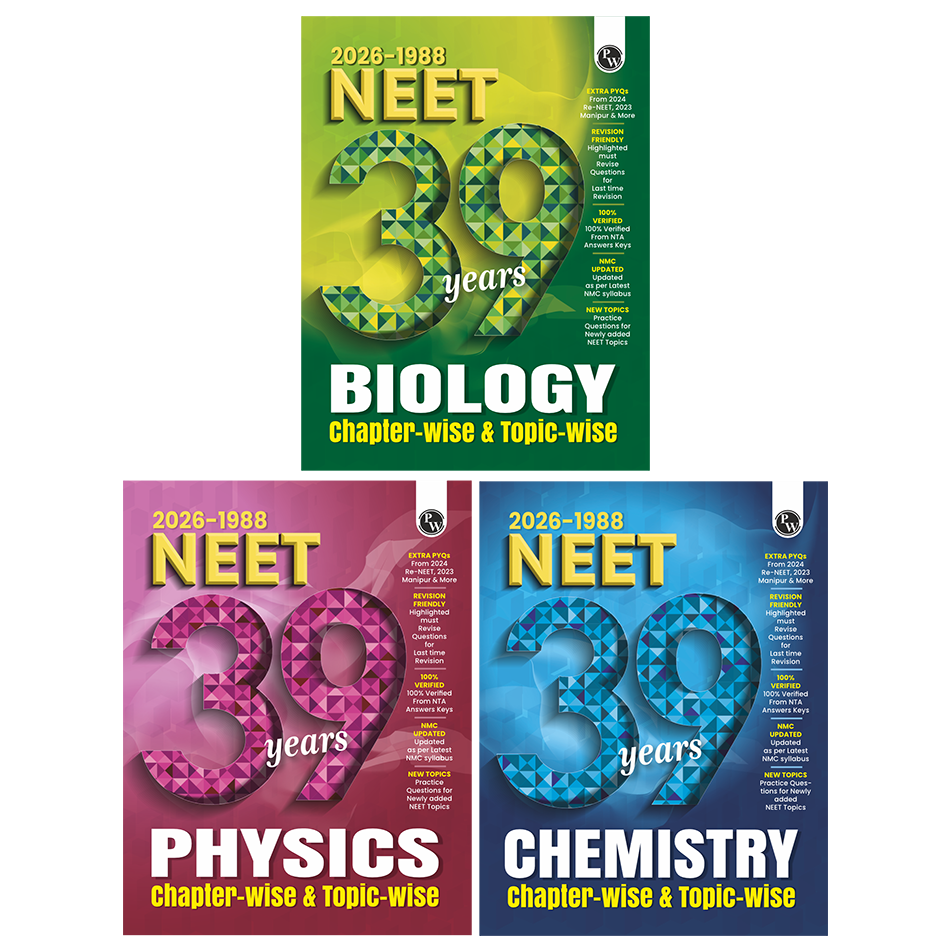
Using a dedicated chemistry PYQ for NEET allows you to see how theoretical concepts translate into actual exam questions. It removes the guesswork from your preparation and highlights the exact phrasing and traps examiners use.
-
Identify repeating patterns: Certain types of numericals reappear every few years with altered values.
-
Analyze mistakes immediately: Do not just check the answer key; study the step-by-step solution to correct your approach.
-
Time your attempts: Solve past questions within a strict time limit to simulate the actual exam environment.
Study Plan for NEET Mission 100 Chemistry Book
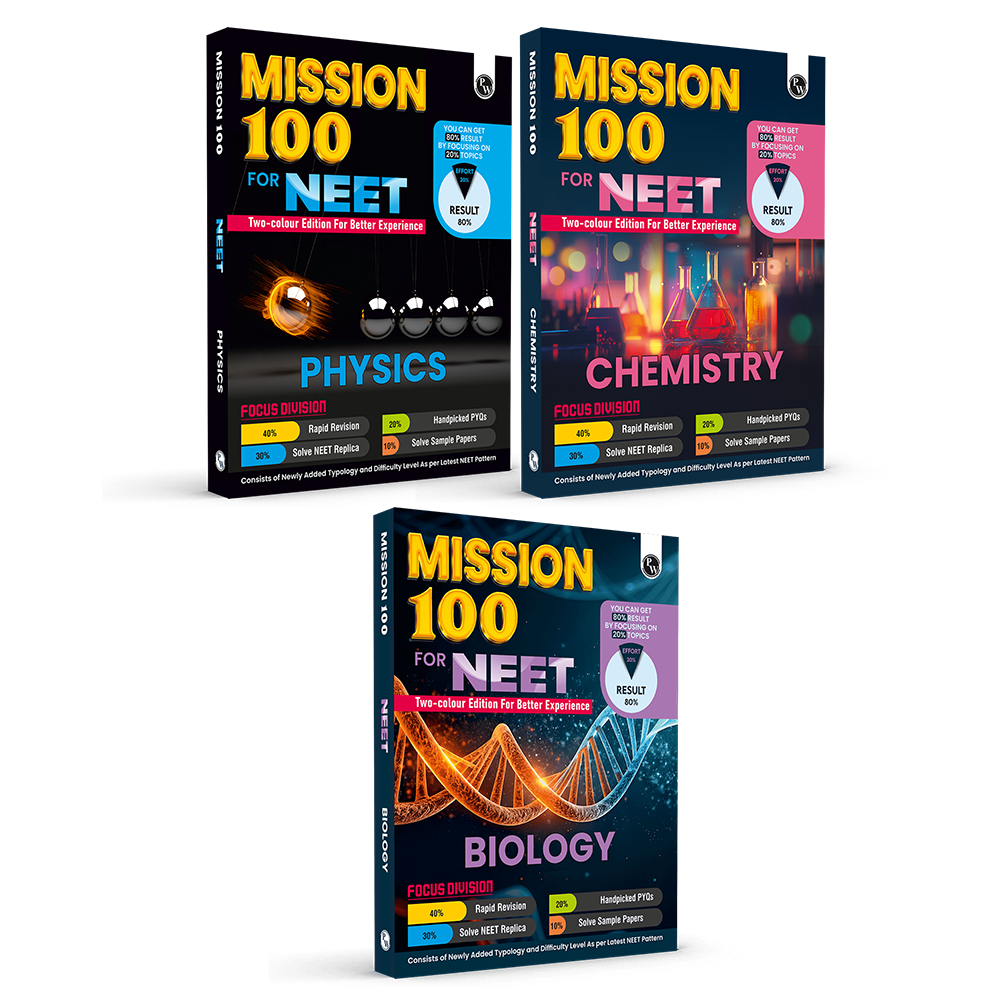
To get good results from your resource, you need a systematic plan rather than random reading. Casual skimming will not help you solve tricky numerical problems under exam pressure. Resources such as the Mission 100 Combo Set of 3 Books can support focused preparation by helping students revise strategically, practice efficiently, and build stronger exam-oriented problem-solving habits.
1. Focus on high-weightage chapters first
Not all chapters carry the same mark value in the final exam. Prioritize topics that yield the highest number of questions year after year.
-
Chemical Kinetics: Focus heavily on first-order reactions, half-life calculations, and Arrhenius equation graphs.
-
Electrochemistry: Master the Nernst equation, molar conductivity, and Faraday's laws of electrolysis.
-
Solutions: Concentration terms, Raoult's law, and colligative properties are always critical.
-
Ionic Equilibrium: Dedicate time to pH calculations, buffer solutions, and solubility products.
2. Implement the formula-first approach
Physical Chemistry is deeply rooted in formulas. Open your Mission 100 chemistry guide and create a dedicated mental map of all core equations. Instead of just memorizing them, understand what each variable represents and the units required for accurate calculation.
3. Solve high-yield practice problems
Theory alone will not secure a high score. Use your resource as a dedicated NEET chemistry practice book to solve around 30 to 40 selected problems per chapter. Focus on variety rather than volume, ensuring you expose yourself to different ways a single concept can be tested.
How to Improve Numerical Problem Solving with NEET Mission 100 Chemistry Book?
Speed and accuracy dictate your performance on exam day. Many candidates understand the theory but fail to get the correct final answer due to calculation errors or poor time management.
|
Chapter Name |
Core Focus Areas |
Average Number of Questions |
|
Some Basic Concepts |
Mole concept, stoichiometry, empirical formulas |
Around 1-2 |
|
Structure of an Atom |
Bohr's model, quantum numbers, and de Broglie wavelength |
Around 2 |
|
Thermodynamics |
Enthalpy changes, Gibbs free energy, entropy laws |
Around 2 |
|
Chemical Equilibrium |
Equilibrium constant, Le Chatelier's principle |
Approximately 1-2 |
To improve your calculation speed, practice mental approximations where possible. Avoid using calculators during your revision sessions, as they build a false sense of security. Learn to work with scientific notation and logarithms efficiently, as these show up constantly in chapters like Electrochemistry and Kinetics.
Tips for Using NEET Mission 100 Chemistry Book
Physical Chemistry often seems scary in the last lap of the medical entrance examination. Unlike organic reactions or trends in inorganic chemistry, this section requires a fine balance between conceptual clarity and mathematical accuracy. When time is running out, students often have difficulties in finding the balance between core theory and rigorous numerical practice.
It is a waste of effort to cram through thick textbooks in the last minute. It only leads to confusion. You want a systematic way to help you pinpoint the high-yield topics without wading through a ton of text. The right NEET chemistry book makes a world of difference to how well you leverage these critical remaining days.
Common Mistakes to Avoid with NEET Mission 100 Chemistry Book
With limited days remaining, avoiding inefficient study habits is just as important as following a good routine. Small errors in your approach can waste hours of valuable study time.
-
Reading theory passively: Simply highlighting text in your textbook does not stimulate active recall. Always solve a problem after reading a concept.
-
Ignoring unit conversions: Physical Chemistry questions often mix different units like Joules and calories, or liters and cubic meters. Always cross-check your units before final calculations.
-
Skipping tough topics: Avoiding difficult chapters like Ionic Equilibrium entirely can damage your score. Use your NEET book to master at least the basic formulas of these complex chapters.
-
Overloading on new materials: Stick to your core books. Introducing entirely new study material in the final week causes unnecessary anxiety and confusion.
NEET Mission 100 Chemistry Book FAQs
How does the NEET Mission 100 chemistry book help in quick revision?
The book condenses vast theoretical chapters into precise, high-yield bullet points and formula charts. This allows you to review an entire Physical Chemistry chapter in approximately 20 to 30 minutes, making it highly effective for final-stage preparation.
Can I master Physical Chemistry numericals using this book in one month?
Yes, by focusing on the structured formula lists and practicing the selected high-yield problems provided in the book, you can significantly improve your problem-solving accuracy and speed within a limited timeframe.
Does this book contain sufficient previous years' questions for practice?
The book integrates essential trend-based questions and patterns derived from past exams, helping you understand how theoretical formulas are applied to real exam problems.
Should I study Organic and Inorganic Chemistry from this guide as well?
Absolutely. While it works exceptionally well for the numerical demands of Physical Chemistry, the guide provides equally crisp mind maps and reaction mechanisms for Organic Chemistry and factual summaries for Inorganic Chemistry.
How should I schedule my final revision with this book?
Divide your remaining days by chapter weightage. Spend the first half of your study session reviewing formulas and key concepts from the book, and devote the second half to solving the targeted practice questions and reviewing errors.