What the 39 Years NEET PYQ Physics Covers — Topics, Years and Features

Many students have trouble figuring out which concepts are repeated and how to pace themselves during the actual test.
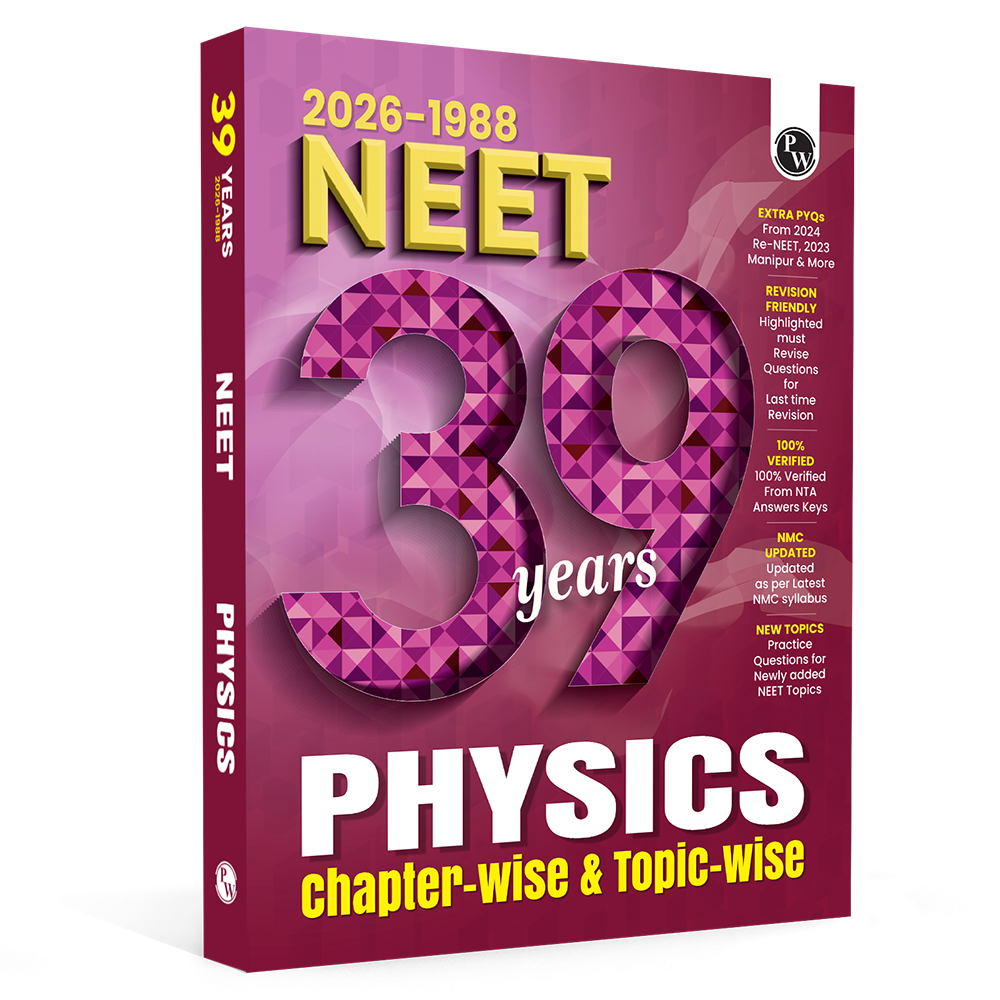
The NEET PYQ Physics covers a complete set of fully solved previous year papers from 1988 to 2026. It provides a well-organized format with chapter-wise and topic-wise segregation, important questions highlighted for revision, and practice sets for newly added topics as per the latest syllabus guidelines.
Check out: NEET Books
Importance of NEET PYQ Physics Book
This book stands out as a highly comprehensive repository, capturing nearly four decades of medical entrance exam history. It provides an unbroken chain of past questions, allowing students to trace how the difficulty level and question language have evolved.
-
Complete Timeline: The book covers approximately 39 years of past papers, running continuously from the latest 2026 exam back to 1988.
-
Recent Exam Variances: It includes specialized question papers such as the 2024 Re-NEET and the 2023 Manipur papers, ensuring no question variation is missed.
-
Diverse State Papers: Apart from core papers, it features specific old state-level entrance questions that match the present national standard.
Features of NEET PYQ Physics Book
Simply gathering old questions is not enough; how they are presented matters. The NEET physics PYQs book integrates smart pedagogical tools to save study time and optimize self-assessment.
1. Chapterwise and Topicwise Arrangements
Instead of shuffling through mixed question papers, the content is segmented by specific chapters and subtopics. This enables students to answer questions straight after a topic is finished in class, thereby reinforcing their learning.
2. The "PYQs Deja Vu" Trend Tracker
This specialised tool makes it easy for students to find the very concepts that get repeated year after year. It gives you a visual image of repeated trends, which helps you focus on high-yield areas instead of low-weightage topics.
3. Highlighted "Must Revise Questions"
During the final days before the exam, checking thousands of questions is impossible. The book highlights selected questions that cover multiple combined concepts, making them perfect for quick last-minute revision.
4. 100% NTA-Verified Step-by-Step Solutions
Get verified answers from official answer keys for all NEET physics previous year question with step-by-step detailed solutions. This lets you see the precise logical steps needed to arrive at the correct answer.
5. Alignment with New Syllabus & New Topics
Completely revised to include the latest changes to the national curriculum. It has bespoke practice questions on newly introduced topics so that students are not taken by surprise on the day of the exam.
Topics Covered in NEET PYQ Physics Book
The NEET PYQ book segregates the extensive syllabus of Class 11 and Class 12 into clear segments. This systematic organization helps students systematically tackle their NEET PYQ physics chapter wise questions after finishing each chapter from their textbooks.
Class 11 Physics Syllabus Topics
The Class 11 section builds the fundamental physical mechanics and thermal properties. The book contains thousands of questions from these basic units:
-
Units and Measurements: Focuses on dimensional analysis, significant figures, and around 5% weightage of error calculation methods.
-
Kinematics and Laws of Motion: Includes uniform motion, relative velocity, projectile motion, friction, and Newton's laws.
-
Work, Energy, and Power: Covers kinetic and potential energy, work-energy theorem, and collisions.
-
Rotational Motion: Solves problems on the moment of inertia, torque, and angular momentum, which holds an estimated 6% weightage.
-
Gravitation: Covers planetary motion, Kepler's laws, and escape velocity.
-
Properties of Bulk Matter: Examines the mechanical properties of solids and fluid mechanics.
-
Thermodynamics and Kinetic Theory: Features thermal expansion, calorimetry, and laws of thermodynamics.
-
Oscillations and Waves: Includes simple harmonic motion (SHM), resonance, and the Doppler effect.
Class 12 Physics Syllabus Topics
The Class 12 chapters carry a substantial volume of formula-heavy numerical problems. Students can practice the PYQ of NEET physics to secure high-scoring units:
-
Electrostatics: Covers electric charges, fields, potential, and capacitance.
-
Current Electricity: Focuses on Ohm's law, Kirchhoff's laws, and potentiometers, holding around 10% weightage.
-
Magnetic Effects and Magnetism: Covers the Biot-Savart law, Ampere's law, and moving charges.
-
Electromagnetic Induction and AC: Solves resonance and power factor problems in alternating currents.
-
Optics: Covers reflection, refraction, lenses, wave optics, and Young's double-slit experiment.
-
Modern Physics: Includes the dual nature of matter, atoms, radioactivity, and nuclei.
-
Semiconductor Electronics: Focuses on diodes, transistors, and logic gates with an estimated 5% weightage.
How NEET PYQ Physics Book Can Improve Your Score?
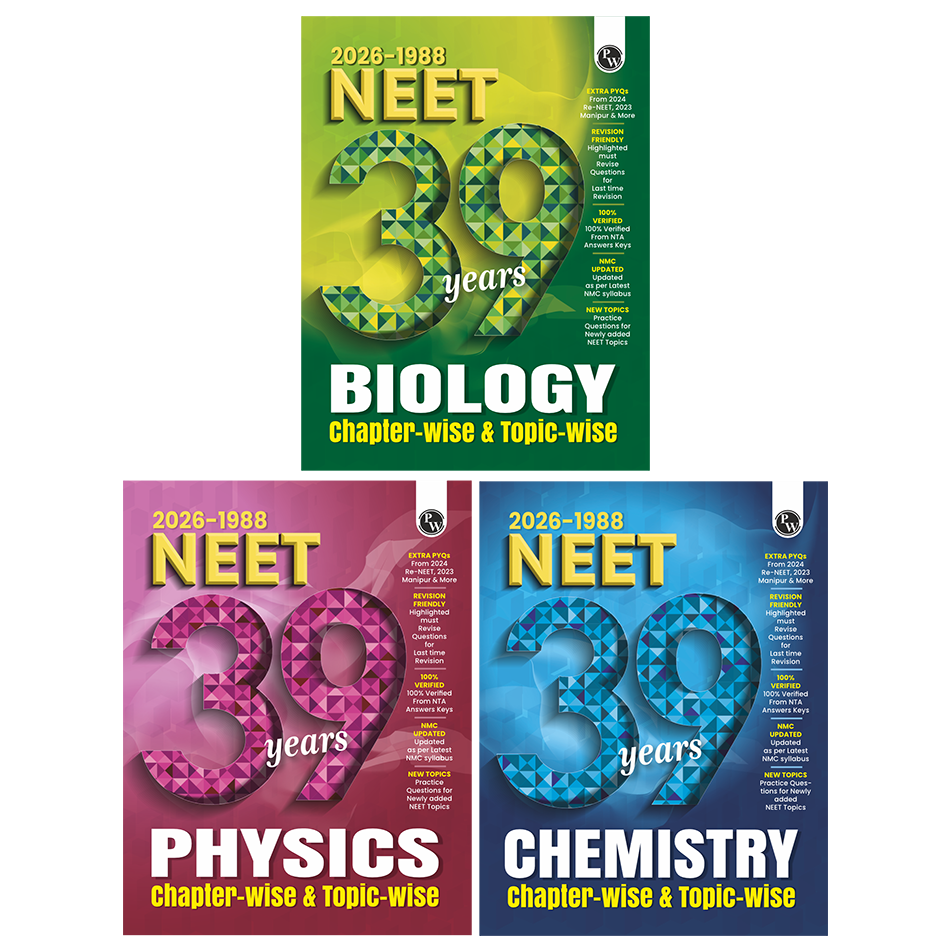
To turn your preparation into a major strength, you must follow a disciplined strategy while practicing from the NEET previous year paper Physics collections. Build concepts first, solve questions chapter-wise, analyse mistakes carefully, and revise weak areas regularly. Along with subject-wise practice, students can also use the 39 Years NEET PYQ Combo to access extensive previous year questions across subjects, identify recurring patterns, and improve overall exam readiness through structured preparation.
-
Solve with a Timer: Always sit in a quiet room and set a timer for around 3 hours when attempting full-length papers. This trains your brain to handle the pressure of answering questions within approximately 1 minute each.
-
Maintain a Mistake Notebook: Dedicate a specific notebook to write down the questions you answered incorrectly. Note the core formula you missed and review this book every week.
-
Follow the 80/20 Rule: Allocate an estimated 80% of your revision time to high-weightage chapters like Current Electricity, Electrostatics, and Modern Physics, and the remaining 20% to smaller units.
-
Analyse Question Language: Pay close attention to how the questions are twisted. Often, the theory is simple, but the language is framed to test your deep conceptual clarity rather than rote memory.
NEET PYQ Physics Book Chapter Weightage and Questions
This section provides a chapter-wise breakdown of NEET Physics PYQs, highlighting important topics and the number of questions asked from each chapter. It helps students prioritize high-weightage areas and plan their preparation effectively.
|
Physics Chapters & Units |
Average Number of Questions |
Approximate Weightage (%) |
|
Current Electricity |
5 Questions |
10% |
|
Rotational Motion |
3 Questions |
6% |
|
Ray Optics and Instruments |
3 Questions |
6% |
|
Semiconductor Electronics |
3 Questions |
5% |
|
Units and Measurements |
3 Questions |
5% |
|
Electrostatic Potential & Capacitance |
3 Questions |
5% |
|
Modern Physics (Atoms + Nuclei) |
3 Questions |
7% |
|
Moving Charges and Magnetism |
2 Questions |
5% |
|
Thermodynamics & Kinetic Theory |
2 Questions |
5% |
Read More: How to Start NEET Preparation After Class 10?
NEET PYQ Physics FAQs
How does solving NEET PYQ physics help in managing time?
Practicing past questions under timed conditions teaches you to balance speed and accuracy. Since you learn to solve regular question styles efficiently, you save crucial minutes for the complex calculation-based numericals in the actual test.
Are the solutions in the NEET PYQ physics chapter wise book reliable?
Yes, the solutions provided are 100% verified with the official answer keys. Expert faculty members write the detailed, step-by-step explanations to ensure students grasp the foundational concepts easily.
Does the PYQ of NEET physics book include recent changes in the syllabus?
Yes, the book is fully updated as per the latest guidelines. It includes additional practice questions for newly added topics and incorporates specific question sets from recent sessions, like the 2024 Re-NEET.
Why is the "PYQs Deja Vu" feature important in PYQ NEET physics books?
The "PYQs Deja Vu" feature helps students spot recurring question trends and highly repeated concepts across approximately 39 years. This allows you to focus on high-yield questions and manage your revision time effectively.
Can a dropper rely on NEET physics previous year question sets for final revision?
Absolutely. Droppers can benefit greatly from these sets because they highlight weak areas, provide immediate clarity on concepts through detailed explanations, and offer a clear picture of the actual exam pattern.