Nursing Syllabus: How to Cover All Subjects With PW Books?

Nursing aspirants often face significant hurdles when attempting to organize vast amounts of clinical and theoretical material across multiple disciplines. Juggling competitive test dates alongside comprehensive subject lists creates unnecessary stress, particularly when students rely on scattered notes or outdated materials.
Selecting high-quality nursing books offers a direct path through this confusion, supplying clear explanations and structured practice sets to build exam confidence.
Overview of Nursing Books
Standard study resources form the primary foundation for students preparing for competitive entrance tests and competitive recruitment tests across the healthcare sector. Examinations such as AIIMS NORCET, RRB Nursing, NHM CHO, DSSSB, ESIC, and JIPMER demand a clear grasp of foundational concepts coupled with steady problem-solving skills.
Quality nursing book combines structured theoretical explanations with extensive practical exercises, allowing candidates to strengthen their subject knowledge systematically.
-
Concept Clarity: Clear language breaks down difficult topics to build a sturdy theoretical foundation across core disciplines.
-
Chapter-Wise Practice Questions: Structured exercises follow every topic, enabling candidates to test their knowledge immediately.
-
Previous Year Questions (PYQs): Authentic questions from past exams help candidates grasp question formats and topic weightage.
-
Updated Content: Textbooks reflect current patterns and latest syllabi across national entrance and recruitment tests.
-
Mock Tests & Revision Support: Practice papers, quick reference notes, and full-length mock tests assist in periodic performance evaluation.
Which Nursing Subjects Can You Cover with Nursing Books
Candidates preparing for competitive healthcare examinations must master a broad spectrum of topics spanning theoretical principles and clinical skills. Relying on well-organized nursing preparation books ensures thorough coverage across each area without leaving out key concepts.
The major subjects included in standard competitive test coverage comprise:
-
Anatomy and Physiology: Covers fundamental structural and functional systems of the human body to support clinical understanding.
-
Fundamentals of Nursing: Details core nursing principles, clinical techniques, patient care procedures, and ethics.
-
Community Health Nursing: Focuses on public health guidelines, national health programmes, disease prevention, and community care.
-
Medical-Surgical Nursing: Details adult health conditions, surgical management, pharmacology, and emergency interventions.
-
Child Health (Paediatric) Nursing: Focuses on growth development stages, childhood disorders, and specialized paediatric nursing practices.
-
Mental Health (Psychiatric) Nursing: Addresses psychological conditions, therapeutic communication, and psychiatric treatment modalities.
-
Midwifery and Obstetrical Nursing: Covers maternal healthcare, foetal development, ante-natal care, labor processes, and post-natal care.
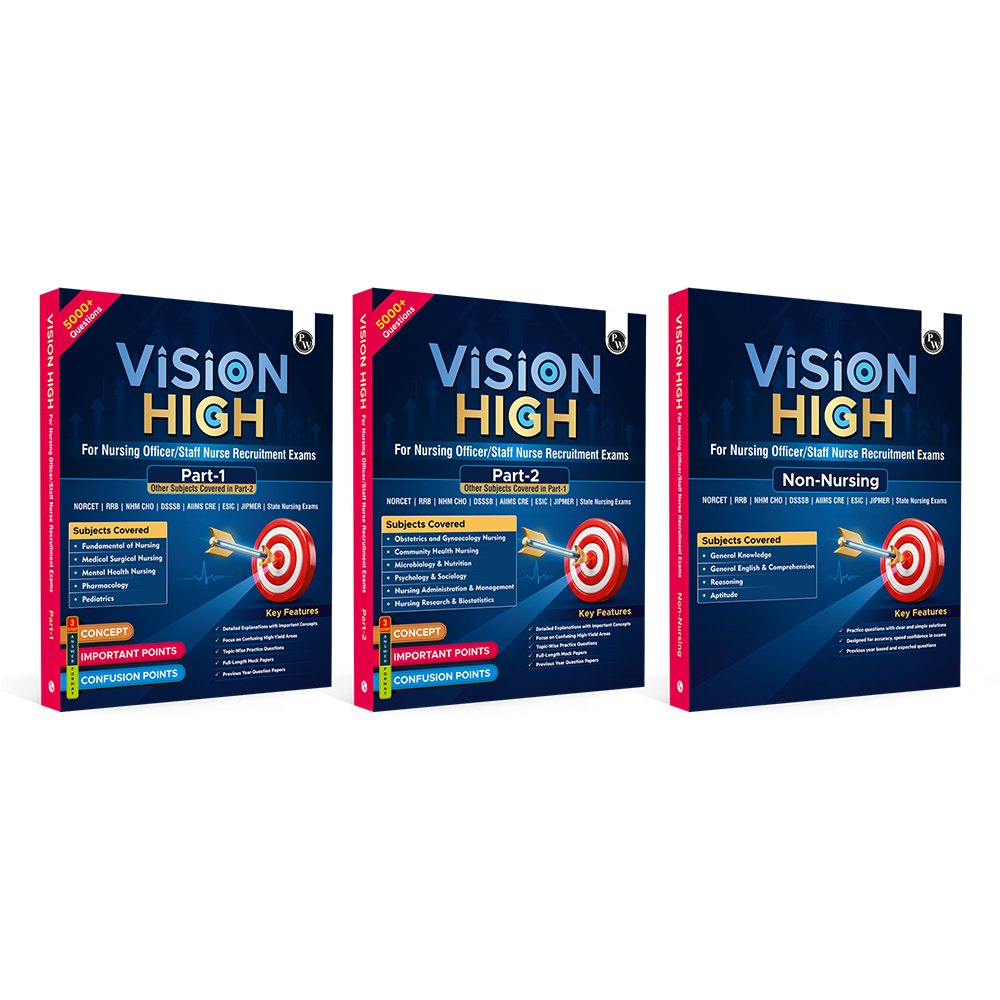
Prepare for NORCET, RRB, NHM CHO, DSSSB, AIIMS CRE, ESIC, and JIPMER exams with PW Nursing Books Vision High Combo Set, featuring 5000+ questions, PYQs, and detailed explanations.
How Can Nursing Books Help You Complete All Subjects
Using dedicated text resources brings order to a vast syllabus by dividing large topics into manageable, logical study units. Structured nursing exam preparation becomes far easier when complex information is organized into defined chapters accompanied by targeted practice problems.
The main benefits of utilizing comprehensive textbooks during study sessions include:
-
Systematic Learning: Textbooks organize broad curricula into structured sequences, preventing students from skipping foundational topics.
-
Enhanced Accuracy: Regular practice using chapter-end exercises helps refine analytical speed and reduces basic mistakes during testing.
-
Targeted Revision: Dedicated summary notes and key takeaways within chapters streamline last-minute reviews before exam dates.
-
Self-Evaluation: Solving practice questions and full-length papers allows students to monitor their progress and isolate weak points early.
Which Nursing Books Should You Use for Different Subjects
Selecting subject-specific text resources helps candidates gain deep theoretical clarity and practical insights tailored to each core topic. A balanced selection of nursing preparation books ensures that both fundamental concepts and advanced clinical applications are thoroughly covered.
-
Foundational Science Textbooks
Initial preparation should focus on structural systems, basic physiology, and core clinical principles. High-quality texts provide detailed explanations of body systems and fundamental care procedures, giving aspirants the necessary groundwork before they attempt advanced clinical questions.
-
Specialized Clinical Practice Books
Advanced preparation requires targeted resources for Medical-Surgical Nursing, Paediatrics, and Midwifery. Quality clinical books feature case studies, clinical scenarios, and procedure-focused questions that mirror real-world exam conditions and recruitment assessments.
-
Practice and PYQ Compilations
In addition to subject texts, dedicated question banks containing previous year papers and full-length mock tests are essential. These compilations provide candidates with realistic exam practice, helping them evaluate speed, accuracy, and overall readiness under timed conditions.
How to Plan Your Study with Nursing Books for the Complete Syllabus
Executing a structured daily plan ensures that every subject receives adequate attention well ahead of exam dates. Combining textbook reading with daily question practice ensures steady progress across the entire syllabus.
A structured plan can be organized into distinct phases:
|
Phase |
Primary Focus |
Key Action Items |
|
Phase 1: Conceptual Foundation |
Fundamental theory and basic principles |
Read core chapter topics; take detailed summary notes. |
|
Phase 2: Practice & Application |
Question solving and topic analysis |
Complete chapter-wise exercises; solve targeted problem sets. |
|
Phase 3: Comprehensive Revision |
PYQs and past paper review |
Solve previous year papers; review complex formulas and procedures. |
|
Phase 4: Final Testing |
Time management and speed |
Attempt full-length mock tests under realistic timed conditions. |
Tips to Cover All Nursing Subjects with Nursing Books
Maintaining an effective study routine requires consistency and structured methods. Applying deliberate strategies while reading through study resources improves information retention and speeds up problem solving.
Key strategies for maximum syllabus coverage include:
-
Establish Strong Concepts First: Focus on understanding underlying theoretical principles thoroughly before moving on to practice question sets.
-
Solve Chapter Exercises Daily: Reinforce newly learned theoretical concepts immediately by solving related practice questions at the end of each chapter.
-
Analyze Past Exam Papers: Work through previous year papers regularly to identify recurring topics, question trends, and time allocation requirements.
-
Simulate Real Exam Conditions: Complete full-length mock papers under strict time constraints to build test stamina and refine pacing.
-
Maintain Regular Revision Schedules: Revisit notes, core definitions, and summary tables weekly to keep earlier subjects fresh in mind.
Common Mistakes to Avoid While Using Nursing Books for Syllabus Preparation
Candidates often encounter obstacles that impede their overall test readiness. Avoiding frequent study missteps helps maintain consistent momentum throughout the preparation journey.
Key pitfalls to avoid include:
-
Jumping Straight to Questions: Attempting practice questions without first mastering basic chapter theory leads to confusion and poor accuracy.
-
Ignoring Previous Year Papers: Neglecting past exam questions prevents candidates from understanding actual question patterns and difficulty levels.
-
Neglecting Weak Subjects: Spending excessive time on comfortable topics while ignoring difficult disciplines creates uneven preparation across the syllabus.
-
Irregular Revision Habits: Moving through new topics without systematically revising previously covered chapters results in rapid information loss.
-
Overlooking Time Limits: Solving practice sets without tracking time fails to build the speed necessary for formal examination settings.
FAQs
Which exams can be prepared for using nursing books?
They are useful for AIIMS NORCET, RRB Nursing, NHM CHO, DSSSB, ESIC, JIPMER, and other major competitive entrance and recruitment examinations.
Are these preparation resources updated according to the latest syllabus?
Yes, quality study resources are published in alignment with current examination patterns, syllabus updates, and testing formats.
Do these textbooks include past examination papers?
Yes, many comprehensive study sets feature previous year questions complete with detailed solutions to assist candidates in analyzing exam trends.
Are these books suitable for beginner students?
Yes, clear explanations, simple language, and structured chapters make these materials suitable for both first-time candidates and repeat applicants.
What is the most effective way to complete the syllabus using these resources?
Read core concepts systematically, practice chapter-wise question sets, solve previous year papers, revise notes regularly, and complete full-length mock exams.