Don’t Prepare for RRB Group D Without PW PYQs
To clear the Railway Group D exam, you need a strategy built on real exam trends. Using RRB Group D PYQ materials helps you understand the weightage of topics like General Science and Math.
Securing a position in the Indian Railways is a dream for millions, but the massive competition for Level 1 posts makes it a tough nut to crack. Many students spend months reading textbooks without understanding which topics actually appear in the exam.
If you want to stand out, you must integrate PYQ into your daily routine. By solving these papers, you familiarise yourself with the language of the questions and the specific difficulty levels set by the RRB. This article explains why PYQs are the ultimate resource for your selection.
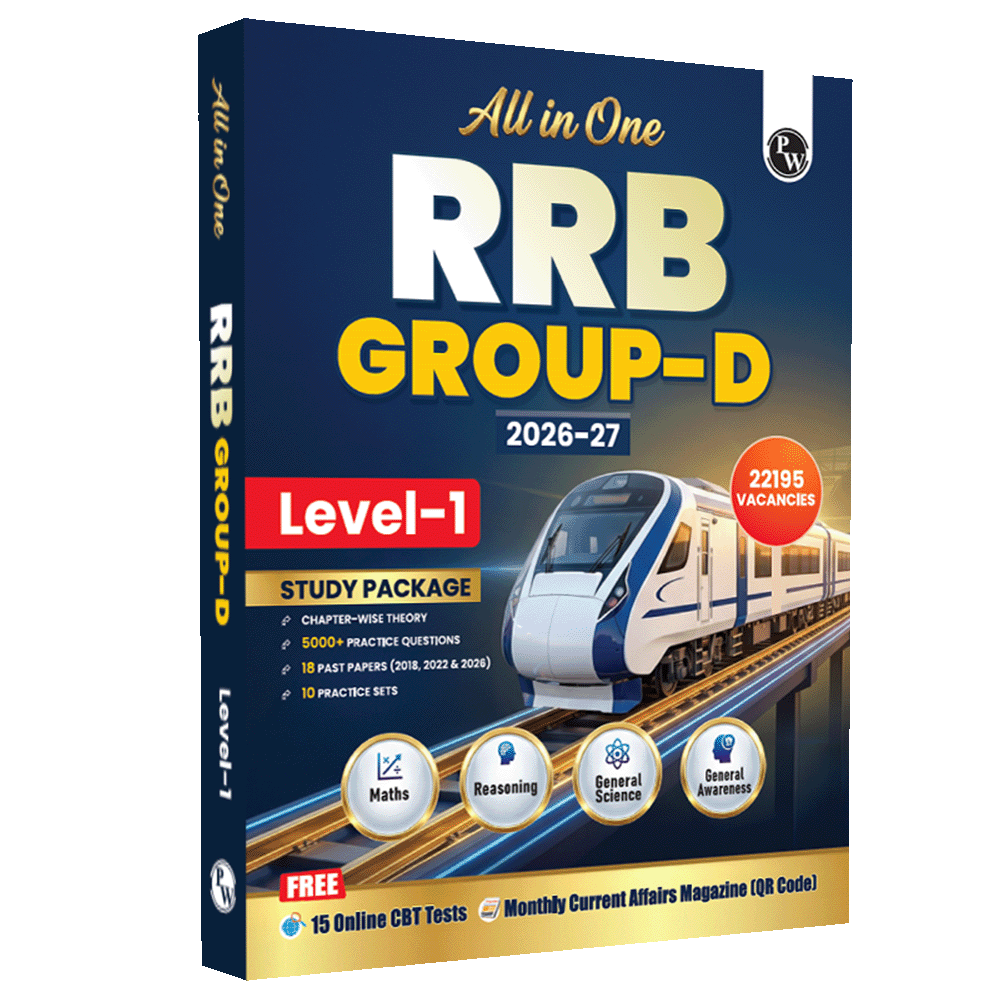
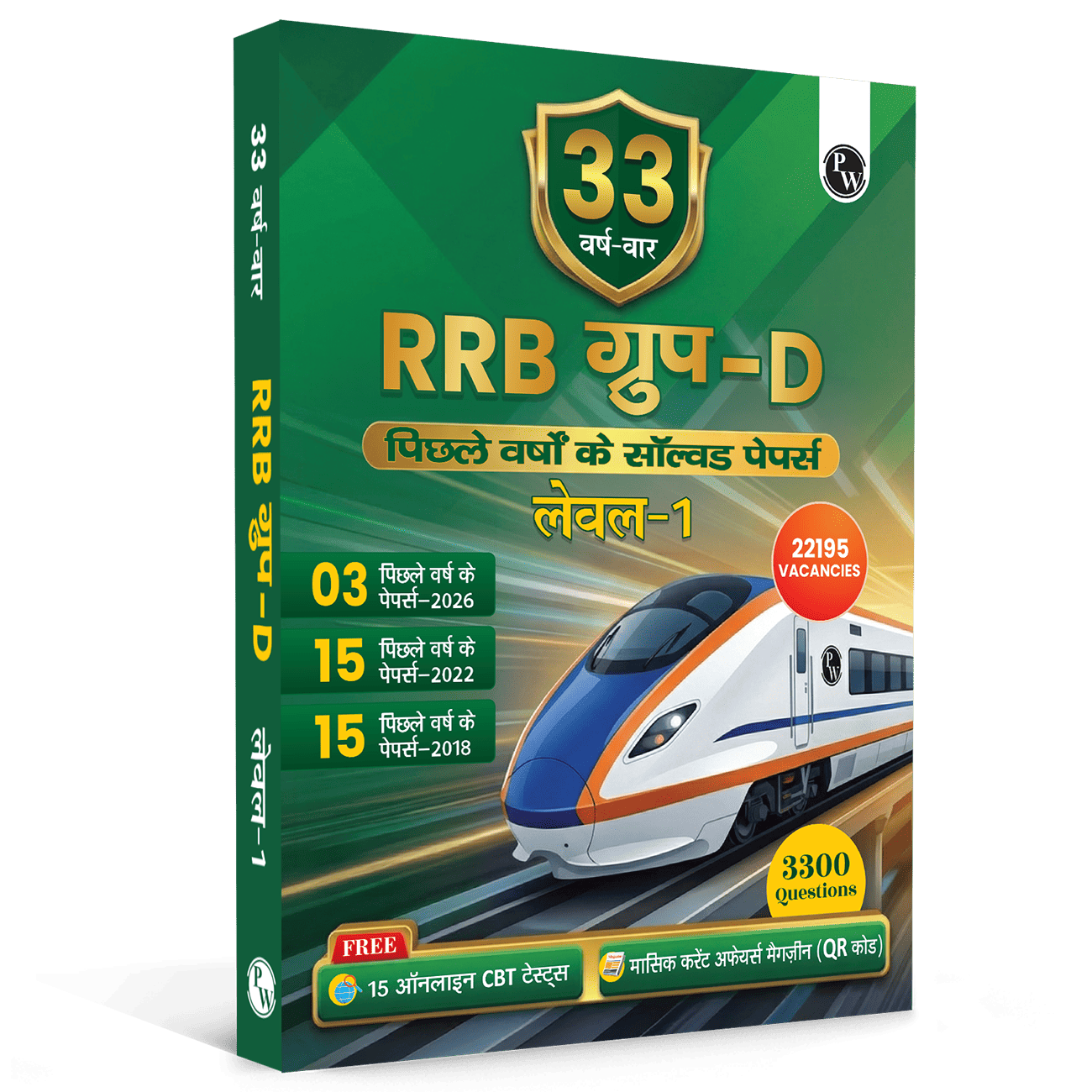
Check Out: RRB Books
Importance of Solving RRB Group D PYQ
Success in Railway exams is less about how much you know and more about how quickly you can solve what you know. Solving the PYQ provides a clear roadmap of the journey ahead.
-
Understanding Question Patterns: You get to see how the RRB frames questions for General Intelligence and Reasoning compared to General Awareness.
-
Time Management: Practising with a question paper helps you track how much time you spend on each section, allowing you to improve your speed.
-
Identifying High-Weightage Topics: Not every chapter is equally important. Past papers show that certain topics in Physics and Chemistry appear more frequently.
-
Boosting Confidence: When you solve an actual RRB Group D past year paper, you lose the fear of the unknown, making you more composed during the actual exam.
Benefits of Using PW RRB Group D PYQ
Using this resource instead of random internet searches for a PDF gives you a competitive edge. It has the following benefits:
Detailed Solutions
Most platforms provide the answer key but leave out the explanation. It provides step-by-step solutions for every PYQ. This ensures that if you get a question wrong, you learn the concept immediately instead of just memorising the answer.
Error-Free Content
One major issue with free downloads is the high rate of errors. The RRB Group D previous year paper collection undergoes multiple rounds of proofreading by subject matter experts to ensure students do not learn incorrect methods.
Exam-Oriented Approach
The study material is structured to match the latest TCS exam pattern. It focuses on the shift-wise variations seen in recent years, helping you prepare for the hardest possible version of the paper.
RRB Group D PYQ Exam Pattern
Before diving into the PYQ, it is vital to know the structure of the Computer-Based Test (CBT). The exam usually consists of 100 questions to be solved in 90 minutes.
-
General Science: 25 Questions (Focuses on 10th-standard CBSE Physics, Chemistry, and Biology).
-
Mathematics: 25 Questions (Includes Number System, Algebra, Geometry, and Trigonometry).
-
General Intelligence and Reasoning: 30 Questions (Analogy, Coding-Decoding, and Syllogism).
-
General Awareness and Current Affairs: 20 Questions (Science & Technology, Sports, Culture, and Economics).
Solving a PYQ allows you to see how these 100 questions are distributed across shifts.
How to Use RRB Group D PYQ PDF for Revision
Downloading a PYQ PDF is only the first step. You must use it strategically to see results in your mock scores.
-
Solve Subject-Wise: Initially, do not try to solve the full paper. Take the Science section from a RRB Group D past year paper and solve it after finishing your Science syllabus.
-
Simulate Exam Conditions: Once you have covered 70% of the syllabus, sit with the paper and a timer for 90 minutes.
-
Analyse Your Mistakes: After finishing the paper, spend two hours analysing why you missed certain questions. Was it a calculation error or a lack of conceptual clarity?
-
Repeat Difficult Questions: Mark the tough questions in RRB PYQ and revisit them every week.
Topics to Prepare for the RRB Group D PYQ
Based on the analysis of the papers, certain topics are "must-haves" for every aspirant.
-
Mathematics: Focus on BODMAS, Percentages, Mensuration, and Time & Work. These form the bulk of the math section.
-
General Science: Chemical reactions, Periodic Table, Motion, Force, and Light (Reflection and Refraction) are recurring themes in RRB Group D PYQ.
-
Reasoning: Practice Venn Diagrams, Data Interpretation, and Blood Relations extensively.
-
Current Affairs: Focus on appointments, sports awards, and budget highlights from the last 12 months.
Preparation Tips for RRB Group D PYQ 2025
To score 80+ marks, you need a disciplined approach.
-
Daily Calculation Practice: Spend 15 minutes on tables, squares, and cubes to speed up your math section.
-
Standard Books: Stick to NCERT for Science and the question bank for practice.
-
Stay Consistent: It is better to study for 4 hours every day than 12 hours once a week.
-
Mock Tests: Use the PYQ as your primary mock tests before moving to the test series.
Analysis of RRB Group D PYQ
If you look at the papers from 2018 and 2022, you will notice a significant shift. The questions have moved from direct factual questions to more conceptual ones, especially in Physics. Numerical problems are now a standard part of the Science section. By practising with PYQ, you adapt to this rising difficulty level.
-
Mathematics Section Trends
In previous years, Arithmetic dominated the papers. However, recent RRB Group D question paper trends show an increase in Elementary Statistics and Algebra.
-
General Science Section Trends
Biology used to be the main focus, but recent years have seen a surge in Physics numericals related to Electricity and Magnetism. You can only find these patterns by scanning through a PYQ.
Check Out: Railway Game Changer PYQ Combo Set of 3 Books
Steps to Download RRB Group D PYQ
While the book is the recommended resource, many students look for digital versions.
-
Visit the official RRB regional websites.
-
Search for the "Candidate Response Sheet" or "Past Papers" section.
-
Look for the RRB Group D previous year paper link.
-
Select the specific shift and date you wish to practice.
-
Save the PDF for offline use.
Read More: RRB Group D Topic Wise Weightage 2026
RRB Group D PYQ FAQs
Q1: Is solving the Railway Group D PYQ enough to pass the exam?
While PYQ is essential for understanding the pattern, you also need to build your concepts through standard textbooks or live classes to handle new types of questions.
Q2 How many years of RRB Group D PYQ PDF should I solve?
It is recommended to solve at least the last 5 years of papers, focusing heavily on the 2018 and 2022 shifts found in a PDF.
Q3: Does the RRB Group D question paper repeat questions?
The exact questions are rarely repeated, but the concepts and the "types" of questions are frequently reused. Practising a question paper prepares you for these recurring patterns.
Q4: What is the benefit of a PYQ of RRB Group D over a mock test?
A PYQ gives you the actual difficulty level set by the RRB, whereas mock tests can sometimes be unnecessarily hard or too easy compared to the real exam.