How to Increase Speed in RRB Reasoning Section
The RRB reasoning section is often the make-or-break component of any railway recruitment drive. While many candidates can solve most questions given enough time, the real challenge lies in the ticking clock. If you find yourself stuck on a single puzzle for five minutes or struggling to complete the section within the allotted timeframe, you are not alone.
Effective RRB reasoning preparation is not just about accuracy; it is about developing the mental agility to identify patterns within seconds. This article focuses on actionable strategies to sharpen your logical thinking and ensure you navigate the reasoning paper with both speed and precision.
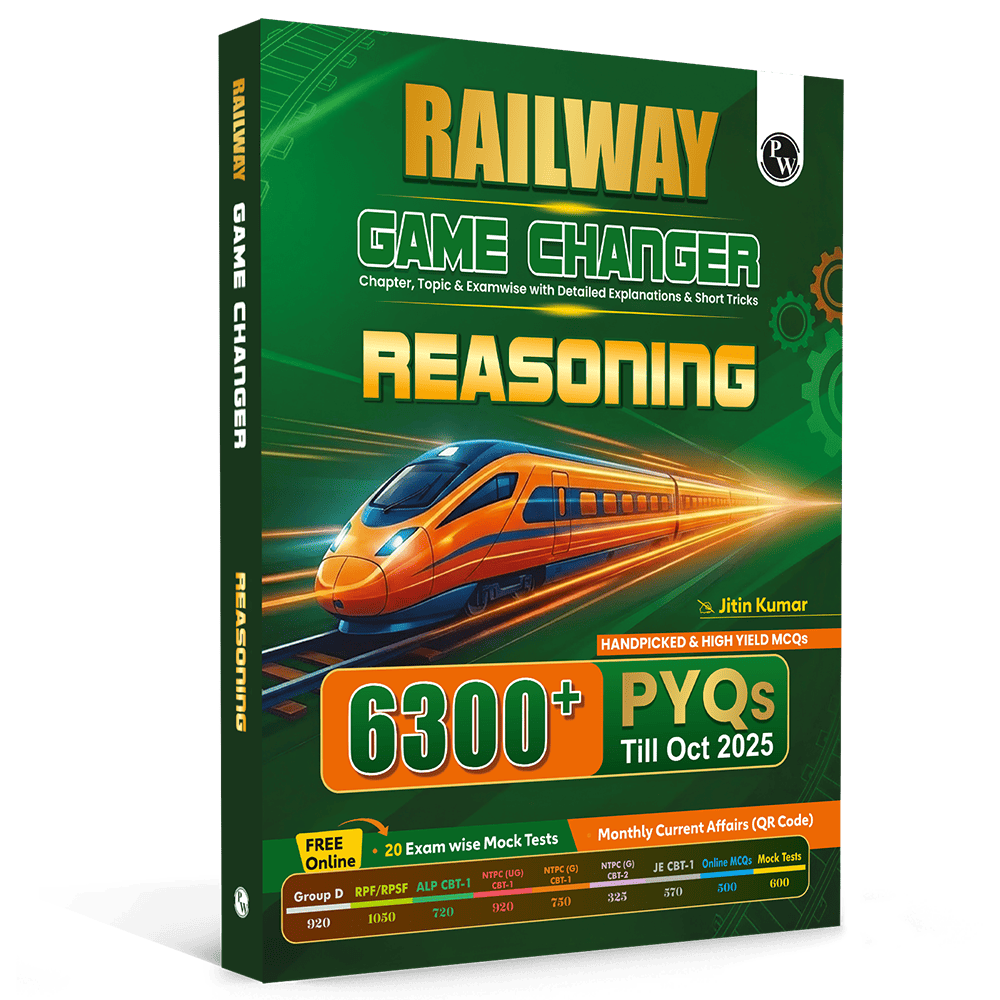
Check Out: PW RRB Books
Exam Pattern of RRB Reasoning
Before diving into speed-building techniques, it is vital to understand what the examiners expect. The reasoning section typically tests your analytical skills through a mix of verbal and non-verbal questions. Whether it is NTPC, Group D, or ALP, the core topics remain consistent.
-
Logical Reasoning: Syllogisms, Statements and Assumptions, and Venn Diagrams.
-
Analytical Reasoning: Blood Relations, Seating Arrangements, and Puzzles.
-
Data Sufficiency: Determining if the provided information is enough to reach a conclusion.
-
Number Series: Identifying patterns in sequences and coding-decoding.
By knowing the weightage of these topics, you can prioritise your RRB reasoning preparation strategy to focus on high-scoring areas first.
RRB Reasoning Preparation Strategy
Speed is a byproduct of clarity. If you are confused about the rules of a "Syllogism," you will naturally take longer. Here is how to build a foundation that supports rapid problem-solving.
Master the Fundamentals
You cannot rush through a seating arrangement if you are unsure of left-right orientations in a circular table. Start by clearing your concepts for every chapter. Once the logic is clear, speed will follow. Use the RRB reasoning books that provide step-by-step explanations rather than just shortcut tricks, as shortcuts often fail when the question pattern is slightly tweaked.
Memorise Alphabetical and Numerical Values
One of the best ways to save time in railway exam reasoning preparation is to stop counting on your fingers.
-
Alphabet Positions: Memorise the rank of every letter (A=1, Z=26) and their reverse pairs (A-Z, B-Y, C-X). This is crucial for coding-decoding questions.
-
Squares and Cubes: Learn squares up to 30 and cubes up to 15. This helps in solving number series and analogy questions almost instantly.
Check Out: RRB PYQs
Study Plan for RRB Reasoning Preparation
Different topics require different approaches to save time. Here is a breakdown of how to handle specific segments during your RRB NTPC reasoning preparation.
Syllogism and Venn Diagrams
Instead of overthinking the logic, use the Venn Diagram method. It is the fastest way to visualise the relationship between statements. If the conclusion does not logically follow the circles you have drawn, mark it wrong and move on. Do not re-read the statement multiple times.
Coding-Decoding and Series
In coding-decoding, look for the difference between the letters immediately. Is it +2, -3, or a reverse pattern? Writing the numerical value of the letters above the question can help you see the pattern faster than looking at the letters themselves.
Blood Relations and Directions
For blood relations, always draw a family tree. Use "+" for males and "-" for females to avoid confusion. For direction-based questions, a quick sketch of the four cardinal directions (North, South, East, West) on your rough sheet will prevent silly mistakes when the person in question takes multiple turns.
Role of Mock Tests in RRB Reasoning
You can study for ten hours a day, but without timed practice, your speed will remain stagnant. Mock tests are the closest you can get to the actual exam environment.
-
Sectional Mocks: Instead of full-length papers, solve 30-minute reasoning-specific mocks. This trains your brain to switch between different logic types rapidly.
-
Analyse Mistakes: Spent time reviewing why a particular question took two minutes instead of thirty seconds. Was it a calculation error or a lack of conceptual clarity?
-
Skip the EGO-Boosters: If a puzzle is taking too long, skip it. In RRB reasoning, every question carries the same marks. Don't let one difficult puzzle ruin your entire paper.
Right RRB Reasoning Books and Resources
While online resources are plentiful, having a structured RRB Reasoning book helps in offline practice. Look for titles that include:
-
Chapter-wise solved papers from previous years.
-
Practice sets with varying difficulty levels.
-
Dedicated sections for "Statement and Conclusion" as these are becoming more frequent in railway exams.
Focusing on books that provide detailed explanations for "Analytical Reasoning" is particularly helpful for exams like the RRB NTPC.
Tips for RRB Reasoning Exam
When you are sitting in the exam hall, your mindset dictates your speed.
-
Read Carefully but Fast: Misreading "North" as "South" can waste minutes. Focus on the keywords in the question.
-
Use the Elimination Method: In many RRB reasoning questions, you don't need to find the correct answer; you just need to eliminate the three wrong ones. This is especially useful in non-verbal reasoning and odd-one-out questions.
-
Rough Work Management: Keep your rough sheet organised. If you have to return to a skipped question, your previous half-solved work should be easy to find and understand.
Consistency is the final piece of the puzzle. Spending just 45 minutes every day on reasoning will yield better results than a 5-hour marathon once a week. By following this structured preparation strategy, you will find yourself finishing the section with time to spare for the tougher mathematics or general awareness questions.
Read More: Railway Exam Preparation for Working Students: A Practical Strategy
Increase Speed in RRB Reasoning FAQs
Q1. Which are the most important topics in RRB reasoning?
The most frequent topics include Coding-Decoding, Syllogism, Blood Relations, Series, and Venn Diagrams. Mastering these ensures a high score in most railway exams.
Q2. How can I improve my speed in RRB NTPC reasoning preparation?
Focus on memorising alphabet ranks and squares. Additionally, practice at least 20-30 questions daily under a strict timer to build muscle memory for different logic patterns.
Q3. Are reasoning books enough for the RRB preparation?
Books provide a great foundation and practice material, but you should supplement them with online mock tests to get used to the computer-based testing (CBT) format.
Q4. How much time should I allot to the reasoning section in the actual exam?
Ideally, you should aim to complete the RRB reasoning section in 20-25 minutes, allowing more time for the quantitative aptitude section, which usually involves more calculations.
Q5. Is there a negative marking in the railway exam reasoning section?
Yes, most RRB exams have a negative marking of 1/3rd of a mark for every wrong answer. Therefore, while speed is important, accuracy should never be sacrificed.