How to Revise Railway Reasoning Using Chapter-wise PYQ
Preparing for competitive exams like RRB NTPC, Group D, ALP, or Technician often leaves candidates overwhelmed by the vast syllabus. Many aspirants struggle with time management, logical deduction, and identifying repeating question patterns during their railway exam preparation.
Solving random mock tests without a targeted plan leads to confusion and slow progress. Using a dedicated RRB reasoning PYQ resource resolves this issue by organising questions systematically by topic.
Importance of Railway Reasoning PYQ Book
A chapter-wise approach transforms a chaotic syllabus into manageable learning modules. Instead of jumping between unrelated concepts, working through chapter-wise railway reasoning modules allows candidates to build strong foundational links. When you solve multiple questions of the same type sequentially, you naturally notice recurring patterns, common traps, and time-saving shortcuts.
Identifying High-Weightage Reasoning Topics
Exam preparation becomes significantly more efficient when you focus on topics that carry the most weight in recent question papers. Analysing railway previous year questions highlights which areas appear consistently across different shifts:
-
Coding-Decoding and Analogy: Frequently account for 4 to 6 questions per paper, testing pattern recognition speed.
-
Syllogism and Statement-Conclusions: Test logical deduction with 3 to 5 questions in almost every exam cycle.
-
Series and Classification: Form a major portion of speed-testing sections, demanding quick numerical and alphabetical reasoning.
-
Blood Relations and Direction Sense: Provide reliable marks once basic rules and visual diagram techniques are mastered.
Understanding TCS Exam Patterns
The Tata Consultancy Services (TCS) pattern places a heavy emphasis on logical clarity, multi-statement questions, and subtle distractors in the options. Practising with a dedicated railway reasoning PYQ volume gives candidates direct exposure to exact TCS question formulations. This familiarity eliminates surprise on exam day, allowing candidates to process questions faster and maintain focus under strict time constraints.
Target Practice for Weak Areas
Random mock tests show you what you scored, but chapter-wise practice shows you why you scored it. If your scores drop in analytical reasoning or coding problems, chapter-wise sets let you drill 50 to 100 questions consecutively on that specific topic until accuracy improves.
Features of Railway Reasoning PYQ
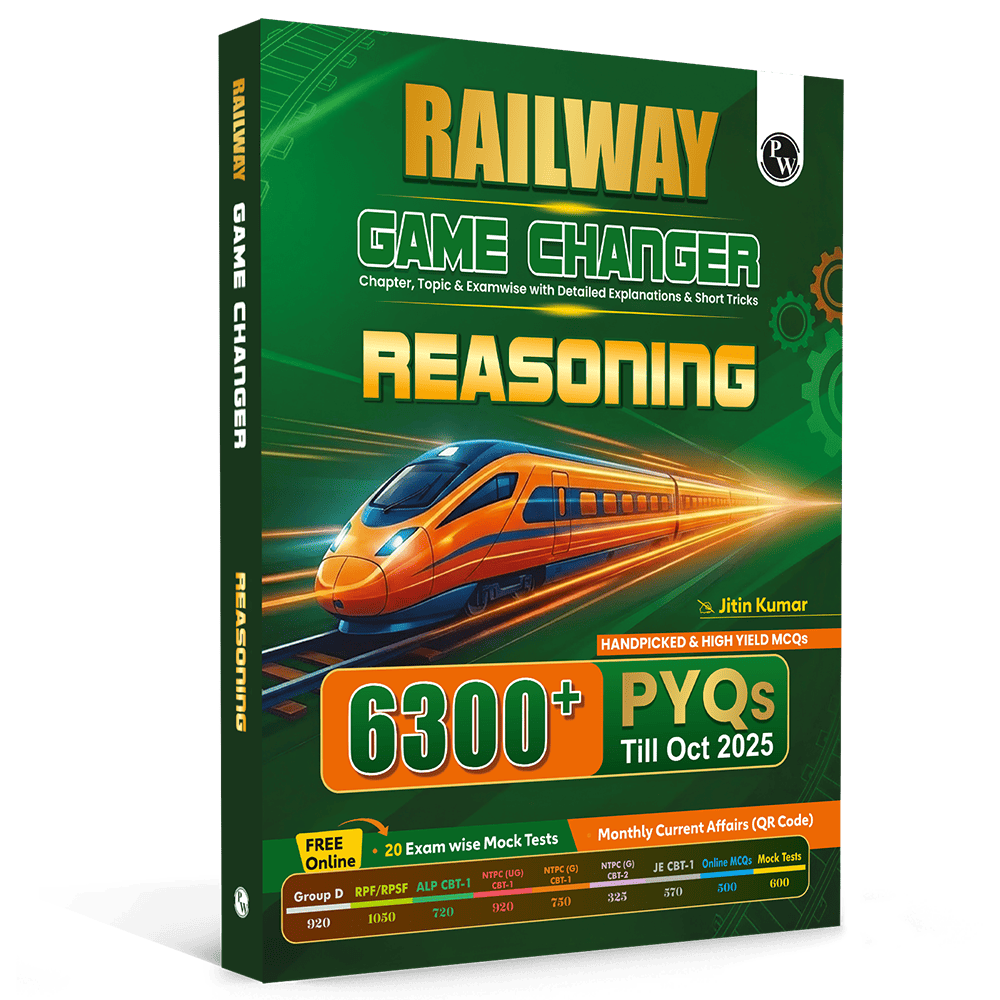
Prepare for Railway exams with a complete practice resource designed around the latest TCS exam style. The RRB books combines extensive question practice, quick revision material, mock tests, online CBT sets, current affairs, and exam-based insights to support your preparation from start to finish.
20,000+ TCS-Based MCQs: Work through 20,000+ questions covering Mathematics, General Awareness, and Reasoning. The MCQs follow the TCS-based Railway exam style and give you broad practice across important areas of the syllabus.
Quick Revision Notes: Find important formulas, short methods, concepts, facts, and revision points in one place. These notes can help you review key topics quickly and make your revision sessions more focused.
20 Sectional Mock Tests: Attempt 20 separate mock tests for different subjects and check your preparation level. Regular sectional practice helps you find weak topics, improve solving speed, and learn how to manage limited exam time.
20 Online CBT Practice Sets: Practise in an online Computer-Based Test format with 20 CBT sets. This gives you additional screen-based practice and helps you become more comfortable with the test format before appearing for the Railway exam.
Monthly Current Affairs (QR Access): Keep track of important events and updates with monthly current affairs available through QR access. Coverage includes Government Schemes, National and International Events, Awards, Sports, Science & Technology, Railway Updates, and other relevant General Awareness topics.
Detailed Exam Analysis: Use previous exam data to understand question patterns, topic importance, difficulty levels, and subject-wise trends. This information can help you decide where to spend more study time and create a more focused preparation plan.
Which High-Yield Topics Are Covered in Railway Reasoning PYQ?
Understanding topic distribution across previous papers ensures balanced preparation. The table below outlines core modules along with their general weightage and required solving strategies.
|
Topic Category |
Specific Sub-Topics Included |
Average Weightage (Per Shift) |
Core Solving Strategy |
|
Verbal Reasoning |
Analogy, Coding-Decoding, Classification |
8 - 10 Questions |
Memorise alphabet positions and square/cube patterns |
|
Logical Deduction |
Syllogism, Statement & Assumptions, Arguments |
5 - 7 Questions |
Use standard Venn diagrams; avoid outside assumptions |
|
Relational & Spatial |
Blood Relations, Direction & Distance, Seating |
4 - 6 Questions |
Draw quick family trees or cardinal direction grids |
|
Sequence & Series |
Number Series, Letter Series, Missing Terms |
3 - 5 Questions |
Check step differences, double differences, or prime factors |
|
Non-Verbal |
Mirror Images, Paper Folding, Embedded Figures |
3 - 5 Questions |
Use option elimination based on key visual markers |
Verbal Reasoning Breakdown
Verbal topics form the backbone of the reasoning paper. Success here depends heavily on recognition speed rather than lengthy calculation.
-
Analogy and Classification: Practice grouping words by semantic relationships, letter shifts, or numerical operations.
-
Coding-Decoding: Work on direct letter coding, reverse alphabet positioning, and matrix-style pattern matching.
-
Alphabet and Number Tests: Master quick sequence counting from left to right and right to left to avoid positional errors.
Non-Verbal and Analytical Reasoning Breakdown
Non-verbal and analytical topics require visual processing and strict adherence to provided text without bringing in external assumptions.
-
Statement and Assumptions: Focus strictly on implicit assumptions directly supported by the statement.
-
Venn Diagrams: Practice overlapping geometric shapes representing sets to answer multi-variable queries accurately.
-
Figure Counting and Folding: Learn standard formulas for counting triangles and squares inside complex geometrical grids.
How to Practise Railway Reasoning PYQ Daily?
Consistency yields the right results when supported by a systematic workflow. Dividing your daily study session into distinct stages prevents fatigue and ensures every minute spent contributes to measurable score gains. Regular practice with RRB PYQs can also help candidates understand exam trends, improve accuracy, and strengthen their preparation.
Step 1: Concept Review Before Question Solving
Never jump directly into questions without a 10-minute conceptual refresh. Review essential rules, positional values of alphabets, prime number patterns, and standard syllogism Venn diagram structures. A quick review reactivates memory pathways and sets a clean baseline for accurate solving.
Step 2: Timed Topic-wise Solving
Execute your railway reasoning practice using a timer. Aim for a speed of 45 to 50 seconds per question during general chapter revision. Timed conditions build mental stamina and prevent the habit of lingering too long on single tricky questions.
-
Target Speed: 30 questions in 25 minutes for verbal topics.
-
Target Speed: 20 questions in 20 minutes for analytical or puzzle-based topics.
-
Rule: Skip immediately if no logical path emerges within 30 seconds during initial passes.
Step 3: Error Log Creation and Analysis
Evaluating your performance after each session holds the key to continuous improvement. Maintain an error notebook specifically for railway reasoning PYQs to record:
-
Conceptual Mistakes: Questions missed due to incorrect application of logic or forgotten rules.
-
Calculation Errors: Mistakes made under time pressure despite knowing the core logic.
-
Time Traps: Questions that took more than 90 seconds to solve, even if answered correctly.
How Should be the Weekly Revision Plan Using Railway Reasoning PYQ?
A structured 4-week timetable guarantees complete coverage of the reasoning section without last-minute stress. Using RRB Game Changer Books alongside the timetable can help candidates strengthen concepts, practise exam-oriented questions, and improve accuracy.
Week 1: High-Frequency Verbal Topics
Focus on high-volume sections to build initial momentum and speed.
-
Days 1 to 2: Solve Coding-Decoding and Analogy sets using your railway reasoning PYQ volume. Aim for 100 questions daily.
-
Days 3 to 4: Practice Number Series, Letter Series, and Odd-One-Out sets. Focus on identifying common numerical patterns.
-
Days 5 to 6: Work through Classification and Order-Ranking questions.
-
Day 7: Review Week 1 error logs, re-solve missed items, and take one sectional reasoning test.
Week 2: Logical and Deductive Reasoning
Dedicate the second week to concepts that require precise visual diagramming and analytical clarity.
-
Days 8 to 9: Practice Syllogisms extensively. Solve 80 to 100 standard two-statement and three-statement Venn diagram problems.
-
Days 10 to 11: Master Blood Relations and Direction Sense. Practice drawing clean diagram notations for complex family relations.
-
Days 12 to 13: Solve Statement & Assumptions, Statement & Conclusions, and Courses of Action.
-
Day 14: Conduct a timed review of all logical reasoning errors logged during the week.
Week 3: Analytical, Seating, and Puzzles
Focus on complex items that usually take longer to solve during the actual examination.
-
Days 15 to 17: Solve Linear and Circular Seating Arrangement sets. Work on step-by-step elimination strategies.
-
Days 18 to 19: Practice Data Sufficiency, Mathematical Operations, and Venn Diagram interpretation.
-
Days 20 to 21: Solve Clock and Calendar problems, reviewing short tricks for angle and day calculations.
-
Day 22: Take two full-length sectional reasoning mock tests to evaluate overall speed and accuracy under time limits.
Week 4: Non-Verbal Reasoning and Full Mock Integration
Finalise preparation by mastering visual topics and integrating online CBT practice.
-
Days 23 to 24: Solve Mirror Images, Water Images, Paper Folding, and Embedded Figures. Focus on rapid option elimination.
-
Days 25 to 26: Practice Figure Counting and Completion of Patterns.
-
Days 27 to 28: Re-solve all flagged questions from your error log across all four weeks. Complete two online CBT practice sets to match official exam conditions.
Read More: Features of PW Railway Game Changer Book
Railway Reasoning PYQ FAQs
How does solving a railway reasoning PYQ improve exam scores?
Solving a railway reasoning PYQ collection exposes candidates to authentic TCS question structures, recurring logic patterns, and difficulty levels. It helps identify high-weightage topics, highlights individual weaknesses, and builds the speed and accuracy necessary to complete the reasoning section within allotted time limits.
How many previous year questions should I solve daily for railway exam preparation?
Aspirants should aim to solve 50 to 70 topic-wise questions daily during initial revision phases. As exams approach, increase this volume to 100 questions per day split across timed topic sets and full-length sectional mocks.
Why is chapter-wise practice better than random reasoning tests?
Chapter-wise practice allows you to isolate specific concepts, notice repeating question formats, and apply targeted solving techniques consecutively. Random tests are useful for testing overall stamina, but chapter-wise revision builds core topic mastery and fills knowledge gaps effectively.
What features should I look for in a railway reasoning practice book?
Look for books that feature authentic TCS-pattern MCQs organised by chapter and topic, step-by-step solutions, quick revision notes, and sectional practice tests. Comprehensive options like the PW railway reasoning PYQ combo also provide online CBT practice sets and exam trend analysis.
How much time should I spend on the reasoning section in Railway exams?
Ideally, allocate 20 to 25 minutes to complete 30 reasoning questions. Achieving this pace requires regular practice with timed topic sets, memorising alphabet positions, and mastering rapid option elimination strategies for non-verbal questions.