Make RRB NTPC Revision Easy with Previous Year Questions
It is the dream of millions of aspirants across the country to get a permanent job in Indian Railways. However, many dedicated candidates read complex textbooks back-to-back for months and still hit a major roadblock during the actual computer-based test (CBT).
This is the very reason for this common hurdle: successful candidates do not go for passive reading in the last few weeks; instead, they focus heavily on RRB NTPC previous year questions.
Let’s see how adding real past questions to your daily revision routine can make it easier for you to plan your studies and ensure a great score.
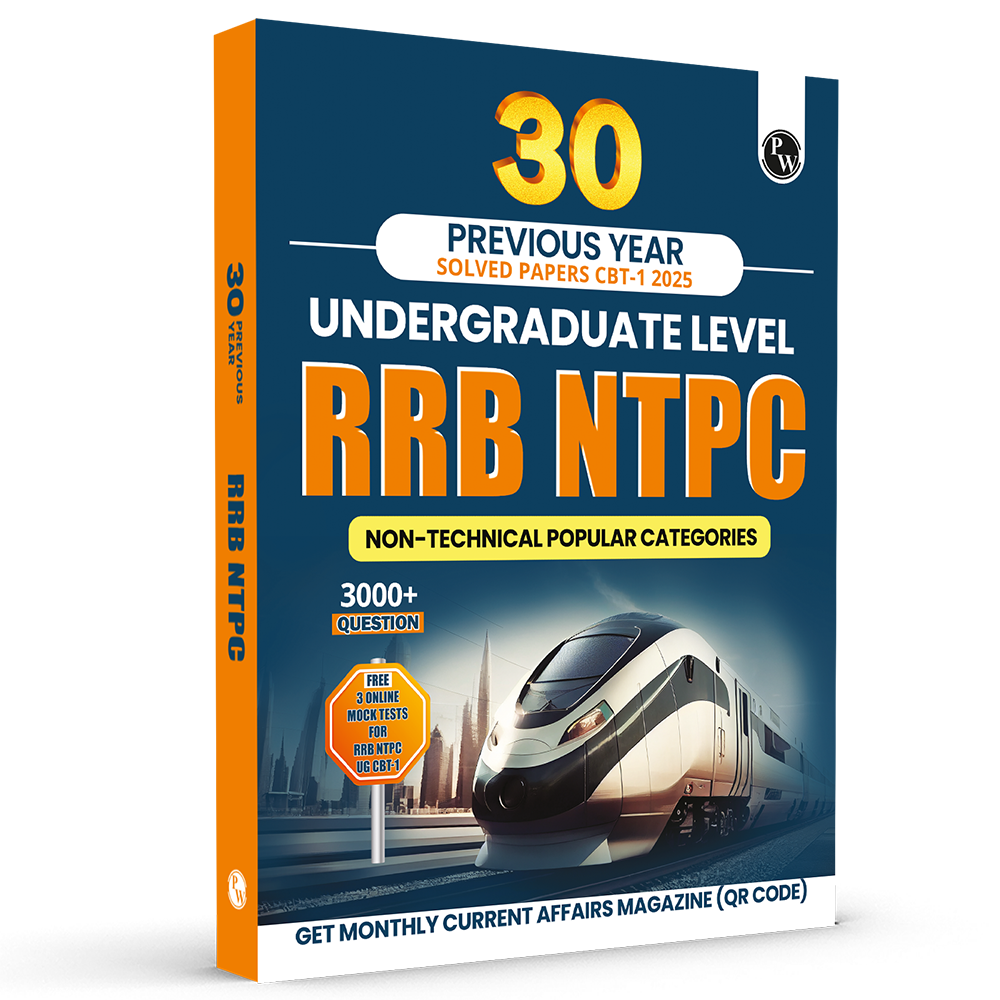
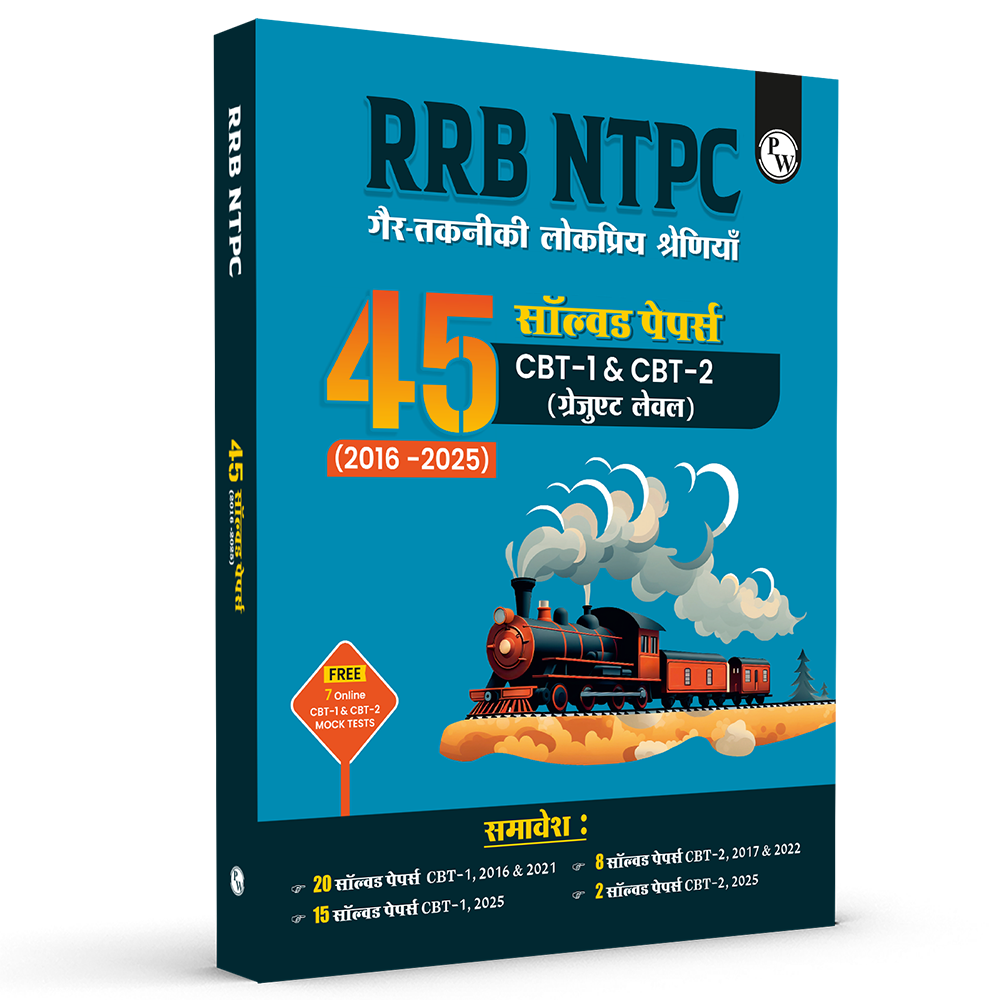
Check Out: PW RRB Books
Importance of RRB NTPC Previous Year Questions for Final Revision
The RRB NTPC exam is one of the most popular exams, known for the huge number of applicants. Lakhs of candidates are competing for limited vacancies. So your final preparation needs to be very structured and efficient.
|
Strategic Focus Area |
Core Benefit of Active Revision with PYQs |
|
Master the 90-Minute Clock |
Helps build precise pacing and spatial awareness of time, training you to complete the exam comfortably within the official time limit. |
|
Target Core Chapters |
Automatically filters out low-yield topics so you can channel your energy directly into high-weightage sections that appear year after year. |
|
Eliminate Wrong Answers |
Sharpens your elimination skills and diagnostic accuracy, helping you spot examiner traps and significantly reduce negative marking. |
The first stage of the test is a test of solving 100 questions in a strict 90-minute window. You have less than 1 minute a question to read, calculate and mark your answer. Doing full papers regularly in a timed environment trains your brain to think fast under pressure and also helps you to manage your time well.
Features of RRB NTPC Previous Year Questions
When selecting your study buddy for the upcoming recruitment drive, RRB NTPC Previous Year Questions resource has these must-have features:
-
Year-Wise Solved Sets Verified: Practice with real test material by using real shift questions up through to the latest exam cycles.
-
Detailed Solutions: Clear and simple solutions that help you understand the concept behind every single question.
-
Online CBT Mock Test Links: Links to online practice platforms that simulate the real thing to help you gain confidence for the computer-based format.
-
Current Affairs Supplements: Monthly highlights of current affairs to score high in the important General Awareness part.
Main Chapters of RRB NTPC Previous Year Questions
Considering the vastness of the official syllabus, trying to revise every single topic with equal weightage can be a bit overwhelming. Looking at past papers, you can see obvious trends and where the paper setters are focusing their attention:
-
General Awareness: (A) Constitutional provisions and basic concepts of general science, landmark events in Indian history, Indian politics, and a heavy focus on national current affairs
-
Mathematics: Questions on Number Systems, Percentages, Profit and Loss, Time and Work, Simple and Compound Interest, and Data Interpretation.
-
General Intelligence & Reasoning: Coding-Decoding, Blood Relations, Linear and Circular Puzzles, Syllogism, Number Series (Predictable patterns)
How RRB NTPC Previous Year Questions Help You Understand the Exam Pattern
The selection process tests your stamina in different, distinct stages. Stage 1 tests the speed of the candidates. Stage 2 is where the advanced computer-based tests require deep analytical clarity and advanced problem-solving skills. Working on special question sets helps you see how simple conceptual subjects develop into multi-step problems and be well ahead of your competitors.
Thus you need to prepare a practice schedule which aligns with the official marks distribution and section pattern. The official test pattern is given in the table below:
|
Core Test Section |
Number of Questions |
Maximum Marks |
Test Duration |
Negative Marking Rule |
|
Mathematics (Arithmetic & Basic Algebra) |
30 Questions |
30 Marks |
Composite 90 Minutes |
1/3 Mark deducted per error |
|
General Intelligence & Reasoning |
30 Questions |
30 Marks |
Composite 90 Minutes |
1/3 Mark deducted per error |
|
General Awareness (Static GK & Science) |
40 Questions |
40 Marks |
Composite 90 Minutes |
1/3 Mark deducted per error |
|
Total Combined Assessment |
100 Questions |
100 Marks |
90 Minutes Total |
High Stakes Negative Penalty |
Check Out: RRB PYQs
How to Analyse RRB NTPC Previous Year Questions Effectively
Just looking at an online document or flipping through answer keys won't improve your final score. To get the most value out of your study sessions, use this structured, three-step evaluation method:
Step 1: Rigid Simulation ──► Step 2: Sort Error ──────► Step 3: Review Explanation
(Set a 90-minute timer) (Concept gap vs silly mistake) (Learn quick calculation tricks)
Step 1: Know the Real Test Conditions
Find a quiet room where you can get away from the daily distractions of the house, phone notifications and background noise.
Open up your practice book, and set a strict countdown timer for exactly 90 minutes.
Complete the whole paper without using shortcut sheets, reference formulas and textbooks.
Use a plain sheet of paper for your calculations to mimic the scratch pads provided at the real exam centre.
Step 2: Sort and Categorise Your Mistakes
When the time is up, check your answers honestly against the official marking scheme. Don’t just look at your final score. Instead, divide your mistakes into 3 different buckets:
-
Silly Calculation Slips: These are just adding and subtracting mistakes caused by rushing or skimming the question too quickly.
-
Conceptual Gaps: Questions where you simply didn’t know the formula/shortcut trick/historical fact behind it.
-
Time Traps: Questions you answered correctly but took more than 2 minutes to solve, thereby taking away valuable time from your general awareness section.
Step 3: Write the Right Explanations
Do not merely memorise the correct letter of the answer. Refer to the step-wise solutions provided in premium preparation books. See how experts rule out wrong choices in reasoning, or use quick estimation strategies to solve lengthy maths problems without writing out long equations.
Which Study Material Should You Use Along With RRB NTPC Previous Year Questions?
Choosing the correct study material could save you hundreds of hours studying. Premium resources allow you to skip over outdated material and zero in on current testing trends.
A well-organised book, such as a complete RRB NTPC undergraduate PYQ book, will prevent you from wasting valuable time searching for previous papers on untrustworthy online forums. A good guide will have past questions chapter-wise, which means you can practise 50-60 targeted questions just after a theoretical lesson.
30 Days Study Plan for Using RRB NTPC Previous Year Questions
This month, move away from reading long textbook chapters and focus on active retrieval and practice so you can perform your best on exam day. Follow this structured timeline to stay on course:
-
Day 1 to 10: Try to solve 1 full-length paper per day from your RRB NTPC ug pyq. Take this test during your exact exam shift hours to train your focus and use your evenings to analyse your errors.
-
Days 11 to 20: If you’re not fast enough, double your practice rate to two full papers a day. Avoid careless mistakes in your calculations. Accuracy is key.
-
Days 21 to 30: Do not solve any new question papers in the last 48 hours before the exam. This is the last chance to revise your personal formula notebook, shortcut tricks and latest current affairs notes.
You take the guesswork out of your study sessions by approaching your revision with proven exam trends. This systematic approach helps to turn your weaknesses into strengths and will ensure you enter the exam hall with real confidence.
Check Out: Railway Game Changer PYQ Combo Set of 3 Books
Tips for Solving RRB NTPC Previous Year Questions
Below are some of the useful tips that will help in solving the previous year's question paper effectively:
-
Focus on High Scoring Areas First: Master the high-yield topics like coding, decoding, percentages, basic data interpretation, etc., before moving on to rare, obscure subtopics.
-
Keep a Personal Formula Notebook: As you solve past papers, write down every unique calculation trick, tricky grammar exception or static general knowledge fact you encounter.
-
Apply the Elimination Technique: Learn the trick of eliminating the obviously wrong options in tricky General Awareness questions and increase your odds of getting the right answers.
-
Monitor Sectional speed: Keep an eye on how much time you spend on each section. Finish the 40 General Awareness questions in less than 15 minutes to save maximum time for maths and reasoning.
-
Also, review explanations for correct answers. Even for questions you got right, check the answer key. Perhaps next time you'll discover a surprise shortcut that will shave off 20 to 30 seconds.
Read More: RRB NTPC Syllabus for CBT 1 and CBT 2 Exam
RRB NTPC previous year questions FAQs
1. Why are the RRB NTPC previous year questions important for final revision?
Practising previous year questions is very effective as it gives you an idea of the exact level of difficulty, the distribution of questions and the topics that are repeated by the Railway Recruitment Board.
2. How is the RRB NTPC PYQ 2026 edition different from the previous study materials?
New questions from recent exam shifts and updated general knowledge are included in the new 2026 edition. This guarantees that your preparation is in line with the latest testing standards and saves you from practising outdated or irrelevant question patterns.
3. How does a RRB NTPC undergraduate PYQ set help 12th pass students?
The RRB NTPC undergraduate PYQ book is designed to match the difficulty level and core concepts of 12th-standard entry roles. This allows you to create a focused study plan and skip time-consuming, difficult graduate-level questions that are not likely to be featured in your paper.
4. How to practise with the RRB NTPC PYQ in the smartest way?
The best way is to treat each past paper as if it were a real exam. Set a 90-minute timer, complete the questions in a silent room without outside assistance, and then spend at least an hour reviewing your errors to improve your approach.
5. Is there any penalty for wrong guesses in the official RRB NTPC CBT 1 PYQ format?
Yes, the computer-based test has a strict negative-marking policy of 1/3 of a mark for every wrong answer. Practising with real papers regularly will help you develop the discipline to not guess, but to be accurate.