RRB Reasoning PYQs From Group D to NTPC: What Changes Across Exams?
Preparing for Indian Railways recruitment tests requires a clear understanding of exam patterns across different tiers. Candidates often struggle to identify how difficulty, question distribution, and reasoning topics shift when moving from 10th-level posts to graduate-level roles.
Solving a reliable RRB Reasoning PYQ set helps candidates map these exact changes. By studying past questions, candidates can adjust their preparation strategy, improve problem-solving speed, and build exact topic-wise accuracy.
What is the RRB Reasoning PYQ?
The Railway Recruitment Board maintains a consistent core syllabus across exams, but the execution and difficulty level change significantly. Group D tests emphasize basic visual reasoning, straightforward coding-decoding, and direct relations. In contrast, NTPC evaluates analytical depth, complex puzzles, and multi-statement logic.
Factors Differentiating Group D and NTPC Questions
-
Complexity of Logic: Group D questions feature single-step logic, whereas NTPC questions require two or three steps to reach the correct answer.
-
Length of Statements: NTPC questions present long, paragraph-based statements in analytical reasoning, whereas Group D keeps text minimal.
-
Time Allocation per Question: Candidates need quick response times in Group D due to total test length, while NTPC requires steady focus for intricate puzzles.
-
Option Elimination Ease: Options in Group D are usually straightforward to eliminate, whereas NTPC options are closely paired to test precision.
What Topics Are Asked In RRB Reasoning PYQ For Group D?
Examining RB Group RD reasoning PYQs reveals a clear focus on speed and foundational logic. Questions are designed to test quick visual processing and simple numerical logic under pressure.
High-Weightage Topics in RRB Group D
-
Analogy and Classification: Direct word, number, or letter associations.
-
Coding-Decoding: Basic letter shifting, reverse alphabetical positions, and direct numerical coding.
-
Visual Reasoning: Embedded figures, paper folding, mirror images, and next-figure series completion.
-
Direction and Distance: Short, 2 to 3-turn navigation paths without complex angle shifts.
-
Blood Relations: Direct relations usually limited to single-family trees or pointer-based statements.
Solving these topics consistently through focused RRB reasoning practice helps build maximum speed for CBT 1 tests.
What Topics Are Asked In RRB Reasoning PYQs for NTPC?
When reviewing RRB NTPC PYQs, the structural difference becomes clear immediately. NTPC tests candidates applying for Undergraduate and Graduate posts, making the evaluation process more comprehensive.
Advanced Question Formats in RRB NTPC
-
Seating Arrangement: Linear, circular, and rectangular seating arrangements involving 6 to 8 people, often with secondary variable conditions.
-
Syllogism and Venn Diagrams: Multi-statement conclusions, including 'Possibility' cases and 'Only a few' logic clauses.
-
Statement and Assumptions / Arguments: Critical reasoning questions requiring careful logical evaluation rather than quick calculation.
-
Mathematical Operations: Multi-symbol substitutions requiring sequential application of BODMAS rules.
-
Data Sufficiency: Questions that evaluate if the provided information is adequate to answer without requiring full calculations.
Practicing these advanced sets regularly ensures you do not get stuck on lengthy items during the actual examination.
Which Is More Difficult Between RRB Reasoning PYQ Group D and NTPC?
The table below contrasts how reasoning concepts are tested across both examination levels:
|
Reasoning Parameter |
RRB Group D Exam |
RRB NTPC Exam (UG & Graduate) |
|
Primary Focus |
Speed, visual recognition, direct rules |
Analytical reasoning, puzzle solving, critical logic |
|
Seating Arrangement |
Simple 4–5 person linear alignment |
Complex 6–8 person circular/linear layouts |
|
Syllogisms |
Direct 2-statement cases |
Complex 3–4 statement cases with conditional logic |
|
Coding-Decoding |
Single-step alphabet/number shifts |
Multi-layer pattern shifts and matrix coding |
|
Critical Reasoning |
Minimal presence |
High presence (Assumptions, Actions, Conclusions) |
|
Average Time per Item |
30 to 45 seconds |
60 to 90 seconds |
How To Choose The Best RRB Reasoning PYQ Book?
Choosing a structured, error-free resource is critical for systematic preparation. A comprehensive collection of RRB previous year questions gives aspirants a true view of actual exam expectations.
When selecting an optimal study material or RRB Reasoning PYQ book, check for these essential elements:
-
TCS Pattern Alignment: Ensures every question matches the current exam conducting body's testing style.
-
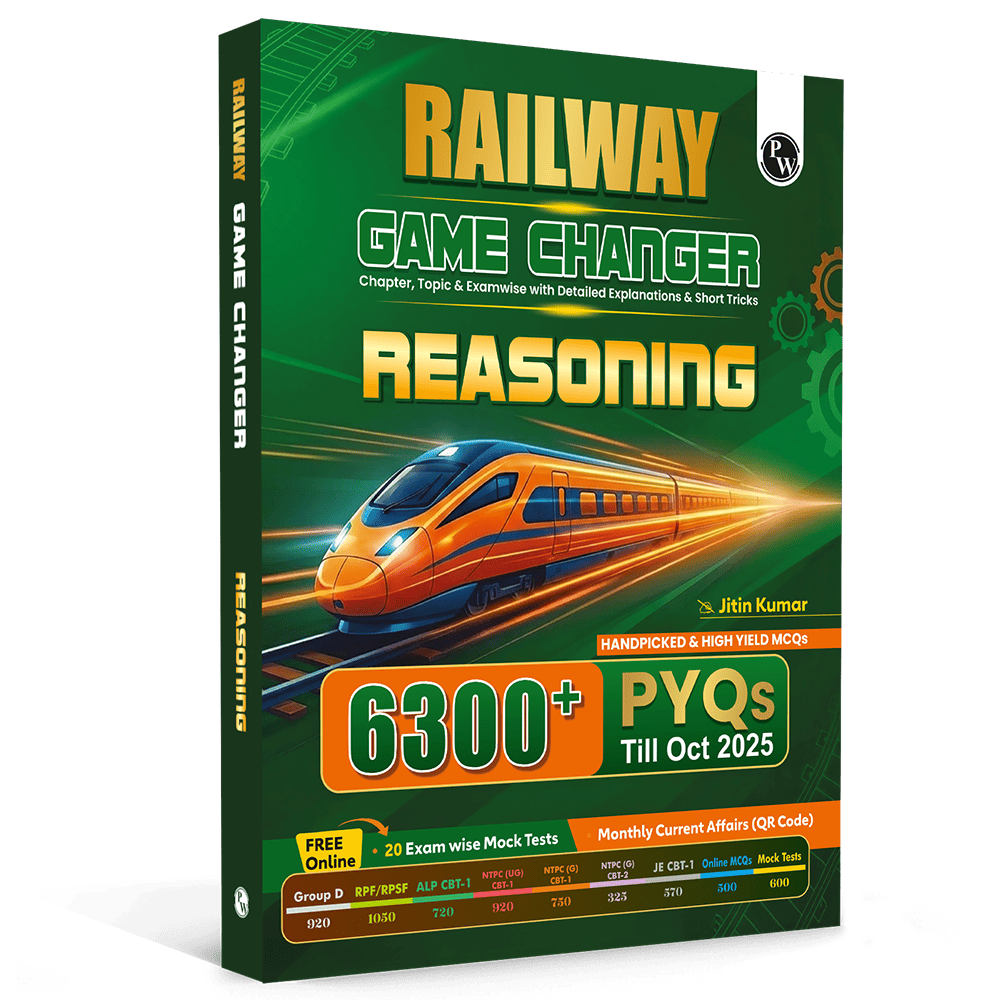
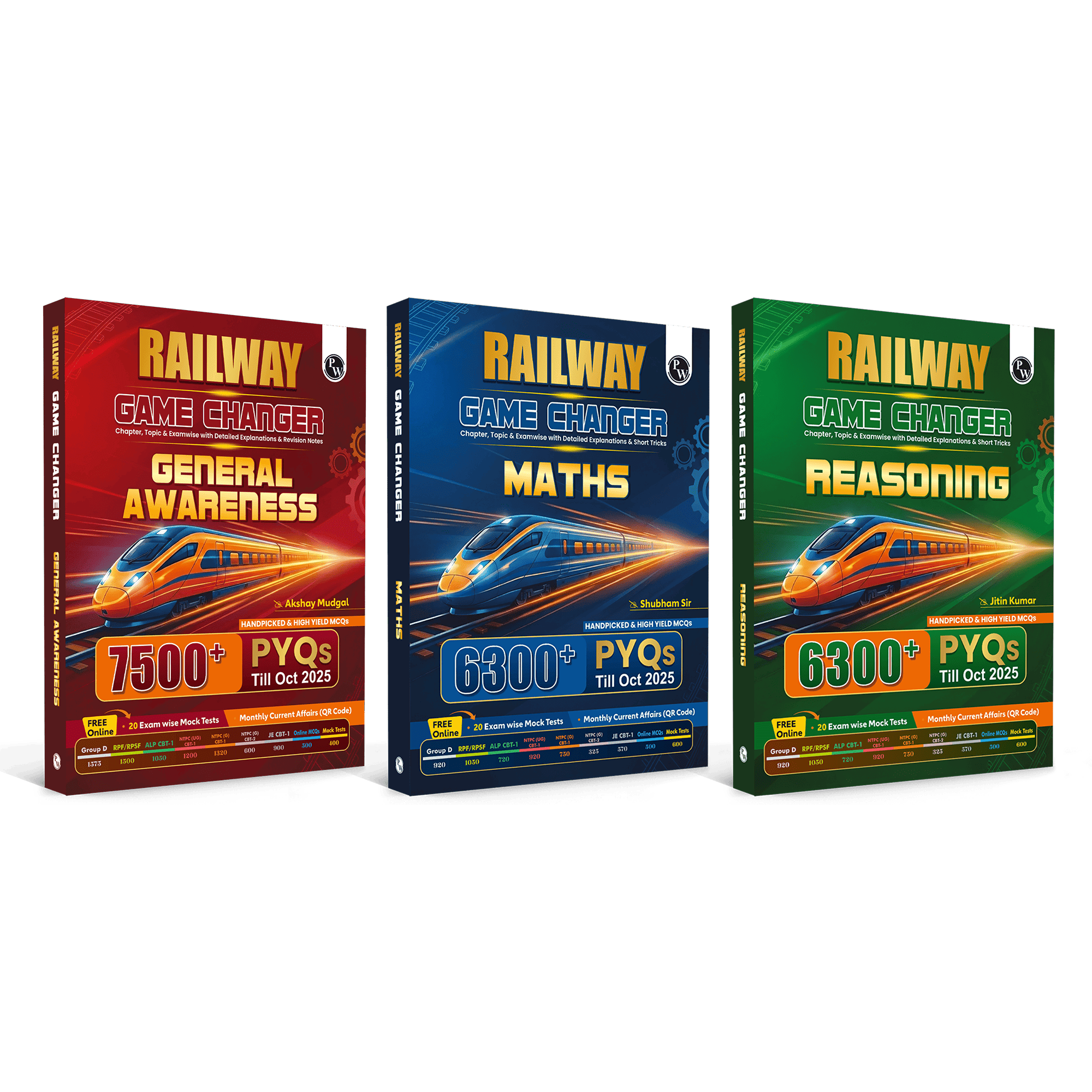
Comprehensive Coverage: Contains high-volume content like 6300+ TCS MCQs covering past exams across Group D, NTPC, RPF, ALP CBT-1, and JE CBT-1.
-
Detailed Exam Analysis: Displays topic-wise trend breakdowns to help prioritize high-scoring topics.
-
Quick Revision Notes: Features short tricks, essential formulas, and core rules for fast last-minute preparation.
-
Full Practice Support: Includes 20 Sectional Mock Tests and 20 Online CBT Practice Sets for complete computer-based test simulation.
What Does An RRB Reasoning PYQ Book Include?
Prepare for Railway exams with a large collection of practice questions, mock tests, revision notes, and current affairs. The RRB book follows the latest exam pattern and helps you improve speed, accuracy, and confidence through regular practice.
-
6300+ TCS-Based MCQs: Practice more than 6300 questions prepared according to the latest TCS pattern for Railway exams. The wide question bank covers important topics from the Railway Reasoning syllabus for complete practice.
-
Quick Revision Notes: Revise important concepts quickly with short tricks, useful formulas, and key points. These notes are helpful for regular revision as well as last-minute Railway Reasoning exam preparation.
-
20 Sectional Mock Tests: Test your preparation with 20 sectional mock tests based on the Railway CBT format. Regular practice helps improve speed, accuracy, and time management.
-
20 Online CBT Practice Sets: Get 20 online practice sets that provide a computer-based Railway exam simulation. This helps you become comfortable with the CBT format and improve your confidence before the actual exam.
-
Monthly Current Affairs (QR Access): Keep track of important national and international events through monthly current affairs updates. This supports your preparation for Railway General Awareness and Current Affairs sections.
-
Detailed Exam Analysis: Understand topic-wise trends, question weightage, and important areas from major RRB Railway exams. This helps you identify high-scoring topics and plan your preparation more effectively.
How To Prepare With RRB Reasoning PYQs for Better Accuracy?
Mastering reasoning demands a planned approach that combines concept building with timed problem-solving.
-
Categorize Syllabus by Exam Difficulty: Divide topics into foundational rules (Group D level) and advanced puzzles (NTPC level).
-
Master Short Tricks First: Learn rapid alphabet-position numbering, calendar formulas, and direction shortcuts.
-
Solve Topic-Wise Past Questions: Solve chapter-wise items using an RRB Reasoning PYQ repository before taking full-length tests.
-
Take Sectional CBT Mocks: Simulate real test conditions using 20 sectional CBT mock tests to track accuracy under pressure.
-
Analyze Error Logs Daily: Review wrong attempts to identify whether errors were caused by conceptual gaps or calculation mistakes.
Read More: RRB NTPC Reasoning Syllabus
RRB Reasoning PYQs FAQs
1. How does the primary keyword topic list differ between RRB Group D and NTPC?
The RRB Group D reasoning section focuses more on visual reasoning, simple analogies, basic coding-decoding, series, and direct questions. In comparison, RRB NTPC usually includes more complex seating arrangements, syllogisms, data sufficiency, puzzles, and critical statement-based reasoning questions.
2. Is solving past questions enough to clear the RRB NTPC reasoning section?
Solving RRB reasoning previous year questions gives candidates a clear idea of TCS patterns, repeated topics, question difficulty, and common question types. However, PYQs should be combined with regular revision, timed mock tests, and sectional practice to improve both accuracy and speed.
3. How many previous years' questions should I solve for RRB exams?
Candidates should practise a large and well-organized question bank covering different Railway exams. Solving 6000+ TCS MCQs from past Group D, NTPC, RPF, ALP, and JE exams can provide wide topic coverage and help candidates understand the question patterns expected in upcoming 2026 RRB exams.
4. Are online CBT practice sets necessary for Railway reasoning preparation?
Yes, online CBT practice sets are useful for Railway reasoning preparation. They help candidates get comfortable with reading questions on a computer screen, using the test timer, moving between questions, and solving visual reasoning items quickly. Regular CBT practice can also reduce exam-day pressure.
5. What is the best strategy to improve speed in RRB reasoning practice?
Start by learning basic shortcuts for alphabet coding, number-based questions, and common mathematical operations. Then solve questions every day using structured RRB Reasoning PYQ collections. Review wrong answers carefully and take regular timed sectional mock tests to improve speed, accuracy, and time management.