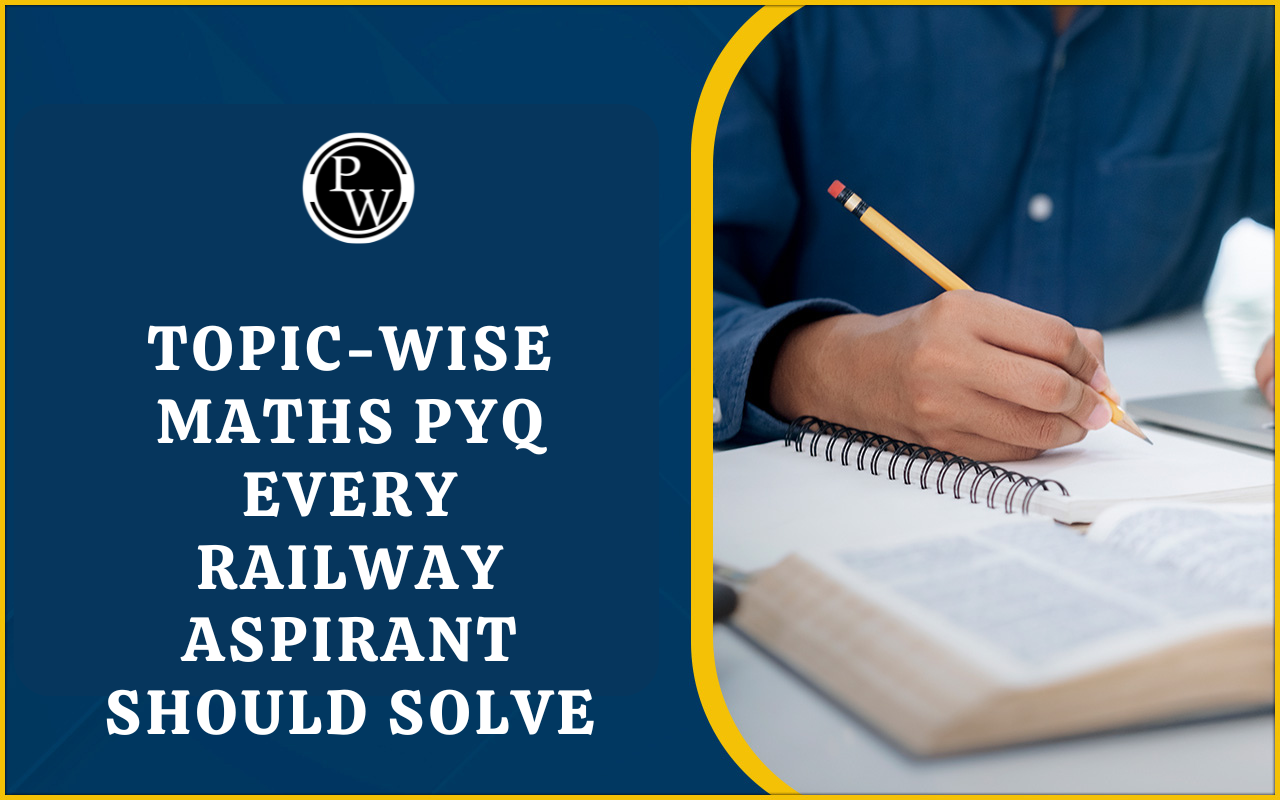
Topic-wise Maths PYQ Every Railway Aspirant Should Solve
Preparing for Indian Railway recruitment exams requires speed, accuracy, and strong conceptual clarity. Many students struggle to manage time during the examination, causing low confidence and poor scores. The Mathematics section carries significant weightage across competitive tests like RRB NTPC, Group D, ALP, and RPF.
Without clear direction, candidates waste time solving random problems that do not align with current paper trends. Practicing structured RRB Maths PYQ material solves this exact issue. It highlights recurring question patterns, sharpens calculation speed, and clarifies fundamental formulas. Dedicated practice with past papers ensures you focus your efforts on high-return topics.
Importance of Railway Maths PYQ in Exam Preparation
Solving past question papers helps candidates understand the actual standard of Indian Railway examinations. Railway previous year questions serve as an accurate article to the exam format, allowing students to align their preparation with real testing standards.
-
Understanding Exam Patterns: Analyzing past test papers reveals recurring topic weightage and structural question shifts across different recruitment drives.
-
Speed and Accuracy Improvement: Daily practice with realistic numerical questions trains the mind to calculate quickly without committing silly errors.
-
Building Exam Confidence: Familiarity with original paper layouts reduces anxiety and improves overall time management under exam conditions.
-
Identifying Weak Areas: Attempting structured questions helps candidates spot difficult chapters early, allowing targeted revision before the final exam.
Features of Railway Maths PYQ
Prepare for Railway exams with the RRB Game Changer PYQ Combo Set of 3 Books, featuring complete study and practice material based on the latest TCS pattern. The books include MCQs, revision notes, mock tests, CBT practice sets, current affairs, and exam analysis to support complete exam preparation.
20,000+ TCS-Based MCQs: Practice with more than 20,000 TCS-based MCQs covering Mathematics, General Awareness, and Reasoning. The questions follow the latest TCS pattern for Railway Exams and provide complete syllabus coverage with exam-level practice.
Quick Revision Notes: Revise important topics quickly with short tricks, key formulas, important concepts, and exam-focused notes. These notes help you save time and remember key points during revision.
20 Sectional Mock Tests: Practice with 20 subject-wise mock tests based on the latest Railway exam pattern. These tests help improve speed, accuracy, problem-solving skills, and time management.
20 Online CBT Practice Sets: Practice in a Computer-Based Test (CBT) environment with 20 online practice sets. These tests help you become familiar with the actual exam format and build confidence before the exam.
Monthly Current Affairs (QR Access): Stay updated with the latest Current Affairs, Government Schemes, National & International Events, Awards, Sports, Science & Technology, and Railway Updates through QR-based access.
Detailed Exam Analysis: Understand topic-wise weightage, question trends, difficulty levels, and previous Railway exam patterns. This analysis helps you identify important topics and focus on areas that can improve your score.
What Are the High-Weightage Topics in Railway Maths PYQ?
|
Mathematical Topic |
Expected Question Range |
Priority Level |
Key Focus Areas |
|
Number System & Simplification |
4 – 6 Questions |
High |
BODMAS, Fractions, Decimals, Surds & Indices |
|
Percentage, Profit & Loss |
3 – 5 Questions |
High |
Discounts, Equivalent Margins, Markups |
|
Ratio & Proportion, Ages |
2 – 4 Questions |
Medium |
Mixture & Alligation, Direct Ratios |
|
Time, Speed & Distance |
3 – 4 Questions |
High |
Train Problems, Boats & Streams, Relative Speed |
|
Simple & Compound Interest |
2 – 3 Questions |
Medium |
Annual/Half-Yearly Interest, Rate Calculations |
|
Algebra & Geometry |
3 – 5 Questions |
High |
Basic Identities, Angles, Triangles, Circles |
|
Mensuration 2D & 3D |
2 – 4 Questions |
Medium |
Area, Volume, Surface Areas of Prisms/Spheres |
Which Topics Are Covered in Railway Maths PYQ?
Number System, HCF, and LCM
The Number System forms the base of the entire quantitative aptitude section. Questions range from fundamental divisibility rules to complex BODMAS calculations.
Key concepts to cover in this section include:
-
Divisibility Rules: Testing numbers for divisibility by prime digits like 7, 11, and 13.
-
Unit Digit Calculation: Finding the last digit of complex exponential expressions.
-
Remainder Theorems: Solving remainder problems efficiently using standard algebraic shortcuts.
-
HCF & LCM Applications: Word problems related to bell ringing intervals, circular tracks, and minimum grouping quantities.
Simplification and Decimal Fractions
Simplification tests your raw calculation speed. Most questions in Railway Maths PYQs evaluate how accurately you can process multiple operations in a short period.
Essential points to practice:
-
Strict Application of BODMAS: Resolving nested brackets, orders, and division before multiplication and addition.
-
Recurring Decimals: Converting repeating decimals into pure algebraic fractions.
-
Square and Cube Roots: Using estimation techniques to find square roots of large numbers rapidly.
Percentage, Profit, Loss, and Discount
Commercial arithmetic carries high marks across all Railway Recruitment Board exams. Candidates must master percentage transformations to solve these questions quickly.
Practice these core problem models:
-
Successive Percentage Changes: Calculating overall change in population, salary, or prices.
-
Dishonest Trader Problems: Solving profit margin questions involving false weights and measures.
-
Marked Price and Cash Discounts: Finding net profit after applying successive trade discounts.
Ratio, Proportion, and Partnership
Ratio techniques reduce the need for lengthy equations across multiple arithmetic chapters.
Key categories of railway maths questions include:
-
Mean, Third, and Fourth Proportional: Direct numerical calculations using standard ratio formulas.
-
Age Problems: Setting up linear equations based on past, present, and future age ratios.
-
Partnership Profit Distribution: Distributing capital gains based on varying investment periods.
Time, Speed, Distance, and Trains
Questions on relative speed and train crossings appear frequently in railway previous year questions.
Focus on these key problem types:
-
Train Crossing Objects: Calculating time taken to cross moving or stationary platforms, poles, and other trains.
-
Boats and Streams: Finding downstream and upstream speeds using simple boat velocity formulas.
-
Average Speed Concepts: Determining net average velocity across unequal distance segments.
Time & Work and Pipes & Cisterns
These chapters test your ability to calculate individual work efficiencies and joint operational times.
Primary focus areas:
-
Alternate Day Work Schedules: Finding total completion times when workers operate on alternating shifts.
-
Efficiency Comparisons: Solving problems where one worker is twice or thrice as efficient as another.
-
Inlet and Outlet Pipes: Calculating net tank filling or emptying times with multiple pipes operating together.
Simple and Compound Interest
Interest calculations evaluate both basic formula application and shortcut usage for multi-year periods.
Core areas to review:
-
Difference Between SI and CI: Applying standard shortcuts for two-year and three-year interest gaps.
-
Compounding Frequencies: Solving questions with half-yearly and quarterly compounding schedules.
-
Equal Annual Installments: Calculating loan repayment schemes under simple and compound interest.
Algebra, Geometry, and Mensuration
Advanced mathematics forms a significant part of technical and non-technical railway assessments.
Important topics include:
-
Algebraic Identities: Expanding and simplifying polynomial expressions using basic square and cube formulas.
-
Geometric Theorems: Properties of parallel lines, cyclic quadrilaterals, tangents, and chord intersections.
-
Mensuration 2D & 3D: Formulas for calculating perimeter, total surface area, and volume of cylinders, cones, and spheres.
How to Prepare Railway Maths PYQ Chapter-Wise?
Building a strong daily routine ensures thorough coverage of all chapters well before exam day. Regular practice with RRB PYQ can further help candidates understand previous exam trends, improve accuracy, and strengthen their preparation.
-
Step 1: Focus on Conceptual Clarity: Review core formulas, theorems, and shortcut methods for a single chapter before touching past papers.
-
Step 2: Solve Topic-Wise Questions: Work through chapter-wise railway maths sets to apply formulas directly to real exam questions.
-
Step 3: Analyze Mistakes Thoroughly: Maintain an error notebook to record calculation slips, missed formulas, and time-consuming steps.
-
Step 4: Practice Timed Exercises: Set a strict timer while practicing railway exam practice modules to simulate real testing pressure.
-
Step 5: Utilize Quality Resources: Refer to reliable preparation guides like the Railway Maths PYQ book set from the official Store to get structured, error-free solutions.
What Are the Benefits of Solving Railway Maths PYQ?
Regularly attempting past paper questions yields several practical benefits for aspirants:
-
Pattern Recognition: You quickly learn to identify familiar question structures on exam day, saving valuable thinking time.
-
Improved Short-Cut Application: Practice helps you transition from long textbook procedures to fast calculation tricks.
-
Accurate Self-Assessment: Real exam questions provide an objective measure of your current preparation level.
-
Better Time Allocation: Candidates learn which questions to attempt first and which complex items to skip initially.
Read More: Features of PW Railway Game Changer Book
Railway Maths PYQ FAQs
Why is Railway Maths PYQ practice necessary for RRB exams?
Solving past questions helps candidates understand real paper patterns, manage exam time effectively, and master high-weightage topics efficiently.
How do chapter-wise railway maths questions help in preparation?
Chapter-wise practice allows candidates to isolate weak topics, master specific mathematical concepts, and track individual progress systematically.
What are the most important chapters in railway maths questions?
Number System, Simplification, Percentage, Profit & Loss, Time & Distance, and Algebra carry the highest weightage across most railway exams.
Can I clear the quantitative aptitude section using railway previous year questions alone?
Past questions are essential for pattern mastery, but combining them with strong conceptual understanding and regular mock tests ensures the best results.