What RRB NTPC Previous Year Papers Reveal About the Exam Pattern

Preparing for the Railway Recruitment Board Non-Technical Popular Categories examination can be challenging due to its wide syllabus and limited exam time. RRB NTPC Previous Year Papers help candidates understand the actual question pattern, topic weightage, difficulty level, and recurring concepts.
Reviewing past papers also helps identify high-yield topics and improve speed and accuracy. Understanding the RRB NTPC exam pattern through regular PYQ practice allows candidates to create a focused study plan and avoid spending too much time on low-weightage topics.
Overview of RRB NTPC Previous Year Papers
Previous Year Papers are an important practice resource for candidates preparing for the Railway Recruitment Board Non-Technical Popular Categories examination. These papers help aspirants understand the actual exam pattern, question types, difficulty level, topic weightage, and time requirements. By solving questions from different years and shifts, candidates can identify recurring concepts and focus their preparation on important areas
Features of RRB NTPC Previous Year Papers
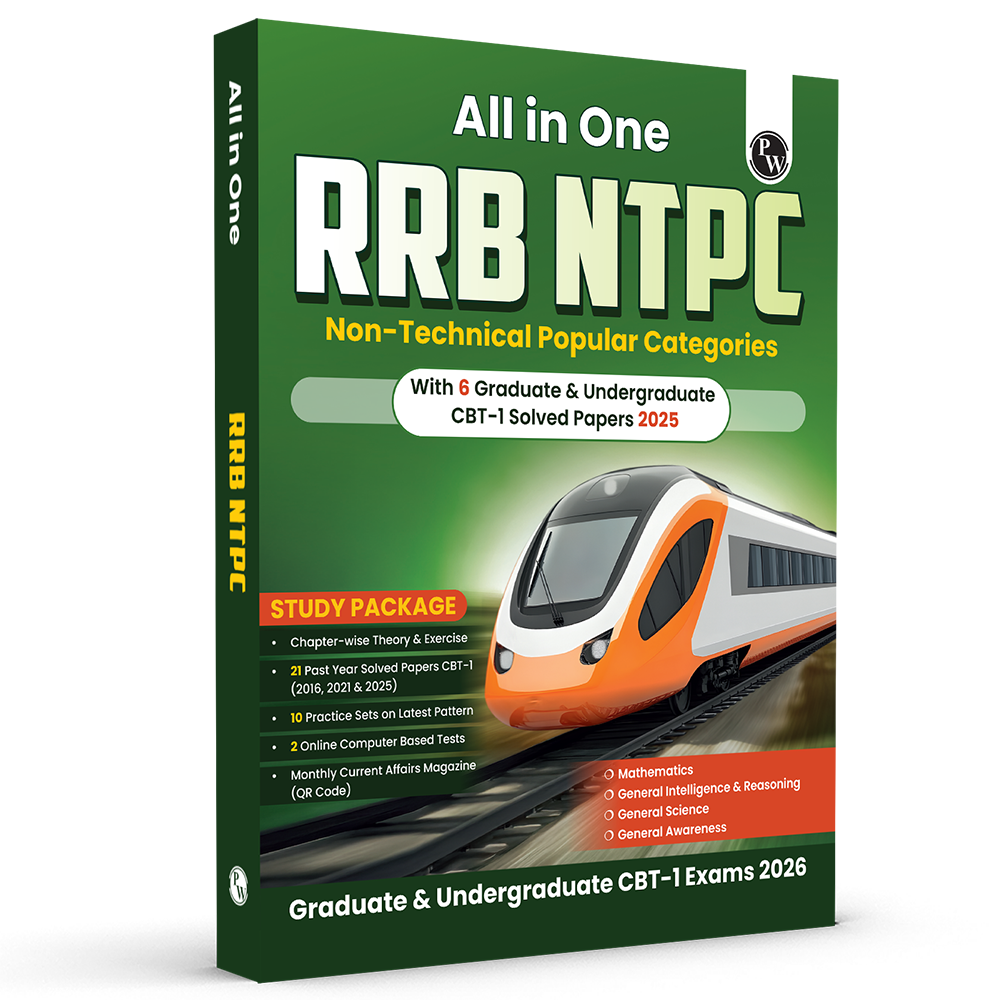
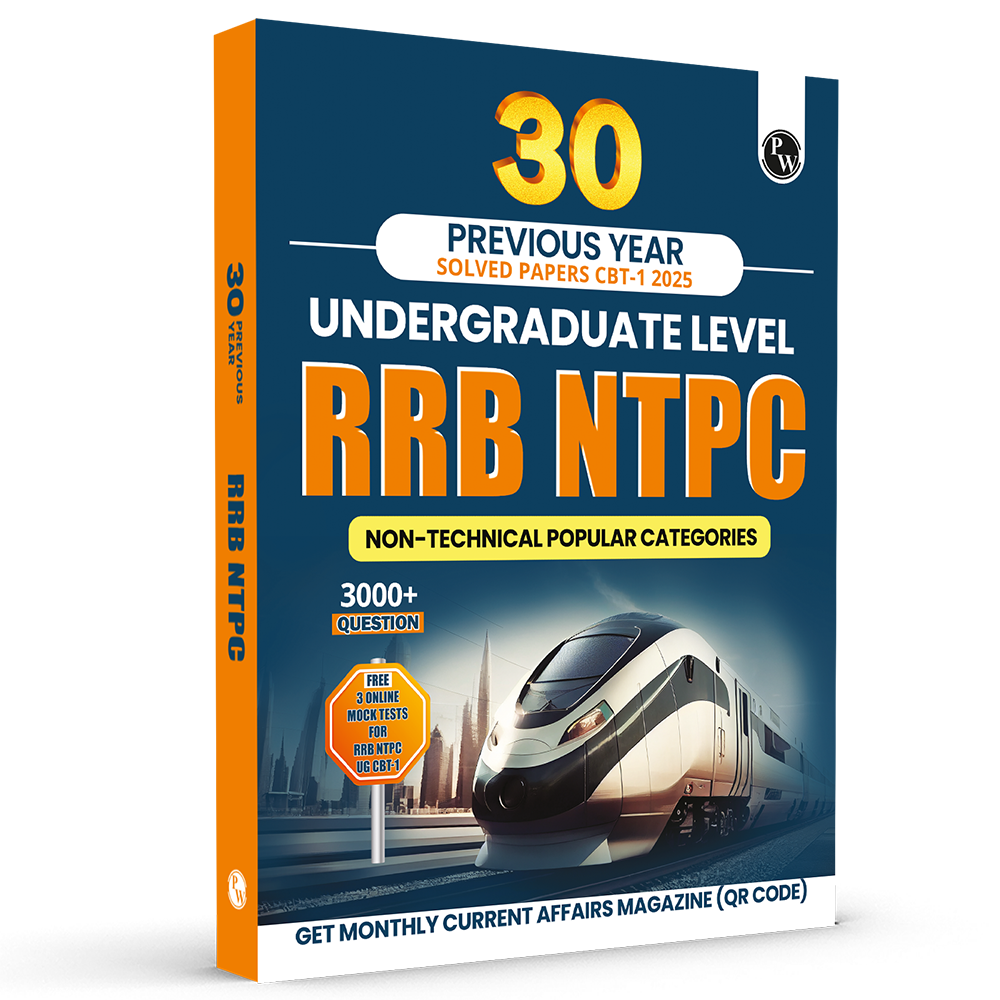
Get complete preparation support for the RRB NTPC CBT-1 exam with RRB NTPC Previous Year Papers, practice sets, online tests, detailed solutions, and current affairs. The RRB books is designed to help you understand the exam pattern and improve your preparation with regular practice.
Latest Syllabus-Based Content: Study chapter-wise concepts, useful formulas, quick tricks, and practice questions for Mathematics, General Intelligence & Reasoning, and General Awareness. The content is aligned with the latest RRB NTPC CBT-1 syllabus and exam pattern.
21 Solved Previous Year Papers: Practice 21 RRB NTPC Previous Year Question Papers (PYQs) with detailed answers. Solving these papers helps you understand question patterns, difficulty levels, important topics, and concepts that are frequently asked in the exam.
2 Online CBT Practice Tests: Attempt two computer-based tests designed to provide an exam-like practice experience. These tests help you work on speed, accuracy, time management, and overall exam preparation.
10 Full-Length Practice Sets: Test your preparation with 10 complete practice papers covering the major sections of the RRB NTPC CBT-1 exam. Regularly solving full-length sets can help improve your confidence and question-solving ability.
Detailed Solutions and Answer Keys: Check your answers with easy-to-follow solutions and answer keys. Step-by-step explanations help you understand the correct approach, identify mistakes, and improve your performance in future practice sessions.
Monthly Current Affairs Magazine: Access a monthly current affairs magazine through a QR code. It covers important Current Affairs, Railway GK, Static GK, Government Schemes, Awards, Sports, National and International Events, and other topics useful for RRB NTPC and Railway exam preparation.
What is the RRB NTPC Previous Year Papers Section-Wise Weightage?
Understanding the distribution of questions across sections forms the foundation of smart exam preparation. CBT 1 comprises three distinct sections: General Awareness, Mathematics, and General Intelligence and Reasoning. Past paper evaluation demonstrates how marks are spread among these subjects and where candidates should direct their primary revision focus. Examining past performance metrics aligns directly with the official RRB NTPC exam pattern.
|
Section Name |
Total Questions |
Total Marks |
Exam Duration |
|
General Awareness |
40 |
40 |
90 Minutes (Composite) |
|
Mathematics |
30 |
30 |
90 Minutes (Composite) |
|
General Intelligence & Reasoning |
30 |
30 |
90 Minutes (Composite) |
|
Total |
100 |
100 |
90 Minutes |
General Awareness Trends in Railway NTPC PYQs
The General Awareness section accounts for 40 percent of the total CBT 1 score, making it the most decisive segment. Analyzing railway ntpc PYQs shows that static General Knowledge and Science dominate this section alongside current events.
Key distribution trends observed across previous shifts include:
-
Current Affairs: 8 to 10 questions focusing on government schemes, national summits, sports events, and major awards.
-
General Science: 10 to 12 questions covering basic concepts in Physics, Chemistry, and Life Sciences up to Class 10 level.
-
History and Culture: 6 to 8 questions emphasizing the Indian Freedom Struggle, ancient monuments, and major historical dynasties.
-
Geography and Polity: 8 to 10 questions covering Indian Constitution articles, physical geography, and national parks.
-
Computer Fundamentals: 3 to 5 questions on basic computer hardware, operating systems, shortcut keys, and internet terminology.
Mathematics and Reasoning Breakdowns
Mathematics and Reasoning test analytical speed and problem-solving techniques. Past paper trends show that Arithmetic dominates the Mathematics section, accounting for nearly 70 percent of numerical questions.
Common mathematical topics include:
-
Number System, BODMAS rules, and Decimals
-
LCM and HCF calculation problems
-
Percentage, Profit and Loss, and Simple or Compound Interest
-
Time and Work, Pipe and Cisterns, Distance and Speed
-
Elementary Algebra, Geometry, and Basic Trigonometry
In Reasoning, questions test logical deductions and pattern recognition. Recurring themes include Coding-Decoding, Venn Diagrams, Syllogism, Blood Relations, Series Completion, and Data Sufficiency. Systematic ntpc preparation requires analyzing topic weightage to allocate daily study hours effectively.
RRB NTPC Previous Year Papers Marking Scheme
Understanding examination mechanics goes beyond section weightage. RRB previous year papers highlight the impact of negative marking, composite timing, and shift-based normalisation on final candidate scores.
Negative Marking and Time Constraints
The exam pattern mandates a strict penalty for incorrect attempts. For every wrong response, one-third of the mark assigned to that question is deducted.
Key tactical takeaways regarding timing and marking include:
-
Composite Timing: Candidates receive 90 minutes for 100 questions without individual sectional timers, allowing flexible navigation between sections.
-
Speed vs Accuracy Balance: Attempting questions blindly leads to severe mark loss due to the one-third negative penalty.
-
Pacing Target: Candidates have less than 54 seconds per question, meaning complex mathematical calculations must be executed swiftly.
-
Question Selection: Identifying and skipping lengthy or tricky reasoning puzzles early saves crucial minutes for easier general awareness questions.
Normalisation Formula and Cut-off Trends
Because the exam is conducted across multiple shifts over several days, question paper difficulty naturally varies. The Railway Recruitment Board applies a raw-score normalisation formula to standardise candidate performance across shifts.
Evaluating ntpc solved papers from previous shifts reveals:
-
Moderate-to-tough shift papers experience positive score adjustments post-normalisation.
-
Candidates maintaining high accuracy levels benefit significantly during normalisation calculations.
-
Cut-off scores vary across railway zones, but maintaining a raw score above 70 to 75 marks ensures a safe margin for CBT 2 qualification.
Subject-Wise Breakdown in RRB NTPC Previous Year Papers
A granular evaluation of previous tests reveals specific topic frequencies within each subject area. Candidates can streamline their revision by identifying high-yield topics that appear consistently year after year.
High-Yield Topics in NTPC Solved Papers
Reviewing ntpc solved papers provides a clear roadmap of high-yield chapters. Rather than covering exhaustive textbooks, candidates should focus on topics with proven recurrence.
-
Mathematics Priority Focus:
-
Ratio and Proportion, Averages, and Mixture Problems.
-
Mensuration 2D and 3D formulas and direct applications.
-
Trigonometry basic identities and height and distance problems.
-
Simple and Compound Interest calculation shortcuts.
-
General Intelligence Priority Focus:
-
Statement-Conclusion and Statement-Assumption logical questions.
-
Mathematical Operations and Symbol Substitution.
-
Non-Verbal Reasoning including Mirror Images and Counting Figures.
-
Analogy and Classification visual patterns.
Question Repetition and Concept Overlap
While exact wordings rarely repeat, conceptual frameworks and formula applications remain consistent across exam cycles.
Key findings from historical paper analysis demonstrate:
-
Direct Formula Applications: Around 60 percent of math questions test basic formula memory without multi-stage complexity.
-
Standard Static GK Questions: Questions on Indian Constitution amendments, historical dates, and scientific units repeat across shifts with minor variations.
-
Reasoning Logic Chains: Coding-decoding patterns often mirror previous years' shift logic, such as letter shifting and reverse alphabetical positions.
-
Current Affairs Timeframes: Current events questions consistently span the 8 to 12 months preceding the exam date.
Also Check - RRB NTPC PYQ Undergraduate 35 Previous Year Papers
Strategies for Solving RRB NTPC Previous Year Papers
Simply downloading past question papers is not enough. Aspirants must adopt structured practice techniques to translate historical data into actionable score improvements.
Timed Practice and Speed Enhancement
To replicate actual test environments, candidates should solve complete papers under timed conditions without interruptions.
Recommended steps for timed practice:
-
Simulate Real Test Conditions: Set a strict 90-minute countdown timer and work in a quiet, distraction-free environment.
-
First-Pass Strategy: Answer simple General Awareness questions and quick reasoning items within the first 30 minutes.
-
Second-Pass Calculation: Dedicate the next 40 minutes to numerical problems and logical puzzles.
-
Final Review: Reserve the final 20 minutes to review flagged questions and recheck calculations.
-
Avoid Blind Guesswork: Leave uncertain questions unattempted to safeguard against negative marking penalties.
Error Analysis for Targeted NTPC Preparation
Post-test analysis is where actual learning happens. Every completed paper should be followed by a comprehensive review session.
Effective error analysis involves:
-
Categorising Mistakes: Separate errors into conceptual gaps, calculation blunders, and misread questions.
-
Maintaining an Error Log: Note down forgotten formulas, tricky vocabulary, or unfamiliar static GK facts in a dedicated notebook.
-
Re-solving Incorrect Questions: Attempt wrong questions again without viewing the step-by-step solutions first.
-
Weak Area Reinforcement: Allocate immediate study sessions to topics where accuracy falls below 70 percent.
Read More: RRB NTPC Exam Pattern For CBT 1 & CBT 2
RRB NTPC Previous Year Papers FAQs
Q1: How many years of RRB NTPC Previous Year Papers should I solve?
Candidates should solve at least 15 to 20 past year papers from the 2016, 2021, and recent exam cycles. Solving papers across different shifts provides a comprehensive understanding of question variety and topic distribution.
Q2: Do questions repeat from RRB NTPC Previous Year Papers?
Direct questions are rarely repeated verbatim, but core concepts, formula patterns, and static General Knowledge themes repeat frequently. Practising past papers ensures familiarity with recurring exam trends.
Q3: How does analyzing previous papers assist in NTPC preparation?
Analyzing past papers helps candidates identify high-weightage topics, master time management within the 90-minute window, minimize negative marking losses, and understand the impact of shift normalisation.
Q4: What is the negative marking scheme revealed in past papers?
Past papers confirm a deduction of one-third mark for every incorrect attempt in CBT 1. Maintaining high accuracy is essential to prevent score erosion.
Q5: Where can I find reliable RRB NTPC PYQ resources for practice?
Authentic past papers and practice sets are available in the pw RRB NTPC PYQ Book on the official Stores, featuring detailed solutions, short tricks, and full-length mock tests.