CBSE Class 10 Maths Half Yearly Sample Paper 2026
The great pressure that students seeking for the highest results in secondary school face generally comes from the preparations for the mid-term tests. It can be daunting to look at intricate formulas, geometric proofs, and long word problems and think of reviewing them. Solving a dedicated CBSE Class 10 half yearly maths sample paper can help learners overcome nervousness, get clarity on tough themes and understand the expected board grading structure. Simulating real test settings allows students to work on their speed, enhance their calculating accuracy and go into their mid-term assessments feeling fully confident.
Why Solve CBSE Class 10 Half Yearly Maths Sample Paper
Mid-term assessments serve as a critical checkpoint before the final board examinations. Working through a sample paper gives students a realistic preview of the actual test environment. It turns theoretical understanding into practical problem-solving skills under strict time limits.
-
Familiarity with Exam Format: Practising a structured maths sample paper class 10 helps students get comfortable with multiple-choice questions, assertion-reasoning items, short-answer problems, and case studies.
-
Identifying Weak Spots: Solving a class 10 math practice paper helps to identify places where step errors, calculation errors or conceptual errors are made.
-
Speed and Accuracy: Working on a timed maths half yearly question paper class 10 develops fast calculation habits while maintaining precision.
-
Reduction of Exam Fear: Attempting mock tests builds confidence, making the actual class 10 maths half yearly exam feel like a familiar exercise rather than a scary challenge.
CBSE Class 10 Half Yearly Maths Sample Paper Pattern
The mid-term examination paper closely follows the official board structure to ensure students build early stamina. A standard CBSE Class 10 sample paper covers five distinct sections, evaluated out of 80 total marks over a 3-hour duration.
|
Section |
Question Type |
Number of Questions |
Marks Per Question |
Total Section Marks |
|
Section A |
MCQs & Assertion-Reason |
20 |
1 |
20 |
|
Section B |
Very Short Answer (VSA) |
5 |
2 |
10 |
|
Section C |
Short Answer (SA) |
6 |
3 |
18 |
|
Section D |
Long Answer (LA) |
4 |
5 |
20 |
|
Section E |
Case-Based Integrated Units |
3 |
4 |
12 |
CBSE Class 10 Half Yearly Maths Sample Paper Topics
The mid-term syllabus generally covers the first half of the NCERT curriculum. Learning these core units using a targeted class 10 maths half yearly paper guarantees a strong overall score.
Real Numbers and Polynomials
-
Fundamental Theorem of Arithmetic, including HCF and LCM applications using prime factorisation.
-
Proofs of irrationality for radical expressions.
-
Relationship between zeroes and coefficients of quadratic polynomials.
Pair of Linear Equations in Two Variables
-
Graphical representation and conditions for consistency or inconsistency (unique solution, infinitely many solutions, no solution).
-
Algebraic methods of solution, specifically Substitution and Elimination methods.
-
Real-world contextual word problems involving speed, work, and age calculations.
Quadratic Equations
-
Finding roots using factorisation and the standard quadratic formula.
-
Discriminant analysis to determine the exact nature of roots (real, equal, or distinct).
Triangles and Coordinate Geometry
-
Basic Proportionality Theorem (Thales Theorem) along with its converse and geometric applications.
-
Similarity criteria for triangles (AAA, SSS, SAS) used in geometric proofs.
-
Distance formula, section formula, and midpoint evaluations on Cartesian coordinates.
Introduction to Trigonometry and Statistics
-
Trigonometric ratios for specific standard angles (0 degree, 30 degree, 45 degree, 60 degree, and 90 degree).
-
Fundamental identity proofs involving sin squared theta + cos squared theta = 1.
-
Mean, median, and mode calculation methods for grouped statistical data.
CBSE Class 10 Half Yearly Maths Sample Paper Questions
To practice effectively, use CBSE Class 10 Books alongside these representative questions designed according to the latest marking standards.
Section A: Objective Type Questions (1 Mark Each)
Q1. If two positive integers a and b are written as a = x^3 y^2 and b = x y^3, where x and y are prime numbers, then HCF(a, b) is:
-
(a) x y
-
(b) x y^2
-
(c) x^3 y^3
-
(d) x^2 y^2
Answer: (b) x y^2
Explanation: The HCF of two numbers is the product of the smallest power of each common prime factor involved. Here, the minimum power of x is x^1 and for y is y^2. Hence, HCF = x y^2.
Q2. The value of k for which the system of equations 3x - y - 5 = 0 and 6x - 2y - k = 0 has no solution is:
-
(a) k = 10
-
(b) k != 10
-
(c) k = -10
-
(d) k != -10
Answer: (b) k != 10
Explanation: For no solution, a1/a2 = b1/b2 != c1/c2. Here, 3/6 = -1/-2 != -5/-k. Simplifying 1/2 != 5/k gives k != 10.
Section B: Very Short Answer Questions (2 Marks Each)
Q3. Prove that 3 + 2 root 5 is an irrational number, given that root 5 is irrational.
Solution:
-
Assume on the contrary that 3 + 2 root 5 is a rational number of the form a/b, where a and b are co-prime integers and b != 0.
-
Rearrange the equation:
3 + 2 root 5 = a/b
2 root 5 = (a/b) - 3
root 5 = (a - 3b) / (2b) -
Since a and b are integers, (a - 3b) / (2b) is a rational number.
-
This implies that root 5 is rational, which contradicts the given fact that root 5 is irrational.
-
Therefore, our assumption is incorrect, proving that 3 + 2 root 5 is an irrational number.
Section C: Short Answer Questions (3 Marks Each)
Q4. Find the zeroes of the quadratic polynomial p(x) = 6x^2 - 3 - 7x and verify the relationship between the zeroes and the coefficients.
Solution:
-
Rearrange the polynomial in standard form: p(x) = 6x^2 - 7x - 3.
-
Factorise by splitting the middle term:
6x^2 - 9x + 2x - 3 = 0
3x(2x - 3) + 1(2x - 3) = 0
(3x + 1)(2x - 3) = 0 -
Equating each factor to zero gives zeroes: alpha = 3/2 and beta = -1/3.
Verification:
-
Sum of zeroes (alpha + beta):
(3/2) + (-1/3) = (9 - 2) / 6 = 7/6
Formula: -b/a = -(-7)/6 = 7/6. (Verified) -
Product of zeroes (alpha * beta):
(3/2) * (-1/3) = -3/6 = -1/2
Formula: c/a = -3/6 = -1/2. (Verified)
Section D: Long Answer Questions (5 Marks Each)
Q5. State and prove the Basic Proportionality Theorem (Thales Theorem).
Proof Outline:
-
Statement: If a line is drawn parallel to one side of a triangle to intersect the other two sides in distinct points, the other two sides are divided in the same ratio.
-
Given: A triangle ABC where line DE is parallel to BC, intersecting AB at D and AC at E.
-
To Prove: AD/DB = AE/EC.
-
Construction: Join BE and CD. Draw EN perpendicular to AB and DM perpendicular to AC.
-
Area Calculations:
-
Area(Triangle ADE) = (1/2) * AD * EN
-
Area(Triangle BDE) = (1/2) * DB * EN
-
Dividing these yields:
Area(Triangle ADE) / Area(Triangle BDE) = AD/DB (Equation 1)
-
Similarly:
-
Area(Triangle ADE) = (1/2) * AE * DM
-
Area(Triangle DEC) = (1/2) * EC * DM
-
Dividing these yields:
Area(Triangle ADE) / Area(Triangle DEC) = AE/EC (Equation 2)
-
Note that Triangle BDE and Triangle DEC lie on the same base DE and between the same parallel lines DE and BC. Therefore, Area(Triangle BDE) = Area(Triangle DEC).
-
Substituting this into Equation 1 and comparing with Equation 2 gives:
AD/DB = AE/EC
(Hence Proved)
CBSE Class 10 Half Yearly Maths Sample Paper Practice Tips
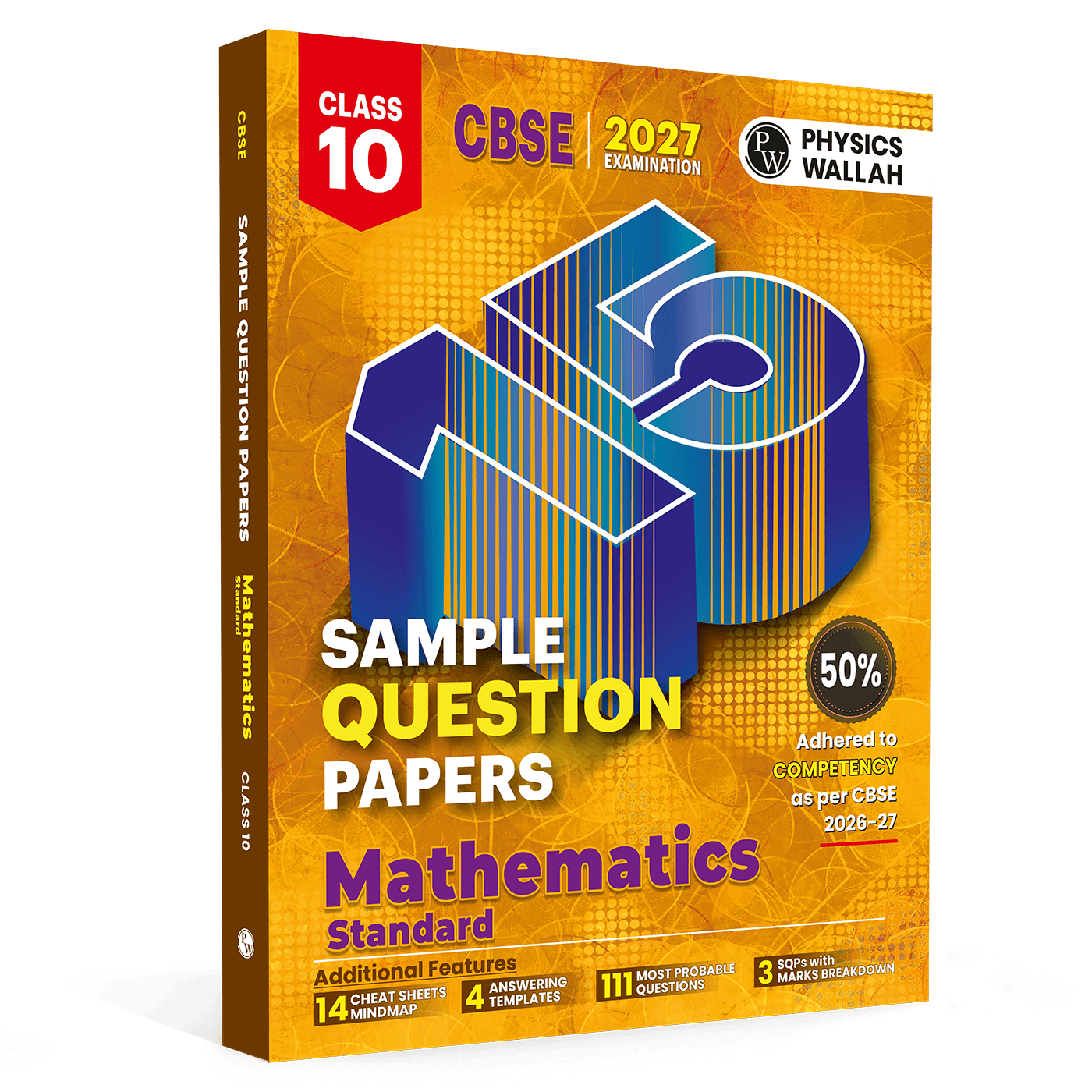
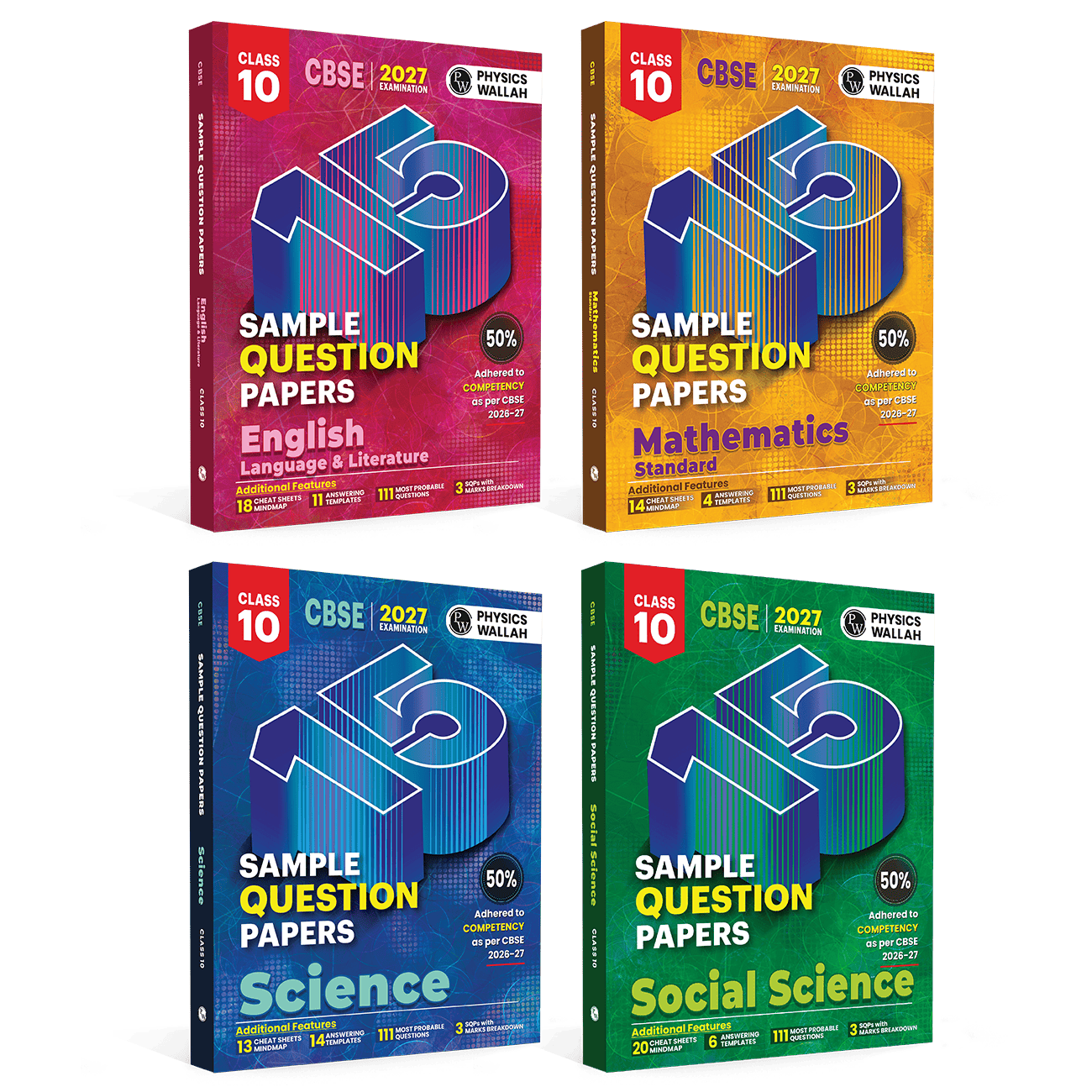
Solving a CBSE Math half-yearly sample paper provides maximum returns only when paired with systematic study habits and the CBSE Class 10 Sample Papers Combo of 4 Books 2027.
1. Replicate Real Exam Conditions
Always set a 3-hour timer in a quiet room when solving your Class 10 maths practice paper. Avoid checking formulas or notes mid-way. This builds realistic time awareness and improves pacing across sections.
2. Follow Step-Marking Protocols
In CBSE evaluations, every correct step carries marks, even if the final calculation has an error. Always state given values, formulas used, intermediate steps, and final units clearly.
3. Maintain a Dedicated Error Log
Whenever you finish a sample paper, analyze your mistakes. Note down whether an error was caused by a calculation lapse, misreading the question, or a conceptual gap. Re-solve those specific questions two days later.
4. Leverage Comprehensive Prep Material
For complete coverage across all subjects, students benefit from structured collections like the CBSE Class 10 Sample Papers Combo Set of 4 Books.
These books include:
-
15 Board-Style Level-Wise Sample Papers (Easy, Medium, Hard) for step-by-step skill progression.
-
Past 5 Years' Trend Analysis alongside solved board papers.
-
13 Cheat Sheets (Mind Maps) for fast formula revision.
-
Handwritten topper-style solutions via QR code for step-presentation practice.
Read More: CBSE Class 10 Science Half Yearly Sample Paper 2026
CBSE Class 10 Maths Sample Paper FAQs
1. Where can I find a reliable cbse class 10 half yearly maths sample paper?
You can have a look at the official sample questions accessible on the CBSE academic page or choose for the structured practice sets available in the CBSE Class 10 Sample Paper collections.
2. How many sample papers should I solve before my class 10 maths half yearly exam?
Solving at least 3 to 5 full-length papers under timed conditions gives you sufficient exposure to different question typologies and builds operational speed.
3. Is the maths sample paper class 10 harder than the actual school paper?
Sample papers often include a balanced blend of easy, medium, and high-order thinking (HOTS) questions to prepare students for all difficulty levels.
4. What is the benefit of solving a class 10 maths practice paper with step-wise marking schemes?
Checking solutions against an official marking scheme shows you how marks are allocated for formulas, working steps, and final units, ensuring you don't lose unnecessary marks.
5. Does the CBSE math half yearly sample paper cover standard and basic maths patterns?
Yes, the core syllabus and section-wise structure of standard and basic maths are same but standard papers will be more concept application oriented.