CBSE Class 11 Physics Notes Chapter 9 Mechanical Properties of Solids
CBSE Class 11 Physics Chapter 9 focuses on the Mechanical Properties of Solids, an important topic that helps students understand how solid materials behave when different forces act on them. These class 11 physics chapter 9 notes explain what happens when a solid object is stretched, compressed, bent, or twisted.
In mechanical properties of solids class 11 notes, students learn about key terms such as force, stress, strain, elasticity, and plasticity. Stress is the force applied per unit area, while strain is the change in shape or size of a material due to that force. Elasticity tells us how well a material can return to its original shape after the force is removed.
The class 11 phy ch 9 notes also cover Hooke’s Law, which states that stress is directly proportional to strain within the elastic limit. Another important concept included in the mechanical properties of solids notes is Young’s modulus, which measures the stiffness of a material. Materials with a high Young’s modulus are harder to stretch.
These class 11 physics mechanical properties of solids notes also explain different types of elastic moduli such as bulk modulus and shear modulus, along with topics like stress-strain curve, elastic limit, and breaking point. Diagrams and examples make these ideas easier to understand.
Studying physics class 11 mechanical properties of solids notes is useful in real life too. These concepts help engineers design strong buildings, bridges, machines, and tools. Overall, class 11 mechanical properties of solids notes build a strong foundation for future chapters and competitive exams.
Check Out: Class 11th Books
CBSE Class 11 Physics Chapter 9 Notes
A rigid body is a solid object with a fixed shape and size. However, even seemingly rigid objects can be deformed under sufficient force. This implies that no solid is perfectly rigid; they can be stretched, compressed, or bent with force.
Deforming Force
A deforming force is a type of force that causes a change in the size or shape of an object when applied to it. When an external force is exerted on an object, it can cause the object to undergo deformation, which refers to any change in the object's physical form. This force can be applied in various ways, such as stretching, compressing, or bending, depending on the nature of the object and the direction of the force. Deforming forces can result from factors like pressure, tension, or impact, and they play a crucial role in determining how materials respond to external stimuli. Understanding deforming forces is essential in fields such as engineering, physics, and materials science, as it helps in predicting and analyzing the behavior of objects under different conditions.
Hooke's Law
Hooke's Law is a fundamental principle in mechanics that describes the behavior of materials under elastic deformation. It was formulated by Robert Hooke in the 17th century.
Elastic Modulus (K)
The Elastic Modulus is a measure of the material's ability to resist deformation under stress. Different materials have different elastic moduli, which means they respond differently to the same amount of stress.
Elastic Limit
The elastic limit is the maximum stress that a material can withstand without undergoing permanent deformation. Beyond this limit, the material will not return to its original shape and may experience plastic deformation or break.
Exceptions to Hooke's Law
Not all materials obey Hooke's Law. Examples of such materials include:
- Rubber : Rubber exhibits nonlinear elasticity, meaning its stress-strain relationship is not a straight line.
- Biological Tissues : Human muscles and other biological tissues also do not follow Hooke's Law due to their complex structure and composition.
Stress
Stress is the internal restoring force per unit area of the cross-section of a deformed object. It is expressed as the applied force divided by the area.
Types of Stress:
-
-
- Longitudinal Stress: Acts normal to the cross-section of the object, causing either tensile stress (increase in length) or compressional stress (decrease in length).
- Tangential or Shearing Stress: Acts tangentially to the surface of the body, causing a change in shape.
- Hydraulic Stress: Results from a liquid applying uniform force from all sides.
-
Strain
Strain is the fractional change in dimensions of an object due to the deforming force. It is calculated as the change in dimension divided by the original dimension.
Types of Strain
- Longitudinal strain (change in length/original length)
- Volumetric strain (change in volume/original volume)
- Shearing strain (tangential applied force/area of force)
Young’s Modulus of Rigidity (Y)
Young's modulus of rigidity, often denoted by the symbol Y , is a measure of the stiffness of a material. It quantifies the ratio of stress (force per unit area) to strain (change in length per unit length) in a material subjected to tensile or compressive forces along its length. Young's modulus characterizes the material's resistance to deformation under tensile or compressive loads. It is an essential property in materials science and engineering, as it helps engineers and designers select materials suitable for specific applications based on their mechanical properties. Materials with higher Young's moduli are stiffer and require greater force to deform, while materials with lower moduli are more flexible and deform more easily under stress.
Applications of Elasticity
Elasticity, the property of materials to return to their original shape and size after deformation, finds numerous applications across various fields. Some of the key applications of elasticity include:
Structural Engineering : Elasticity is crucial in designing buildings, bridges, and other structures. Materials with high elasticity, such as steel and concrete, are preferred for constructing sturdy and resilient structures that can withstand external forces and loads.
Mechanical Engineering : Elasticity plays a vital role in designing mechanical components and systems, such as springs, shock absorbers, and dampers. Springs made from elastic materials store mechanical energy when compressed or stretched and release it when the force is removed, making them useful in various mechanical devices.
Material Testing : Elasticity is extensively used in material testing to assess the mechanical properties of materials. Techniques such as tensile testing, compression testing, and bending testing measure the elastic modulus and other parameters to evaluate the strength, stiffness, and durability of materials.
Medical Devices : Elastic materials are used in the manufacturing of medical devices and implants, such as prosthetics, orthotics, and medical gloves. These materials provide comfort, flexibility, and support, making them suitable for wearable medical devices and protective gear.
Automotive Industry : Elasticity is essential in designing automotive components and systems, including tires, suspension systems, and body panels. Elastic materials in tires provide traction, shock absorption, and stability, while elastic components in suspension systems absorb road shocks and vibrations to ensure a smooth ride.
Textile Industry : Elasticity is employed in the textile industry to produce stretchable fabrics and garments, such as spandex, elastane, and elastic fibers. These materials offer flexibility, comfort, and shape retention in clothing, sportswear, and medical textiles.
Geotechnical Engineering : Elasticity is critical in geotechnical engineering for analyzing soil and rock mechanics, slope stability, and foundation design. Understanding the elastic properties of soil and rock formations helps engineers assess the stability and integrity of civil engineering projects.
Acoustics and Vibrations : Elasticity influences the propagation of sound waves and vibrations in materials. Understanding the elastic behavior of materials is essential in designing acoustic systems, musical instruments, and noise control solutions.
Electronics and Microelectronics : Elastic materials, such as silicone rubber and elastomers, are used in electronic devices and microelectromechanical systems (MEMS) for encapsulation, insulation, and vibration damping. These materials protect delicate electronic components from mechanical shocks and environmental hazards.
Sporting Goods : Elasticity is integral to the design of sporting goods and equipment, including tennis rackets, golf clubs, and athletic shoes. Elastic materials enhance performance, energy transfer, and player comfort in sports equipment.
Check Out: Class 11th Question Banks
Limit of Elasticity
The limit of elasticity is defined as the maximum value of the deforming force that a material can withstand while still being able to return to its original shape once the force is removed. Beyond this limit, the material will undergo permanent deformation.
Stress-Strain Curve
The stress-strain curve for a metal wire under gradual loading provides valuable insights into the elastic and plastic behavior of the material.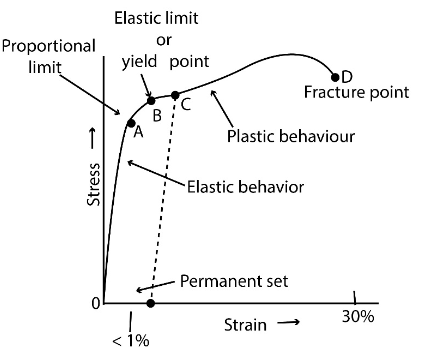
Key Points and Regions on the Stress-Strain Curve:
Proportional Limit (Point A) :
- Region OA : The initial part of the graph is a straight line, indicating that stress is proportional to strain, which means Hooke's Law is obeyed.
- Point A : Known as the proportional limit. Up to this point, the material exhibits perfect elasticity.
Elastic Region (OB) :
- Region AB : After point A, the curve deviates from being a straight line, indicating that stress is no longer proportional to strain. However, if the load is removed at any point between O and B, the curve is retraced along BAO, and the material regains its original length.
- Point B : Known as the elastic limit or yield point. The stress corresponding to point B is called the yield strength. Beyond this point, the material begins to deform plastically.
Plastic Region (BC) :
- Region BC : Beyond point B, the strain increases more rapidly than stress. If the load is removed at any point along this region, the material does not return to its original length, indicating permanent deformation.
- Residual Strain : Even when stress is reduced to zero, a residual strain (OE) remains, indicating that the material has undergone permanent deformation (plastic flow).
- Elastic Hysteresis : The fact that the stress-strain curve is not retraced on reversing the strain indicates elastic hysteresis.
Necking and Fracture (Point D) :
- Region CD : As the load increases beyond point C, significant increases in strain occur without additional stress. Constrictions, known as necks and waists, develop in the wire.
- Point D : Known as the fracture point, where the wire finally breaks.
- Ultimate Strength : The stress corresponding to the breaking point (point D) is termed the ultimate strength or tensile strength of the material.
Check Out: CBSE Question Bank Class 11 Physics
Benefits of CBSE Class 11 Physics Notes
Help students understand concepts clearly with simple and easy language
-
Make revision quick and effective before exams
-
Save time by covering important points in short form
-
Prepared as per the latest CBSE Class 11 syllabus and exam pattern
-
Improve exam performance and confidence
-
Useful for self-study and independent learning
-
Highlight important formulas, definitions, and keywords
-
Help in better memorization and recall
-
Reduce exam stress by giving structured and organized content
Read More: CBSE Class 11 Important Topics - Subject Wise
CBSE Class 11 Mechanical Properties of Solids Notes FAQs
Q1. What is Chapter 9 of Class 11 Physics about?
Chapter 9, Mechanical Properties of Solids, explains how solid materials behave when forces like stretching, compressing, bending, or twisting are applied. It covers concepts such as stress, strain, elasticity, and elastic moduli.
Q2. Why are Mechanical Properties of Solids important for Class 11 students?
This chapter helps students understand the basic behavior of materials used in daily life and engineering. It also builds a strong foundation for higher physics topics and competitive exams.
Q3. What are the main topics covered in Class 11 Physics Chapter 9 notes?
The notes include stress and strain, Hooke’s Law, elastic limit, Young’s modulus, bulk modulus, shear modulus, stress–strain curve, and breaking point.
Q4. Is Chapter 9 important for exams?
Yes, questions from Mechanical Properties of Solids are frequently asked in school exams and also form the base for numerical problems in higher classes.
Q5. How can Class 11 Physics Chapter 9 notes help in revision?
These notes summarize all important formulas, definitions, and concepts in a clear way, making last-minute revision quick and effective.