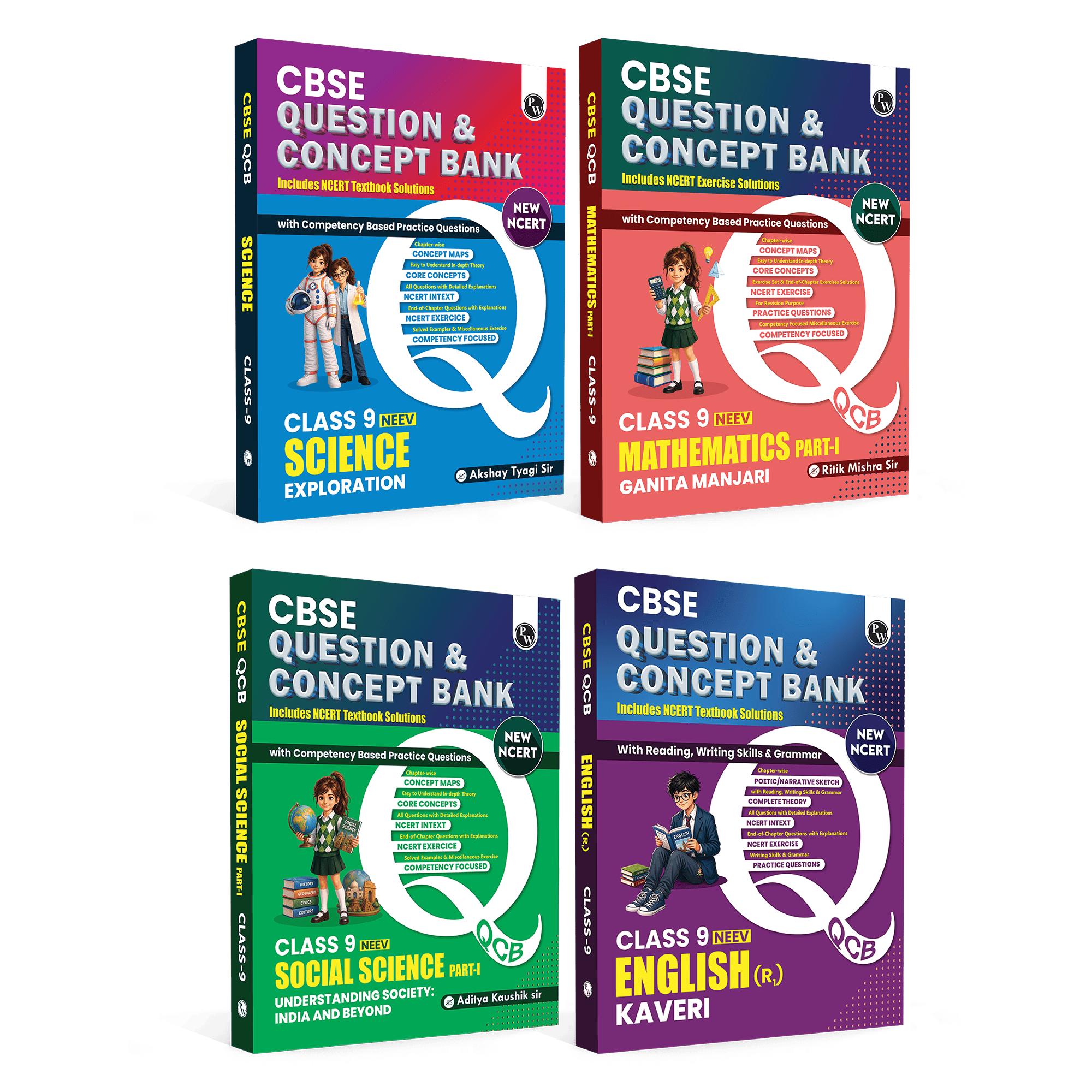
CBSE Class 9 Question Bank: How to Identify Your Weak Chapters

Class 9 students often spend hours studying but still struggle in exams because some conceptual gaps remain unnoticed. Identifying class 9 weak chapters early can make revision more focused and organised. Using a reliable CBSE Class 9 question bank allows students to practise different question types, assess their understanding, and identify topics that need more attention.
Why Use a CBSE Class 9 Question Bank to Find Weak Chapters
Identifying weak chapters starts with understanding the difference between reading a topic and actually understanding it. Students may feel confident after reading a chapter several times, but this confidence can change when they have to answer questions without looking at their notes.
A question bank can help students test their understanding through different types of questions. When a student repeatedly makes mistakes in a particular topic, it becomes easier to identify that area as a weak chapter or sub-topic.
Some common reasons why students fail to identify their weak areas include:
-
Passive Reading: Reading the same theory repeatedly may create familiarity without improving recall.
-
Limited Question Practice: Solving only easy questions can hide gaps in concept application.
-
Ignoring Difficult Topics: Instead of practicing difficult chapters frequently, students may skip these chapters.
-
Avoiding Mistakes: If you don’t examine your mistakes and go on to the next question, you may make the same mistakes again.
-
No Progress Tracking: Without recording practice results, it can be difficult to know which chapters need more attention.
Using questions as a self-checking tool helps students replace assumptions about their class 9 exam preparation with actual practice results.
How to Use a CBSE Class 9 Question Bank for Self-Assessment
A CBSE Class 9 Question Bank Combo Set Books can be used as a diagnostic resource to check preparation chapter by chapter. Students should first study a topic and then attempt related questions without referring to their notes or solutions.
The result can help show whether the problem is related to concept clarity, memory, calculation, or answer writing. For example, if a student understands a Science chapter but repeatedly gets application-based questions wrong, more concept practice may be needed. Similarly, repeated calculation errors in Mathematics may indicate the need for additional problem-solving practice.
Students can follow these steps:
-
Attempt Without Help: Solve questions independently before checking the answers.
-
Record Your Score: Note the number of correct, incorrect, and unanswered questions.
-
Review Mistakes: Identify exactly why each answer was incorrect.
-
Track Difficult Topics: Record the chapter and sub-topic where mistakes occur.
-
Retest Later: Attempt similar questions after revision to check improvement.
|
Evaluation Metric |
High Performance Indicator |
Warning Sign of a Weak Chapter |
|
Accuracy Rate |
Above eighty percent correct responses |
Below fifty percent correct responses |
|
Time Per Question |
Standard pace matching exam guidelines |
Excessive time spent or questions left blank |
|
Doubt Nature |
Minor calculation errors |
Inability to start the given problem |
How to Find Weak Chapters With a CBSE Class 9 Question Bank
Finding weak chapters becomes easier when students follow the same process for every subject. A question bank can provide chapter-wise practice, while an error notebook can help record the results.
Start by completing the basic study of a chapter. After understanding the concepts, attempt a set of questions without checking the solutions. Once the set is complete, classify the mistakes instead of simply counting the wrong answers.
A simple process is:
-
Complete the Chapter: Read the prescribed material and understand the basic concepts.
-
Solve Chapter-Wise Questions: Attempt a suitable set of questions without assistance.
-
Mark Incorrect Answers: Keep a record of questions that were wrong or incomplete.
-
Find the Reason: Decide whether the mistake happened because of poor recall, conceptual confusion, calculation, or careless reading.
-
Revise the Topic: Return to the relevant textbook section or notes.
-
Practise Again: Solve similar questions to check whether the problem has been corrected.
-
Update Your Tracker: Mark the chapter as improving, needs practice, or completed.
How to Find Science and Maths Weak Areas With a CBSE Class 9 Question Bank
Science and Mathematics require different approaches when using CBSE Class 9 Books to identify weak areas. Students should consider the type of mistake they make rather than only looking at their overall score.
In Science, difficulties may appear when students have to explain concepts, interpret diagrams, apply formulas, or connect different parts of a chapter. Students can use CBSE Class 10 Books to practise a mixture of conceptual, numerical, diagram-based, and competency-focused questions to find these gaps.
For Mathematics, repeated errors may occur while applying formulas, understanding a question, performing calculations, or following multiple steps. Students should use CBSE Class 10 Books to record the exact stage where they get stuck instead of simply marking the complete chapter as difficult.
-
Science Exploration Focus: Look for trouble spots in chemical balancing, physics numericals, or biological terminology by solving targeted competency problems.
-
Mathematics Practice Focus: Track calculation blocks and algebraic manipulation errors using structured problem sets found in reliable class 9 chapter wise practice manuals.
-
Cross-Verifying Solutions: Use detailed answer keys with step-by-step explanations to understand alternative approaches to difficult problems.
How to Use an Error Log With a CBSE Class 9 Question Bank
Creating an error log changes how students review past mistakes. Simply completing practice sets is insufficient if recurring errors go undocumented and uncorrected over time.
Students should review their error log once or twice a week. Questions that continue to cause problems should receive additional practice.
-
Record Specific Errors: Write the exact concept or step where the mistake occurred.
-
Add the Correct Method: Note the correct approach in simple words.
-
Review Regularly: Revisit the log during weekly revision.
-
Retest Yourself: Solve similar questions without checking the earlier solution.
-
Remove Fixed Errors: Once a mistake is no longer repeated, mark it as resolved.
Also Check - Class 9 Mind Map Books
Importance of Competency Questions in a CBSE Class 9 Question Bank
Modern evaluation patterns demand higher-order thinking skills instead of rote memorisation. Traditional school testing often fails to highlight hidden conceptual vulnerabilities because questions remain predictable and formulaic.
-
Application-Oriented Scenarios: Competency items place standard scientific or mathematical rules into real-world contexts.
-
Case-Based Analysis: Students must extract hidden data points from short paragraphs before applying formulas.
-
Exposing Superficial Learning: Encountering unfamiliar framing forces learners to confront whether they truly grasp the underlying principle.
How to Plan Revision With a CBSE Class 9 Question Bank
Fixing identified academic vulnerabilities requires consistency rather than last-minute cramming sessions. A balanced weekly routine ensures that newly strengthened topics do not fade while working on fresh material.
-
Allocating Remedial Hours: Reserve specific slots during the weekend exclusively for reviewing logged errors.
-
Mixed Practice Rounds: Combine questions from mastered chapters with problems from vulnerable units to maintain retention.
-
Regular Mock Testing: Take full-length diagnostic tests monthly to measure overall progress across all subjects.
Read More: CBSE Class 9 Study Tips and Strategies
CBSE Class 9 Question Bank FAQs
What is the fastest way to use a Class 9 question bank for self-assessment?
The fastest method involves attempting chapter-end practice sets under timed conditions, immediately checking answers against detailed explanations, and compiling all incorrect responses into a dedicated error log for focused revision.
How do I know if a difficult topic is truly a class 9 weak chapter?
If you repeatedly fail application-based or competency-focused questions on the same topic despite reviewing theory notes, it qualifies as a vulnerable area requiring deep remedial practice.
Why are competency-based questions essential to identify weak chapters class 9?
Competency questions test real-world application and analytical thinking rather than direct memorisation, exposing hidden conceptual gaps that standard textbook exercises often miss.
How often should I engage in class 9 chapter wise practice to prevent learning gaps?
Students should practice chapter-wise problem sets weekly immediately after finishing school lectures, ensuring that doubts are cleared before moving on to advanced syllabus units.
What makes CBSE Class 9 practice questions effective for long-term retention?
High-yield questions combined with step-by-step solutions help students understand alternative problem-solving approaches, correct recurring mistakes, and build solid academic confidence for school evaluations.