How 10 Years of Maths PYQs Help You Spot High-Weightage Chapters
Stepping into the final months before your board exams can feel overwhelming. Many students spend hours reading textbooks without knowing which sections matter most. This lack of direction leads to wasted time and unnecessary stress.
Analyzing Class 10 maths PYQs is the most effective way to separate critical topics from minor ones. It gives you a direct look into the examiner’s mind, helping you plan your study schedule with complete confidence.
What is CBSE Class 10 Maths PYQ?
A CBSE Class 10 maths PYQ refers to an official question paper from previous board examinations conducted by the Central Board of Secondary Education. These papers represent the exact evaluation standard that students face in their final exams. Rather than random practice questions, maths previous year questions serve as a realistic blueprint of the test layout, difficulty level, and question types.
These questions are usually organized into two formats: year-wise papers or chapterwise PYQs. A year-wise collection provides the complete paper exactly as it appeared in a specific year, which helps during timed mock tests.
On the other hand, chapter-wise sets group CBSE Class 10 previous year questions by specific topics, such as Algebra or Trigonometry. This targeted format allows you to check your understanding of an individual chapter immediately after completing it. It also features the latest 2026 board paper coverage alongside older sets, giving you a complete overview of the changing trends over a decade.
Why is CBSE Class 10 Maths PYQ the Best Source to Identify High-Weightage Chapters?
When preparing for your board exam in maths, guessing which chapters carry the most weight can lead to poor results.
Looking through a CBSE Class 10 maths PYQ is the most reliable way to spot high-weightage chapters because it relies on historical exam data rather than assumptions.
-
Reveals Mark Allocation: Going through ten years of papers shows you which chapters consistently feature 4-mark or 5-mark long-answer questions.
-
Shows Pattern Shifts: You can see how the weighting of certain topics has evolved over time, including recent years like 2026.
-
Highlights Question Frequency: It helps you track how often specific subtopics appear, making it easier to prioritize your study time.
-
Provides Authentic Trends: It offers real exam insights that help you understand the exact balance between theory and application.
Which Chapters Carry High Weightage in CBSE Class 10 Maths PYQs?
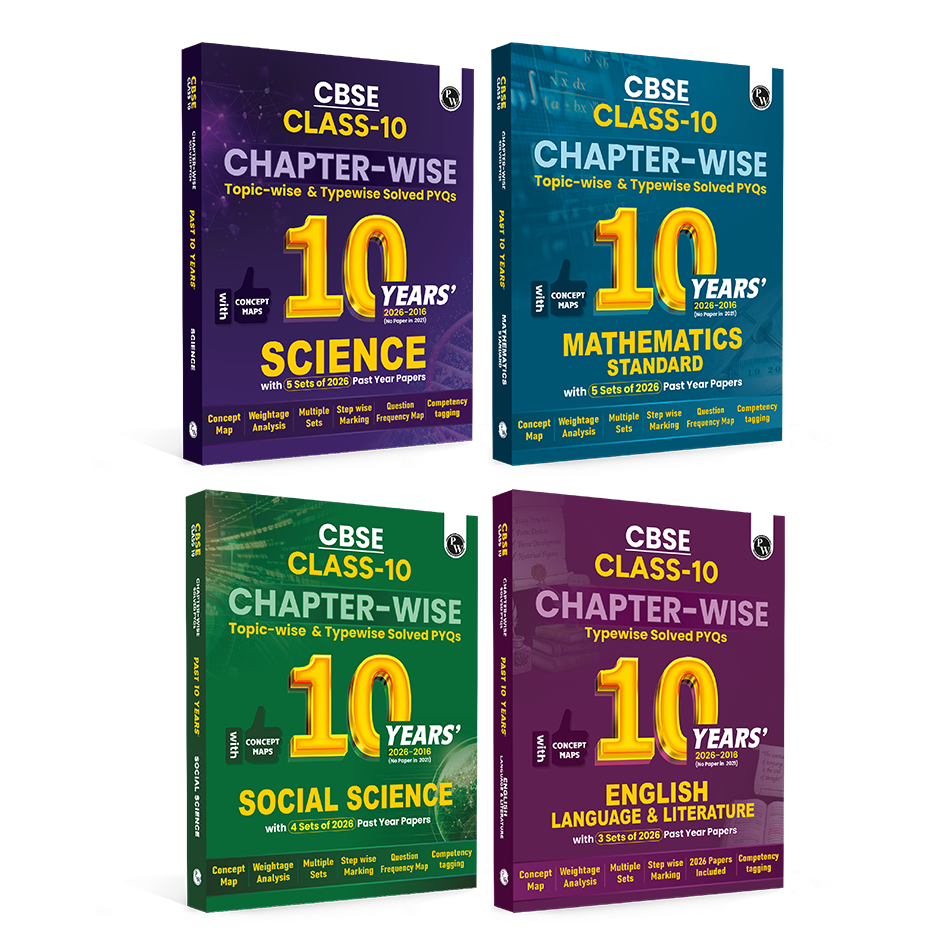
The table below shows how different chapters are generally prioritized based on past examination patterns. While analysing these trends, practising with CBSE Class 10 PYQ Combo 2027 helps you identify frequently asked topics, understand chapter-wise weightage, and become familiar with the latest question patterns. Solving previous year questions alongside this analysis enables you to focus your revision on high-scoring areas and prepare more effectively for the CBSE Class 10 Board Examination.
|
Chapter Group / Topic |
Expected Weightage Range |
Common Question Types Found in PYQs |
|
Algebra (Polynomials, Linear Equations, Quadratic Equations, AP) |
High |
4-mark and 5-mark algebraic proofs, word problems, and roots calculation |
|
Geometry (Triangles, Circles) |
High |
Theorem proofs, riders, and multi-step geometric calculations |
|
Trigonometry (Introduction & Applications) |
Medium to High |
Identity verifications and height-and-distance word problems |
|
Surface Areas and Volumes |
Medium |
Formula-based long answers involving combined solid shapes |
|
Statistics and Probability |
Medium |
Mean, median, mode calculations and simple probability distributions |
|
Coordinate Geometry & Number Systems |
Low to Medium |
Distance formula applications, section formula, and irrationality proofs |
How to Analyse CBSE Class 10 Maths PYQ?
Simply reading through past papers will not improve your score. To get the most out of your CBSE Class 10 maths PYQ, you must use a structured, analytical approach that helps you understand the underlying patterns.
1. Track Question Typologies
Look closely at how questions are categorized. Note whether a chapter features more objective questions, short-answer problems, or long case-study questions. Grouping questions this way ensures you practice the exact skills needed for different sections of the exam paper.
2. Group Questions by Cognitive Level
Pay attention to how questions are framed based on complexity. Some questions test basic recall of formulas, while others require analytical thinking or real-world application. Sorting your maths previous year questions into these distinct levels helps you identify whether you struggle with basic calculations or complex application problems.
3. Compare Solutions with Official Schemes
Always check your answers against official step-by-step marking schemes. This helps you understand exactly how marks are awarded for intermediate steps, formula writing, and final calculations. Learning the proper way to present your steps prevents you from losing easy marks during final grading.
When to Start Solving CBSE Class 10 Maths PYQ?
Timing your preparation correctly changes how much value you get from your study materials. Starting to solve your CBSE Class 10 maths PYQ too early can cause confusion, while waiting until the last minute leads to panic.
-
During the School Year: Use chapterwise PYQs immediately after finishing a topic in class to reinforce your learning and check your understanding.
-
Mid-Term Preparation: Begin reviewing mixed papers to get used to shifting between different mathematical concepts.
-
Two Months Before Exams: Dedicate this time to solving full 10-year paper sets under strict exam conditions to build your speed.
-
During Final Revision: Revisit the most difficult questions you flagged earlier to keep key methods fresh in your mind.
Study Plan with CBSE Class 10 Maths PYQ
To turn your insights into actual marks, you need an actionable study plan built around your CBSE Class 10 maths PYQ resources. This structured approach helps you cover the entire syllabus systematically.
First, allocate your study time based on the high weightage maths chapters you identified during your analysis. Spend your energy on high-value topics first before moving on to smaller chapters. When practicing, use visual aids like concept maps to quickly review formulas and geometric theorems before starting a question set.
Second, gradually shift from open-book practice to timed mock exams. Set a three-hour timer and solve a complete previous year paper without referring to your notes. This builds exam temperament, improves time management, and increases accuracy. After every test, analyse your mistakes, revisit the relevant textbook concepts, and practise similar questions from your CBSE Class 10th Question Banks until you can solve them confidently.
This builds the mental stamina and time management skills needed to finish your actual exam without rushing. After each test, review your errors, locate the corresponding textbook sections, and rework those specific problems until you can solve them flawlessly.
Common Mistakes to Avoid While Solving CBSE Class 10 Maths PYQ
Many students use past papers during their maths revision but fail to see an improvement in their scores because of a few common mistakes. Recognizing these errors early helps you get better results from your study sessions.
-
Skipping Step-by-Step Writing: Students often look at a solution, assume they know how to do it, and skip writing down the full process. This leads to losing marks for missing steps in the actual exam.
-
Ignoring Recent Changes: Focusing only on very old papers might cause you to miss recent adjustments in question styles, such as newer case-study questions.
-
Relying on Memorization: Trying to memorize specific question steps instead of learning the core mathematical principle makes it difficult to solve slight variations of the problem.
-
Neglecting Weak Areas: Skipping difficult questions in past papers leaves dangerous gaps in your preparation that can hurt your final score.
Read More: Tips to Prepare for CBSE Class 10 Maths Formula
CBSE Class 10 Maths PYQ FAQs
How far back should I go when solving a CBSE Class 10 maths PYQ?
Focusing on a complete 10-year collection from 2016 to 2026 gives you the best balance of historical consistency and modern exam trends.
Can I rely entirely on maths previous year questions to pass the exam?
While past papers show you the main trends, you must pair them with regular textbook studying to build a strong foundation.
Why should I choose chapterwise PYQs over full papers early in the year?
Targeted sets let you focus on one topic at a time, making it easier to spot and fix your weaknesses without feeling overwhelmed.