Class 12 Maths Chapterwise Question Practice Strategy for 2027 Boards
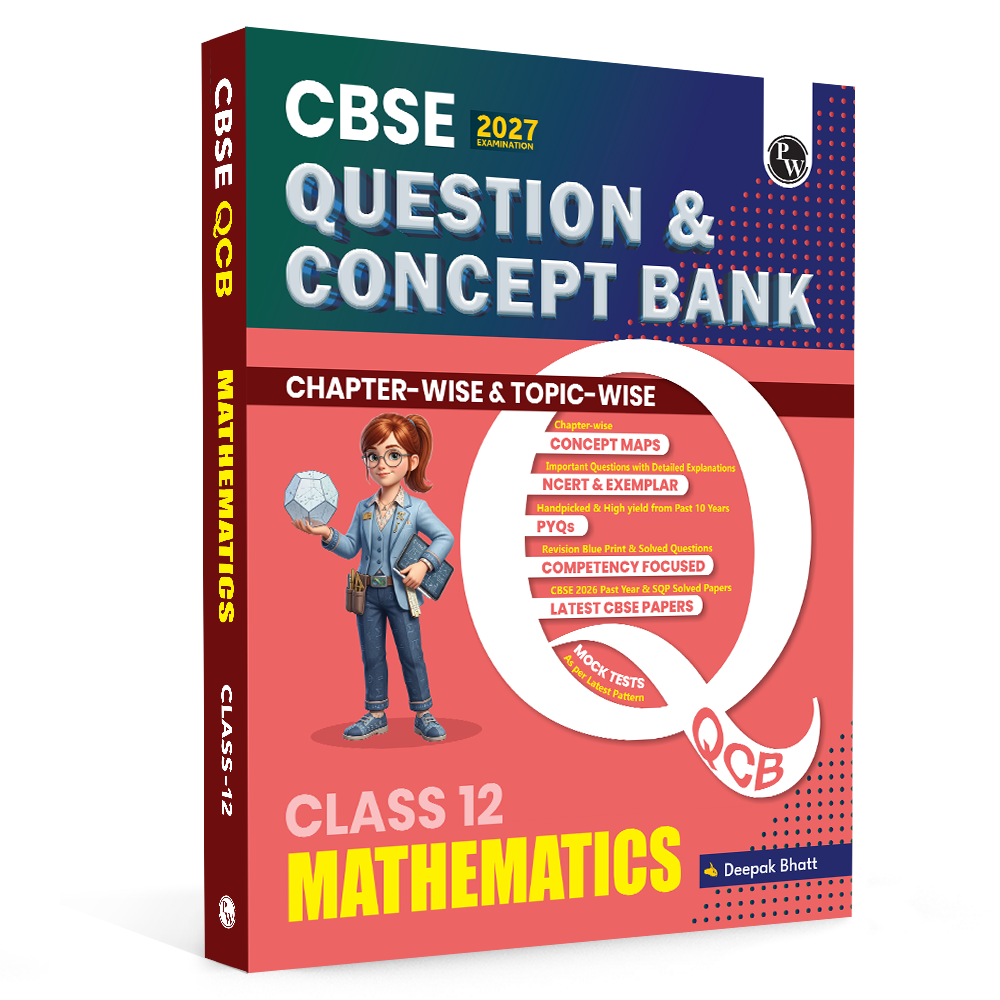
Maths is often viewed with a mix of respect and anxiety by Class 12 students. Most learners struggle not with the formulas themselves, but with knowing which problems to prioritize and how to apply theory to complex exam scenarios. This is where a strategic, chapter-by-chapter approach becomes vital. By integrating a quality CBSE Class 12 question bank maths into your daily routine, you can transform an overwhelming textbook into a series of manageable, high-yield practice sessions that build genuine exam confidence.
Check Out: CBSE Class 12th Books
Benefits of CBSE Class 12 Question Bank Maths
Attempting to learn the entire syllabus at once can make preparation feel overwhelming. A chapterwise strategy allows you to compartmentalise your learning. When you focus on a single unit, you give your brain the space to recognize specific patterns and recurring question types. Using a CBSE Maths Class 12 question bank helps you transition from passive reading to active problem-solving, which is one of the most effective ways to improve in Mathematics.
By breaking down the curriculum, you can identify exactly where your logic falters. For instance, you might be excellent at solving Matrices but struggle with the application of Integrals. Isolating these topics ensures that no weak link remains in your preparation chain. This targeted method also makes revision much faster as the exams approach, as you can jump directly to the chapters that need the most attention.
How to Use CBSE Class 12 Question Bank Maths
A question bank acts as a bridge between the basic concepts found in textbooks and the actual difficulty level of the board exams. To use your CBSE Class 12 question bank maths effectively, you should move through three distinct stages of practice.
Level 1: Basic Questions
Start with the Multiple Choice Questions (MCQs) and very short answer types. These questions test your immediate grasp of properties and direct formula application. If you find yourself checking the solution key frequently at this stage, it is a sign that you need to revisit the core concepts of the chapter.
Level 2: Application Questions
Once the basics are clear, move to short answer questions. These often involve two or three logical steps. This is where you practice the "flow" of a mathematical proof or calculation. A good CBSE Maths question bank class 12 will provide diverse problems here to ensure you aren't just memorizing one specific method.
Level 3: Advanced Questions
The final stage involves long-form questions and case-based studies. These carry the most marks and require you to connect multiple concepts. Case studies, in particular, test how well you can extract mathematical data from a real-world story. Regular practice of these ensures that the exam-day pressure doesn't lead to confusion.
Important Chapters in CBSE Class 12 Question Bank Maths
To score optimally, you must align your effort with the marks distribution. Not every chapter requires the same amount of time. Focusing your energy on units that carry the most weight ensures a higher return on your study hours.
|
Unit |
Estimated Marks |
Practice Difficulty |
|
Calculus |
Around 35 |
High - Requires daily consistency |
|
Vectors and 3D Geometry |
Around 14 |
Medium - Formula and logic-heavy |
|
Algebra (Matrices & Determinants) |
Around 10 |
Low - Scoring and calculation-based |
|
Relations and Functions |
Around 08 |
Medium - Conceptual and abstract |
|
Probability |
Around 08 |
Medium - Logic-driven |
|
Linear Programming |
Around 05 |
Low - Visual and graphical |
How to Practice Calculus for Boards
Calculus is the backbone of the Class 12 curriculum. Because it accounts for nearly 40% of the total marks, it can make or break your result. The challenge here is the sheer variety of problems. Using a CBSE question bank class 12 maths is essential for Calculus because it categorizes problems into sub-topics like "Increasing and Decreasing Functions" or "Integration by Parts."
-
Continuity and Differentiability: Focus on proving limits and handling trigonometric derivatives.
-
Application of Derivatives (AOD): This is a favorite for case-based questions. Practice word problems related to maxima and minima.
-
Integrals: This requires the most practice. Dedicate time to learning substitution techniques and definite integral properties.
-
Differential Equations: Learn the method of solving linear differential equations, as these are frequent 5-mark candidates.
How to Practice Vectors and 3D Geometry
This unit is highly scoring if you can visualize the problems correctly. Many students lose marks here due to simple calculation errors or by confusing the formulas for lines and planes. A chapterwise question bank class 12 provides a repository of diagrams and step-by-step solutions that help in learning the 3D aspect of the syllabus.
-
Vector Algebra: Focus on the physical meaning of dot and cross products.
-
3D Geometry: The most important topics are the shortest distance between two skew lines and the angle between a line and a plane.
-
Accuracy Check: Always double-check your direction cosines and ratios, as a single wrong sign can lead to an entirely incorrect final answer.
How to Score in Algebra and Probability
Algebra—comprising Matrices and determinants—is often the easiest part of the syllabus to excel. However, because it involves long calculations, the risk of "silly mistakes" is high. Probability, on the other hand, is less about calculation and more about understanding the "given" conditions.
-
Matrices: Practice finding the inverse using elementary row operations, as this is a common long-answer question.
-
Determinants: Learn the properties to avoid tedious expansions. Use your CBSE question bank maths class 12 to find shortcut methods for simplification.
-
Probability: Focus heavily on Bayes' Theorem and Conditional Probability. These topics are frequently asked in board exams.
CBSE Class 12 Question Bank Maths Revision Plan
As you approach 2027, your schedule should shift from learning to "testing." A question bank isn't just for practice; it’s a tool for self-assessment.
-
The 5-Question Rule: Every morning, solve five random questions from different chapters in your CBSE Class 12 question bank maths. This keeps your mind sharp across the entire syllabus.
-
Timed Chapters: Give yourself exactly 45 minutes to finish a specific chapter's section in the question bank. This builds the speed required for the actual exam.
-
Weekend Full-Length Practice: Once a month, try to solve a mixed set of questions to simulate the switching of gears between Algebra, Calculus, and Geometry.
Mistakes to Avoid with CBSE Class 12 Question Bank Maths
Even the most hardworking students can fall short if their strategy is flawed. Avoid these common mistakes to stay on track for a top score:
-
Over-reliance on Solutions: Do not look at the answer key immediately. Struggle with a problem for at least 10 minutes before seeking help.
-
Ignoring the Step-Marking System: CBSE awards marks for writing the formula and showing the intermediate steps. Practice writing down the "Given" and "To Prove" sections clearly.
-
Neglecting Rough Work: Keep your rough work organized. If you make a mistake, you should be able to look back and find exactly where the calculation went wrong.
-
Failing to Track Errors: Use class 12 Maths CBSE question bank pdf to mark the toughest questions. These should be the first ones you revisit during your final revision
CBSE Class 12 Maths Question Bank FAQs
How does a CBSE Class 12 question bank maths help in board exams?
It provides a curated list of problems that are specifically designed to match the board's difficulty level. It helps you practice different formats like MCQs and Case Studies that might not be as detailed in standard textbooks.
Which chapters should I finish first for Class 12 Maths?
It is usually best to start with Algebra (Matrices and Determinants) because they are easier to learn and provide a confidence boost. Once comfortable, you should move to Calculus, as it requires the most time and consistent practice.
Is NCERT enough, or do I need a CBSE Maths Class 12 question bank?
NCERT is the foundation and is mandatory. However, a question bank is highly recommended to practice advanced applications and to see how questions are twisted in the actual board exams.
How can I improve my speed in solving Maths problems?
Speed comes from familiarity. By using a chapterwise question bank class 12, you encounter the same logic multiple times. Eventually, your brain recognizes the "pattern" of the solution instantly, which significantly reduces thinking time.
What is the best way to revise a week before the 2027 boards?
Focus only on the questions you previously marked as "difficult" in your CBSE question bank maths class 12. Re-read all your formulas and practice at least two full-length sample papers to get your timing right.