Features of PW Class 8 Maths Question Bank
Building a good math foundation in middle school involves practice and mental understanding. A Class 8 Maths question bank helps learners get a strong understanding with chapter-wise questions, step-by-step explanations, competency-based tasks, and continuous revision. It makes difficult topics easy to learn, helps with better problem solving abilities and prepares pupils confidently for school examinations based on the latest NCERT syllabus.
Importance of Class 8 Maths Question Bank
Class 8 serves as a foundational bridge between elementary arithmetic and high school mathematics. During this academic year, students encounter concepts like linear equations, mensuration, factorisation, and coordinate geometry for the first time. Learning these topics requires more than memorising formulas; it demands consistent application through targeted Maths practice class 8.
Standard textbooks provide a good introduction but frequently lack adequate variation in practice. That’s where a dedicated question bank comes in, providing a wide range of question types, from basic concept checks to complex application difficulties.
|
Learning Requirement |
Standard NCERT Textbooks |
Dedicated Question Bank |
|
Concept Coverage |
Basic theory and primary exercises |
Comprehensive theory with extended examples |
|
Question Variety |
Limited exercise questions |
MCQs, Assertion-Reason, Short & Long Answer |
|
Exam Pattern Alignment |
Focuses on core curriculum |
Integrates competency and case-based questions |
|
Self-Assessment |
Final answers provided |
Step-by-step detailed explanations |
|
Revision Tools |
Scattered across chapters |
Summary tables, formula sheets, and quick notes |
A specialized resource allows students to identify areas of weakness early in the term. If you practice regularly you can turn passive reading into active problem solving skills that will help you remember the information for school assessments in the future.
Features of PW Class 8 Maths Question Bank
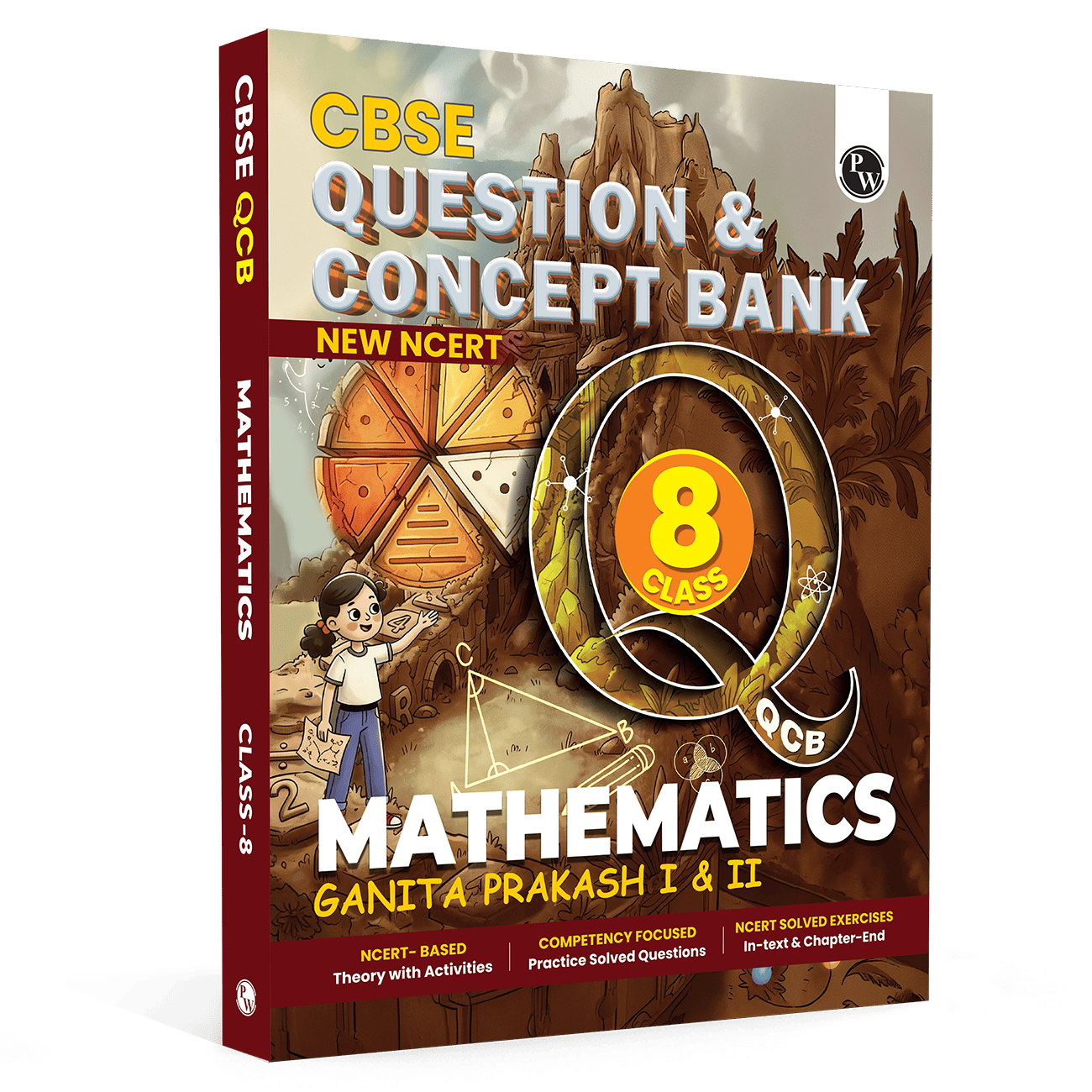
The PW Class 8 books is specifically engineered to cater to the updated NCERT curriculum. It balances theoretical clarity with practical application, providing a complete ecosystem for home study and classroom support.
Complete Theory and Concept Clarity
Each chapter is preceded by extensive theoretical remarks. The content is presented in organized bullet points, with obvious titles and real-world examples, rather than in lengthy blocks of text. Major definitions, mathematical properties, logical procedures are underlined so that initial learning is easy and intuitive.
-
Simplified Definitions: Complex mathematical terms are broken down into plain language.
-
Property Breakdowns: Algebraic rules and geometric theorems are displayed with clear visual proofs and step-by-step derivations.
-
Worked Examples: Immediate sample problems follow every theoretical concept to demonstrate practical application before students attempt exercises.
Important Formulas and Diagrammatic Guides
Visualizing geometric shapes and remembering multi-step formulas are common hurdles for eighth graders. The book integrates dedicated visual elements and formula boxes throughout each chapter.
-
Formula Highlights: Essential equations are framed separately with clear variables defined.
-
Diagrammatic Explanations: Geometry chapters feature accurately labeled diagrams, construction steps, and spatial representations.
-
Probe and Ponder Sections: Special thought-provoking prompts encourage students to think beyond standard formulas and understand the underlying logic behind mathematical operations.
Chapter Summaries and Formulas in Class 8 Maths Question Bank
Effective Maths revision requires quick access to essential concepts without reading through entire chapters. The question bank incorporates structured revision aids at the end of every chapter, serving as a quick-reference guide before examinations.
Chapter Study Workflow:
1. Review Theory Notes -> 2. Learn Key Formulas -> 3. Solve NCERT Exercises -> 4. Attempt Competency Questions
These chapter summaries condense key learning points into bite-sized summaries. Students can review core concepts, operational rules, and shortcut techniques in just a few minutes.
Structured Summary Tables
To streamline revision sessions, chapters feature comparison charts and summaries that group related concepts together.
-
Algebraic Identities: Quick-reference tables showing expansion and factorisation patterns.
-
Mensuration Formulas: Combined charts listing surface area and volume formulas for 2D and 3D shapes.
-
Number System Properties: Organized tables covering closure, commutativity, associativity, and distributivity across rational numbers.
Fascinating Facts and Mind Maps
Learning mathematics is much more exciting when it is tied to the historical background and practical applications. Students will gain an understanding of how abstract numbers are used to real-world scenario design, architecture and technology with the addition of exciting mathematical facts and beautiful mind maps.
Practice Question Types in Class 8 Maths Question Bank
A key advantage of using a structured Maths workbook is exposure to diverse question formats. The CBSE Class 8 question bank categorises problems by difficulty and type, allowing students to progress naturally from fundamental recall to analytical reasoning.
Objective and Multiple Choice Questions
Objective questions test immediate concept clarity and speed. They form a critical component of modern school assessment patterns.
-
Standard MCQs: Test direct factual recall, basic computations, and definition recognition.
-
Assertion and Reason: Require students to evaluate two related statements, fostering logical evaluation and critical thinking skills.
-
Match the Following: Reinforce vocabulary, shape properties, and formula associations through paired matching tasks.
Subjective Short and Long Answer Questions
Subjective sections prepare students for descriptive term exams where step-by-step presentation carries marks.
-
Very Short Answer (VSA): One-mark questions focused on single-step calculations and definition checks.
-
Short Answer (SA): Two to three-mark questions requiring multi-step responses and algebraic operations.
-
Long Answer (LA): 4-5 mark questions requiring deep problem solving, demonstration of geometrical concepts and solving of complex word problems.
|
Question Type |
Focus Area |
Recommended Time Per Question |
Marks Allocation |
|
Multiple Choice (MCQ) |
Speed & Concept Check |
1 - 2 Minutes |
1 Mark |
|
Assertion & Reason |
Logical Evaluation |
2 Minutes |
1 Mark |
|
Short Answer (SA) |
Procedural Accuracy |
3 - 5 Minutes |
2 - 3 Marks |
|
Long Answer (LA) |
In-Depth Problem Solving |
7 - 10 Minutes |
4 - 5 Marks |
|
Case-Based Study |
Real-World Application |
8 - 10 Minutes |
4 Marks |
Competency Based Questions in CBSE Class 8 Maths Question Bank
As per Central Board of Secondary Education recommendations , competence based learning is stressed. The latest examinations are not about measuring your ability to memorize, they are about testing your ability to use maths in new situations. The question bank has a lot of practice with these modern sorts of questions.
Case-Based Real World Scenarios
Case study problems present a short narrative, table, or graph based on practical life—such as calculating interest on savings, budgeting for a project, or measuring land areas. Students answer series of related sub-questions based on the provided data.
-
Interpretation of Data: Interpretation of Bar Graph, Pie Chart and Data Tables to find the values.
-
Practical Arithmetic: Solving ordinary problems of percentage, profit and loss, basic interest.
-
Practical Geometry: Applying mensuration concepts to real-world objects like gardens, rooms, and storage containers.
Higher Order Thinking Skills (HOTS)
HOTS questions challenge students to combine multiple concepts within a single problem. These questions encourage creative problem-solving and prepare students for future competitive exams and Olympiads.
-
Multi-Concept Synthesis: Add equations for linearity and formulas for the perimeter of a figure.
-
Error Analysis: Detecting and remedying conceptual errors through analysis of erroneous mathematical procedures.
-
Pattern Recognition: Looking at numbers and patterns in space to figure out the general rules.
Detailed Explanations in Class 8 Maths Question Bank
Practicing questions without knowing what was done wrong will not help in academic progress. To this end, a detailed answer key is provided for each exercise in the question bank, showing step-by-step solutions.
Problem-Solving Steps:
Understand Problem -> Identify Formula -> Substitute Values -> Calculate Step-by-Step -> Verify Units
Self-Assessment and Error Prevention
Detailed solutions allow students to study independently at home without relying constantly on tutors or teachers.
-
Step-by-Step Working: Explanations show full line-by-line calculations, ensuring students learn how to structure descriptive answers for maximum marks.
-
Alternative Solution Methods: Where applicable, shortcut techniques and alternative methods are demonstrated alongside traditional approaches.
-
Common Pitfalls Highlighted: Frequent calculation errors, sign mistakes and unit omission traps that lead to mark loss are noted.
Building Academic Confidence
Instant access to review their work and fix faults reduces the fear pupils have about math. Clear solution stages indicate exactly where a calculation went incorrect, encouraging correct logical sequences and math habits.
Also Check - PW Stationery
How to Use Class 8 Maths Question Bank for Exam Preparation
Integrating a supplementary question bank into a daily study routine requires a structured approach. Rather than attempting entire chapters in one sitting, a phased study strategy yields the best academic outcomes.
Phase 1: Conceptual Foundation
-
Read the classroom notes or textbook chapter thoroughly.
-
Review the detailed theory section in the question bank to reinforce understanding.
-
Pay close attention to worked examples and formula highlight boxes.
Phase 2: Topical Practice
-
Begin with objective questions (MCQs and Match the Following) to test initial retention.
-
Move to Very Short and Short Answer questions to practice procedural calculations.
-
Solve Long Answer problems on paper, writing down every intermediate step clearly.
Phase 3: Advanced Application and Revision
-
Tackle Case-Based study problems and HOTS sections to test deep comprehension.
-
Review the chapter summary and formula charts weekly to keep concepts fresh.
-
Complete timed self-tests using the answer key to evaluate speed and accuracy.
Weekly Study Distribution:
- Days 1-2: Theory & Solved Examples
- Days 3-4: Standard Objective & Subjective Practice
- Day 5: Competency & HOTS Problems
- Day 6: Self-Correction & Error Analysis
- Day 7: Quick Formula & Summary Review
Regular adherence to this structured routine ensures complete mastery over the syllabus well before final term examinations, turning potential exam anxiety into steady confidence.
Read More: Tips to Prepare for Class 8 CBSE Exams
CBSE question bank FAQs
What makes the CBSE question bank suitable for CBSE exams?
It is as per the latest NCERT curriculum with chapter summary, NCERT practice solutions, MCQs and competence based questions for entire school exam preparation.
How does the PW Class 8 Maths book help in concept revision?
The book includes dedicated chapter summaries, formula charts, and visual diagrams at the end of each topic, enabling quick and effective revision before tests.
Does this Maths practice class 8 book include detailed solutions?
Yes, every question comes with a complete answer key providing step-by-step working, alternative solution techniques, and error prevention notes for independent study.
Are competency-based questions included in the Maths workbook?
The resource features extensive competency-based and case-based scenario questions designed to evaluate real-world application and logical reasoning skills as required by current CBSE patterns.
Can students use this for daily Maths revision?
Yes, its structured format—ranging from brief theoretical notes to varied exercise levels—makes it ideal for both daily homework assistance and periodic exam revision.